Browse Items (116 total)
Sort by:
Fair copy of the Circumstantial Account sent to Gov. Trumbull of Connecticut
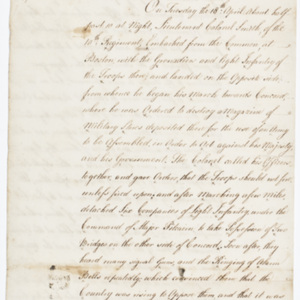
The royal governor of Massachusetts, General Thomas Gage (1719-87), responded to the flurry of news reports of the Battles of Lexington and Concord by sending official accounts of the confrontation to high officials in the adjoining colonies. He…
"PHILADELPHIA, April 27, 1775. Extracts of Letters from BOSTON, per post."
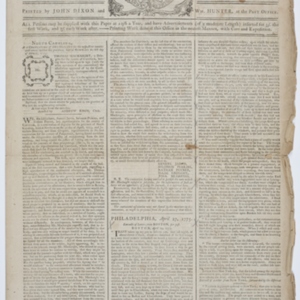
This May 6, 1775, issue of John Dixon (d. 1791) and William Hunter’s Virginia Gazette illustrates how news of Lexington and Concord spread throughout the colonies.On the first page in the middle column are extracts of letters from Boston about…
Marianne Washburn to Emory Washburn, July 29, 1841
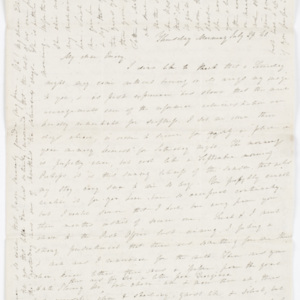
By the beginning of the Civil War, photography had been around for over twenty years, but in many ways it was still a new technology. Only recently had the new albumen process, in the form of cartes-de-visites and stereographs, made photography…
"Williamsburg, July 7. At a respectable meeting of the Freeholders and Freemen of the county of Richmond…"
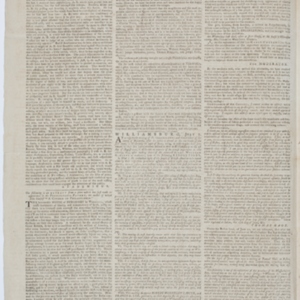
This issue of the Virginia Gazette includes a summary of a meeting held to discuss resolutions with the representatives from Richmond County who would be attending the First Virginia Convention on August 1, 1774. (There would eventually be five…
"Williamsburg, July 27. Thursday the 25th instant the Declaration of Independence of the United Colonies was proclaimed here…"
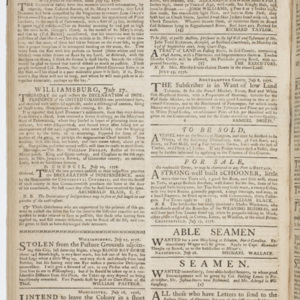
Public readings of the newly minted Declaration of Independence took place in taverns, churches, town greens, or anywhere else people could gather. This July 27, 1776, issue of the Virginia Gazette records a public reading of the Declaration that…
Civil War Envelopes
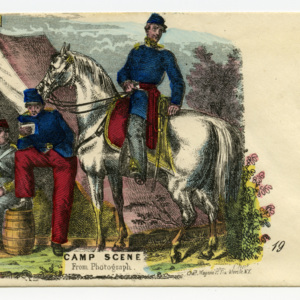
The cheapness of new printing techniques and technology meant that now not only could most households afford to decorate their homes with individual prints, but also that all kinds of ephemera—those items meant to be used and thrown away—could be…
Regimental Album of the 24th Massachusetts
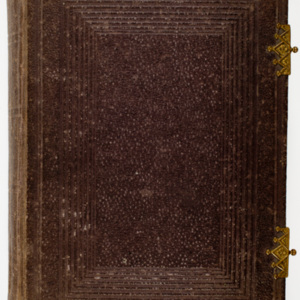
Although tintypes and ambrotypes were both used to capture images of soldiers, by far the most popular form soldier portraits took were cartes-de-visites. Unlike the former two processes, whose glass and metal foundations made them delicate, bulky,…
Bird's Eye View of the Seat of War
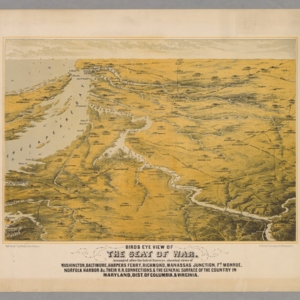
Among the visual ways in which people tried to make sense of the Civil War were maps. Maps helped people visualize the places where their loved ones were fighting, places most of them had never seen. Though few newspapers outside of the illustrated…
"An extensively read News paper"

In the 1840s and 1850s, thanks to steam-powered and rotary presses, newspaper dimensions were often enormous. The size of the printing presses, their ability to print evenly over a large surface area, and the speed with which they could print…
Lecture On the War: C. C. Coffin, Esq. Known as "Carleton" of the Boston Journal

Charles Carleton Coffin (1823-96) was one of a dozen or so battlefield correspondents whose work during the Civil War made them into something new in American journalism: celebrity reporters. Writing under the penname “Carleton” for the…