Browse Items (116 total)
Sort by:
Caroline Barrett White Diaries
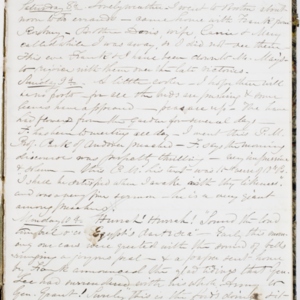
Diary and journal keeping was a common practice during the Victorian era and particularly during the Civil War, by both men and women, North and South. Unlike the generally terse and dispassionate diaries of the eighteenth century, nineteenth-century…
Charleston Mercury Extra: Passed unanimously at 1.15 o'clock, P.M., December 20th, 1860

On November 10, 1860, after a decade of political division and just four days after Lincoln’s election, South Carolina called a secession convention for the following month. Considered by virtue of timing to be the first Confederate imprint, this…
Cherokee Phoenix

The Cherokee Phoenix was the first newspaper published by Native Americans. In 1825 the Cherokee Council pledged $1,500 for the purchase of a printing press and type; the American Board of Commissioners for Foreign Missions also pledged assistance.…
Cincinnati Post and Anti-Abolitionist
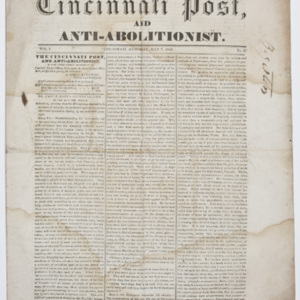
Cincinnati had a powerful pro-slavery faction that published the Cincinnati Post and Anti-Abolitionist, edited by L. Greely Curtiss, from 1841 to 1842. By 1842 the paper boasted that it had the largest circulation of any newspaper in the West.…
Civil War Envelopes
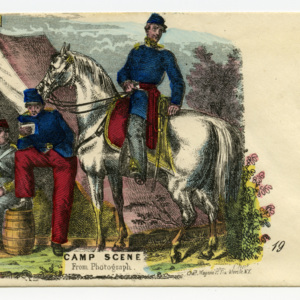
The cheapness of new printing techniques and technology meant that now not only could most households afford to decorate their homes with individual prints, but also that all kinds of ephemera—those items meant to be used and thrown away—could be…
Civil War Stereographs
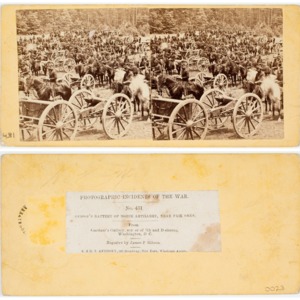
Stereography, an early form of three-dimensional photography, was a major vehicle for popular education and entertainment in the latter part of the nineteenth century. Otherwise known as the stereogram, stereopticon, or stereo view, the stereograph…
Completely Silenced! Dead Confederate Artillery Men, As they lay around their battery after the Battle of Antietam.
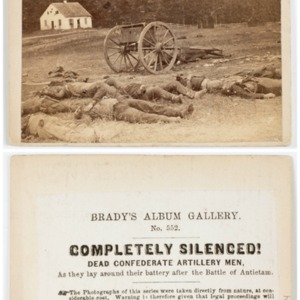
The affordability of the carte-de-visite form meant that it was used in a wide variety of ways, including to reproduce works of art and photography. During and after the Civil War, this included the work of the most famous photographers of the…
Concio Hyemalis. A Winter Sermon.
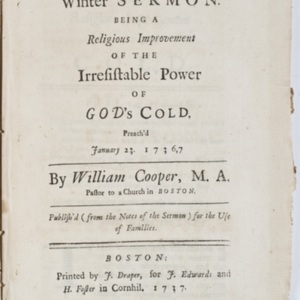
From 1716 until his death in 1743, William Cooper (1694-1743) was Benjamin Colman’s colleague in ministry at Boston’s Brattle Street Church. Like Colman and like Thomas Prince at Old South Church, Cooper frequently preached on current…
Confederate Scrap-Book
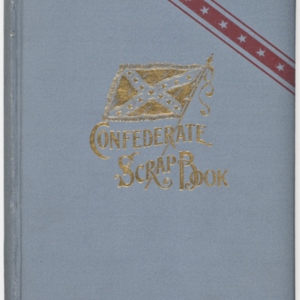
Scrapbooks were a common way for people in both the North and the South to process and keep a record of the war. Thus, they provide insights into what people were reading, what they were feeling, and what kinds of information they found important. A…
Death of Col. Edward D. Baker, at the Battle of Balls Bluff
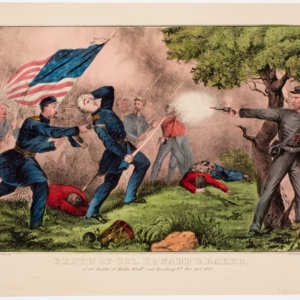
This hand-colored lithograph depicts the dramatic death of Colonel Edward D. Baker (1811-61), the only U.S. senator ever killed in battle. Like Abraham Lincoln, Baker began his political career in Illinois, and the two men developed a strong…