Browse Items (116 total)
Sort by:
The Somerset Whig

While big dailies were beginning to dominate the newspaper markets of the urban centers in the first half of the nineteenth century, smaller newspapers began to pop up in more rural areas. These small local papers carried news from around the…
Freedom's Journal
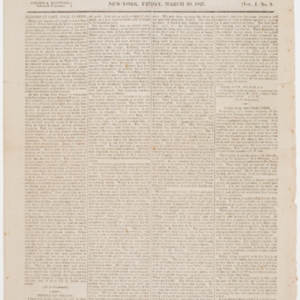
African Americans and abolitionists were among the voices that gained a new outlet during the antebellum newspaper boom. The first newspaper published by African Americans was the Freedom’s Journal, beginning in March 1827. Cofounded by…
Advertisements for stereographs

The stereograph sensation is evident in these advertisements on the last page of the April 29, 1865, issue of Frank Leslie’s Illustrated Newspaper. With the war now over, stereograph publishers began to focus on the medium’s use as…
Civil War Stereographs
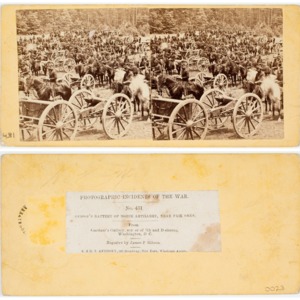
Stereography, an early form of three-dimensional photography, was a major vehicle for popular education and entertainment in the latter part of the nineteenth century. Otherwise known as the stereogram, stereopticon, or stereo view, the stereograph…
War Telegram Marking Map
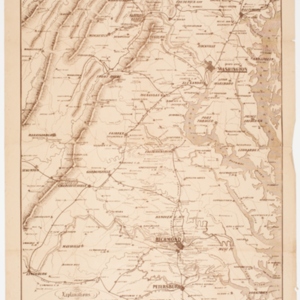
Maps were one tool people used to make sense of the war and visualize the places where their loved ones were fighting, places most of them had never seen. Though few newspapers outside of the illustrated press carried graphics at this time, many…
Ambrotype of unidentified soldier in Union uniform
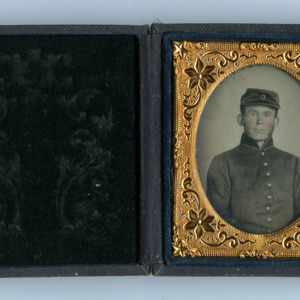
Among the photographic processes available to a widening public and used by Civil War soldiers were ambrotypes. Ambrotypes became popular in the mid-1850s, due in large part to their shorter exposure times (as compared to daguerreotypes), which also…
Lecture On the War: C. C. Coffin, Esq. Known as "Carleton" of the Boston Journal

Charles Carleton Coffin (1823-96) was one of a dozen or so battlefield correspondents whose work during the Civil War made them into something new in American journalism: celebrity reporters. Writing under the penname “Carleton” for the…
Regimental Album of the 24th Massachusetts
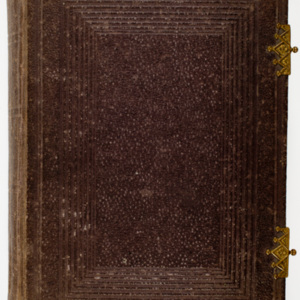
Although tintypes and ambrotypes were both used to capture images of soldiers, by far the most popular form soldier portraits took were cartes-de-visites. Unlike the former two processes, whose glass and metal foundations made them delicate, bulky,…
Civil War Envelopes
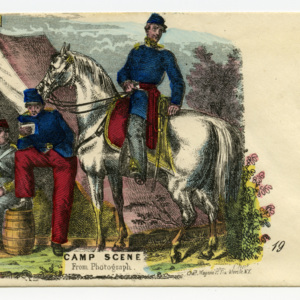
The cheapness of new printing techniques and technology meant that now not only could most households afford to decorate their homes with individual prints, but also that all kinds of ephemera—those items meant to be used and thrown away—could be…
"Williamsburg, July 27. Thursday the 25th instant the Declaration of Independence of the United Colonies was proclaimed here…"
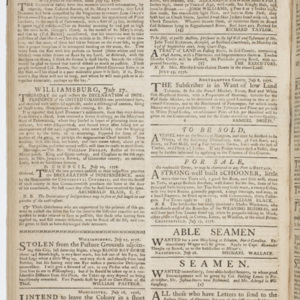
Public readings of the newly minted Declaration of Independence took place in taverns, churches, town greens, or anywhere else people could gather. This July 27, 1776, issue of the Virginia Gazette records a public reading of the Declaration that…