|
|
Visions of Freedmen as Soldiers |

Page overview: click on a link to go directly to a discussion of that topic below.
Despite the fact that African-Americans had served in both the American Revolution and the War of 1812, they were turned away when they tried to enlist in the Union army at the beginning of the Civil War. During the same period, the South was using the labor of slaves to support its war effort. When Generals Fremont and Hunter attempted to train slaves as soldiers, Lincoln quickly ordered them to stop. Their experiments did, however, intensify the debate over the use of African-Americans in the military. Finally, with Congress's adoption of the Second Confiscation and Militia Act of July 17, 1862 and Lincoln's pronouncement of the Emancipation Proclamation, the way became clear for the enlistment of black troops.
In 1862, the 1st Regiment, Louisiana Native Guards and the First South Carolina (African-American) Volunteers received close scrutiny from the press when they became two of the first African-American regiments to be officially mustered into the Union army. However, while black soldiers quickly proved their worth, they received lower pay than white soldiers, were generally commanded by white officers, and were often assigned to menial roles as cooks, or "washerwomen," and teamsters.
Representations of African-American soldiers in the press reflected the complex, conflicting, and shifting racial attitudes of those in the North. Northern newspapers such as Frank Leslie's and Harper's Weekly included reports praising the exploits of individual slaves who managed to control of Southern ships or land and the performance of black troops in key battles. Some of the most positive depicitions of African-American soldiers came in the reports of Southern atrocities at the battles of Fort Pillow and Milliken Bend, probably both because of the sympathy those events provoked and the way they appealed to anti-Southern feelings in the North. And yet, these positive accounts appear virtually side-by side with racist jokes and cartoons, a state of affairs that probably reflects the conflicted opinions of Northern readers on the subject of race. Benjamin Butler and Thomas Wentworth Higginson, white men who commanded African-American regiments, were outspoken in their praise of the men who served with them. And the letters of Freedmen's teachers allow us to see yet another side of African-American soldiers: their love of learning.
You can find a Timeline of African-American Participation in the Civil War at the bottom of this page.
Click on any topic below to OPEN/CLOSE once the page has finished loading:
or choose + Open All Topics or - Close All Topics
The Response to General Fremont's Attempt to Free and Enlist Slaves
In August of 1861, John Charles Fremont, the general in command of the Department of the West, issued a proclamation declaring:All persons who shall be taken with arms in their hands within these lines shall be tried by court martial, and, if found guility, will be shot. The property, real and personal, of all persons in the State of Missouri, who shall take up arms against the United States, or who shall be directly proven to have taken active part with their enemies in the field, is declared to be confiscated to the public use, and their slaves, if any they have, are hereby declared free men.
When Fremont refused the president's request to modify his order, Lincoln rescinded Fremont's proclamation and removed him from command.
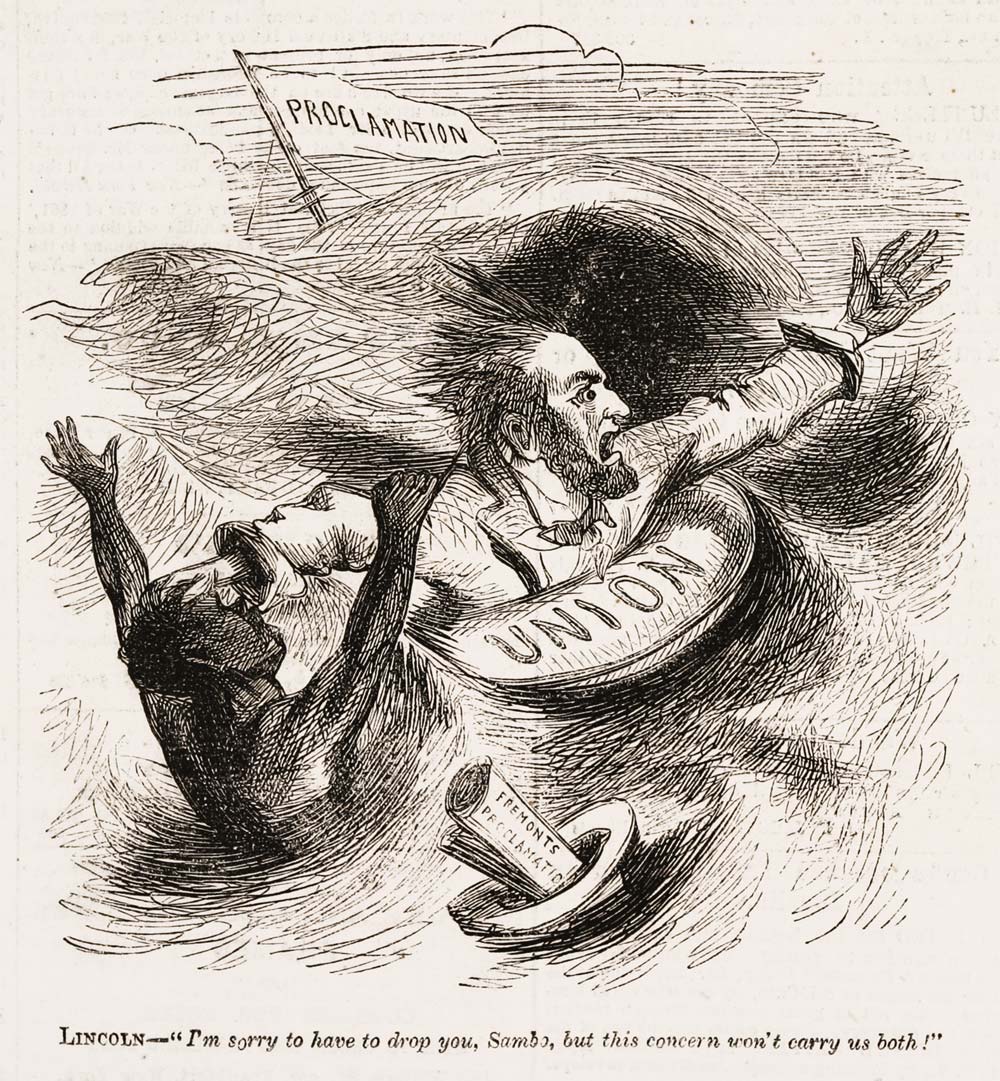 |
|
Comments on Fremont's Declaration |
The direct consequences of [Fremont's] decree, so far as slavery in Missouri is concerned, can not be of much importance. Missouri does not contain 125,000 slaves, and of these considerably more than one half are believed to be held by loyal men. Moreover, under the terms of Fremont's proclamation, no slave can be emancipated until it is proved that his owner has been actually in arms, or laboring actively in aid of those who are in arms against the Government: a large number of slaves may thus be defrauded of emancipation through the want of evidence to establish the treason of their masters. It is doubtful whether 25,000 human beings will exchange slavery for freedom under the proclamation of General Fremont. But its moral effect must be signal. It is a solemn warning to the inhabitants of the rebel States, that wherever the armies of the United States are resisted in the interests of slavery, the cause of the resistance will be removed. It is a pregnant hint that the rebels who have falsely accused us of being abolitionists may, if they choose, make their accusation true. It is a notification to Kentucky, which seems to be on the eve of explosion, that open treason will necessarily involve the extirpation of slavery. This rebellion has more than once recalled the old adage, " Those whom the Gods wish to destroy they first render mad:" we shall now see how far the madness extends. The cost of rebellion is abolition. Those who choose may purchase. Another important result of General Fremont's proclamation has been the discovery of the fact that the people of the North are much more solidly united on the question of slavery than was imagined. It had been generally supposed that the first utterance of the cry of emancipation would divide the North into two hostile camps. How this strange delusion came to be entertained it is difficult to discover; the least reflection should have satisfied every one that it was impossible to build up at the North a party based on protection to slavery any where. But, however the notion originated, there is no doubt it did exist, and that leading men and journals in the confidence of the Administration were so thoroughly imbued with it, that they indignantly repudiated the imputation of being friendly to freedom under any circumstances. It seems, from the temper in which the public receive General Fremont's proclamation, that they are not so tender on the subject. They seem very well satisfied with the prospect. We hear no complaints, no lamentations over the downfall of slavery in Missouri. The respectable Democrats of this part of the country express themselves rather pleased than otherwise. Of course, it must be expected that the lottery-policy dealers and the profligate vagabonds who pretend to represent the Democracy in convention will testify their sorrow at the event, as they will do at every success of the National arms: but neither in this nor in any other particular do they express the sense of the rank and file of the Democracy. What people want now is decided, startling, effective successes on the part of the United States. If these are achieved, no one will complain of what they may cost. Our Generals may emancipate every slave in the country, and lay waste every field from the Potomac to the Rio Grande-the people will sustain them, provided they crush out the enemy and restore the supremacy of the Government. But there will be no mercy for the general who, for fear of breaking a law or dividing a party, suffers the rebels to progress from victory to victory, and the Stars and Stripes to endure defeat after defeat, and disgrace after disgrace. --"The Beginning of the End," Harper's Weekly, September 14, 1861, 578It has been intimated that the government would disapprove of General Fremont's proclamation. We discredit the report. Considerations of policy, or false notions of conciliation, may have hitherto induced the Administration to treat certain "delicate questions" --for it is in this dainty way that a portion of the press speak of the atrocity of Slavery--with great circumspection, and to affect a desire to keep them entirely out of the contest, just as if the whole world does not know that Slavery is at the beginning and the end, is the very essence and body, the motive and sustaining power of the present struggle on the part of the rebel States. But we hope the stern teachings of the past five months have taught it the folly of masking a purpose which must sooner or later be avowed, and through the execution of which alone can the country be restored and its peace and prosperity secured. --"General Fremont's Proclamation--Emancipation," Frank Leslie's Illustrated Newspaper, September 21, 1861, 290Two methods of treating these newcomers seemed equally logical to opposite sorts of minds. Ben Butler, in Virginia, quickly declared slave property contraband of war, and put the fugitives to work; while Fremont, in Missouri, declared the slaves free under martial law. Butler's action was approved, but Fremont's was hastily countermanded, and his successor, Halleck, saw things differently. "Hereafter," he commanded, "no slaves should be allowed to come into your lines at all; if any come without your knowledge, when owners call for them deliver them." Such a policy was difficult to enforce; some of the black refugees declared themselves freemen, others showed that their masters had deserted them, and still others were captured with forts and plantations. Evidently, too, slaves were a source of strength to the Confederacy, and were being used as laborers and producers. "They constitute a military resource," wrote Secretary Cameron, late in 1861; "and being such, that they should not be turned over to the enemy is too plain to discuss." So gradually the tone of the army chiefs changed; Congress forbade the rendition of fugitives, and Butler's "contrabands" were welcomed as military laborers. This complicated rather than solved the problem, for now the scattering fugitives became a steady stream, which flowed faster as the armies marched. --W.E.B. Dubois, The Souls of Black Folk, 1903. |
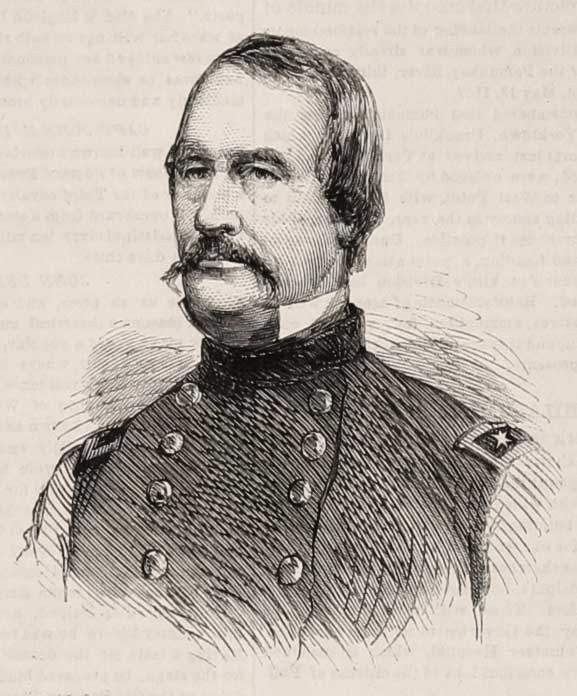
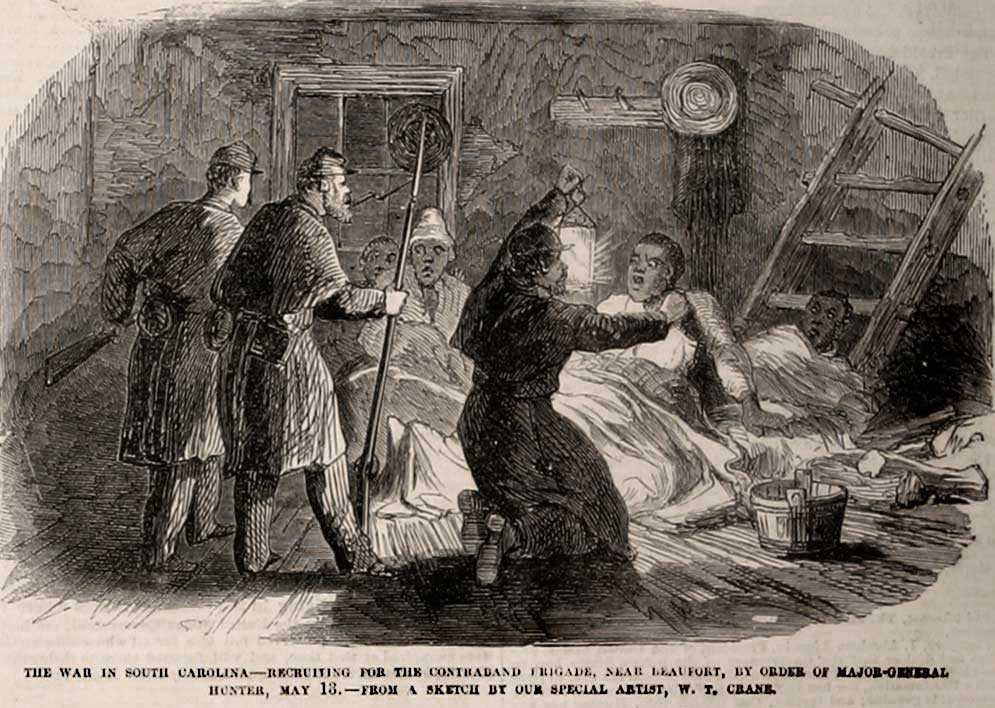
In May, 1862, General David Hunter, Union commander in the South Carolina Sea Islands, issued "Order No. 11" emancipating all slaves in South Carolina, Georgia, and Florida. Hunter also attempted to organize an African-American regiment, the 1st South Carolina Volunteer Infantry at Beaufort.General Orders No 11.—The three States of Georgia, Florida and South Carolina, comprising the military department of the south, having deliberately declared themselves no longer under the protection of the United States of America, and having taken up arms against the said United States, it becomes a military necessity to declare them under martial law. This was accordingly done on the 25th day of April, 1862. Slavery and martial law in a free country are altogether incompatible; the persons in these three States—Georgia, Florida and South Carolina—heretofore held as slaves, are therefore declared forever free.
(Official) David Hunter,
Major General CommandingWhen Congressman Wickliffe of Kentucky introduced a measure in Congress demanding to know whether Hunter had organized black troops, Hunter replied:
|
||||||||
|
 |
|
|
The Debate Over Using African-Americans in the Military
Although Fremont's and Hunter's experiments in transforming slaves into soldiers were rejected by Lincoln, they prompted a national discussion of the idea of African-Americans in the military. On one side of the argument were the people who insisted that blacks were unfit for the military; on the other side were those who believed that savageness and the desire for revenge would make African-Americans particularly effective in battle. (See "The Great Remedy" as one example of a depiction of black soldiers as animalistic.) People also debated how the use of African-American troops would affect the meaning of the war. Some argued that arming African-Americans would wrongly suggest that the purpose of the war was to abolish slavery, others maintained that the arming of African-Americans should be seen as a military necessity that had nothing to do with the war's significance, and still others insisted that redefining the war as a fight against slavery would intensify patriotic spirit in the North.
Arguments Against Enlisting Black Troops Summarized |
|---|
1) That the negro will not fight; 2) It is said that whites will not fight with them, - that the prejudice against them is so strong that our own citizens will not enlist, or will quit the service, if compelled to fight by their side, - and that we shall thus lose two white soldiers for every black one that we gain; 3) It is said we shall get no negroes;or not enough to prove of any service; 4) The use of negroes will exasperate the South: and some of our Peace Democrats make that an objection to the measure. --New York Times, February 16, 1863 |
Arguments in the Press in Favor of Enlisting Black Troops |
|---|
The Need for More Troops [Note: On August 4, 1862 Lincoln had issued an executive order calling for an additional 300,000 troops, which would be drafted if a sufficient number of volunteers did not step forward.]We're coming, Father Abraäm, we're coming all
along, . . . As the matter stands, Old Abe, we've this opinion,
some, Hereditary bondsman, he should just be made to know So, Father Abraäm, if you please, in this here
game of chess, The Need to Offset the Use of African-Americans by the South The South is using her black people against us. She puts spades, axes, and hammers into the hands of some, and arms, it is said, into the hands of others. Thus strongly does she invite us to use our black people against her. Unless the war shall be ended very soon, black regiments wil be seen marching Southward. God forbid that we should arm the slaves unless it be such of them as come into military organizations and under intelligent and merciful guidance. Certainly, so long as they can be made free otherwise, it would be great wickedness to arm them and leave them to their own ignorant, wild, and revengeful impulses. I would commend General Butler for restraining the slaves from falling upon their masters and mistresses. But I would have him either put them into his ranks and subject them to military rule, or send them where they can be harmless as well as free. The South is, however, provoking servile insurrections, and the provoked North is on the eve of welcoming them. --“More About the War for the Union,”Gerrit Smith, Boston Journal, June 1, 1862Historical Precedent Colored men were good enough to fight under Washington. They are not good enough to fight under McClellan. They were good enough to fight under Andrew Jackson. They are not good enough to fight under Gen. Halleck. They were good enough to help win American Independence but they are not good enough to help preserve that independence against treason and rebellion. They were good enough to defend New Orleans but not good enough to defend our poor beleaguered Capital. --Frederick Douglass, "The Black Man's Future in the Southern States," February 5, 1862Is the present war so much higher and holier than the war of the Revolution, that the employment of black soldiers would lower its character or debase its purposes? Are our Generals so much better than Washington, and Jefferson, and Jackson, that they may be contaminated by the apparition of negro regiments in their camps? Are we so strong that we need no assistance in the field? --"What Our Fathers Did," Frank Leslie's Illustrated Newspaper, September 20, 1862, 403 The Need for More Troops AND The problem how to employ the contrabands will necessarily be solved by the war. Necessity will compel us to use them as soldiers. We shall require, to garrison the strategic points in the enormous country which we have undertaken to overrun, more troops than even the populous North can provide. It is clear that even a million of men will be found too few to attack and defeat the rebel armies, storm the rebel forts, and at the same time hold and occupy each point we take. A quarter of a million troops, in detached forts, may not prove too many to hold the line of the Mississippi River, after it has been reopened by our armies and our flotilla. For this service the negroes are well adapted, and whatever scruples may be entertained by individual generals, the logic of events compels us to assign them to it at several points. The work has already been successfully begun. We have a negro regiment at Hilton Head, and a negro brigade at New Orleans. A bill is pending before Congress for the equipment of 200 negro regiments of 1000 men each, and the feeling among loyal men is in favor of its passage. We shall have to feed and clothe the emancipated negroes, and there is no present way of making them earn their living except by making them garrison our forts. The rebels, as the cut on the preceding page shows plainly, have no scruples against arming them. We can safely follow their example. --"Negro Emancipation," Harpers Weekly, January 10, 1863 The Need for African-Americans to Win Public Respect and Rights Two questions are concerned in the social problem of our time. One is, ‘Will the people of African descent work for a living? and the other is, Will they fight for their freedom? An affirmative answer to these must be put beyond any fair dispute before they will receive permanent security in law or opinion. --Edward Pierce, "The Freedmen at Port Royal," The Atlantic Monthly, 12, 71, September, 1863, 291 |
 |
|
Congress & the President Authorize the Recruitment of African-American Soldiers
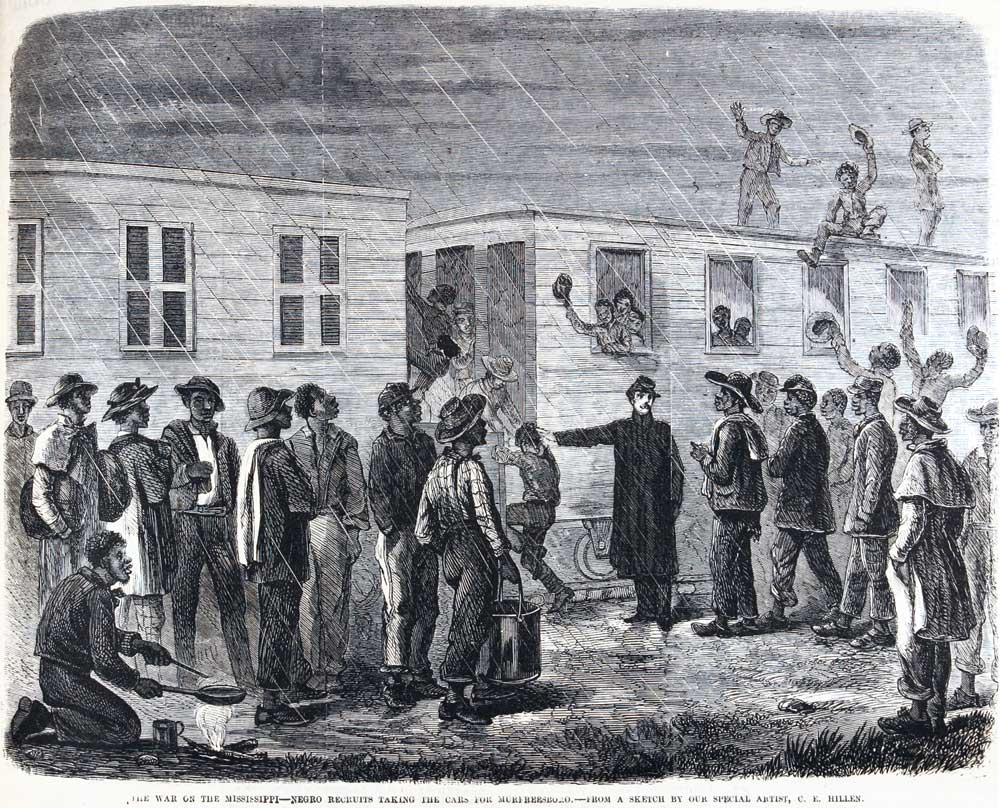
Laws prohibiting African-Americans from serving in the military have usually been overlooked when troops were needed. Blacks served on both sides in the American Revolution, and although the Uniform Militia Act of 1792 had specified that the militia was to be composed of "free, able-bodied white male citizen(s) between the ages of eighteen and forty-five," African-Americans also served in the war of 1812. During the Civil War, Congress the Second Confiscation and Militia Act of July 17, 1862, to give the President the authority to:receive into the service of the United States, for the purpose of constructing intrenchments, or performing camp service or any other labor, or any military or naval service for which they may be found competent, persons of African descent, and such persons shall be enrolled and organized under such regulations, not inconsistent with the Constitution and laws, as the President may prescribe.
(The same act authorized the president to "make provision for the transportation, colonization, and settlement, in some tropical country beyond the limits of the United States, of such persons of the African race, made free by the provisions of this act, as may be willing to emigrate.")
Lincoln exercised his authority to enlist black troops when he announced in the Emancipation Proclamation that
persons of suitable condition, will be received into the armed service of the United States to garrison forts, positions, stations, and other places, and to man vessels of all sorts in said service.--The Emancipation Proclamation, January 1, 1863
 |
|---|
|
The First African-American Regiments and Their Reception
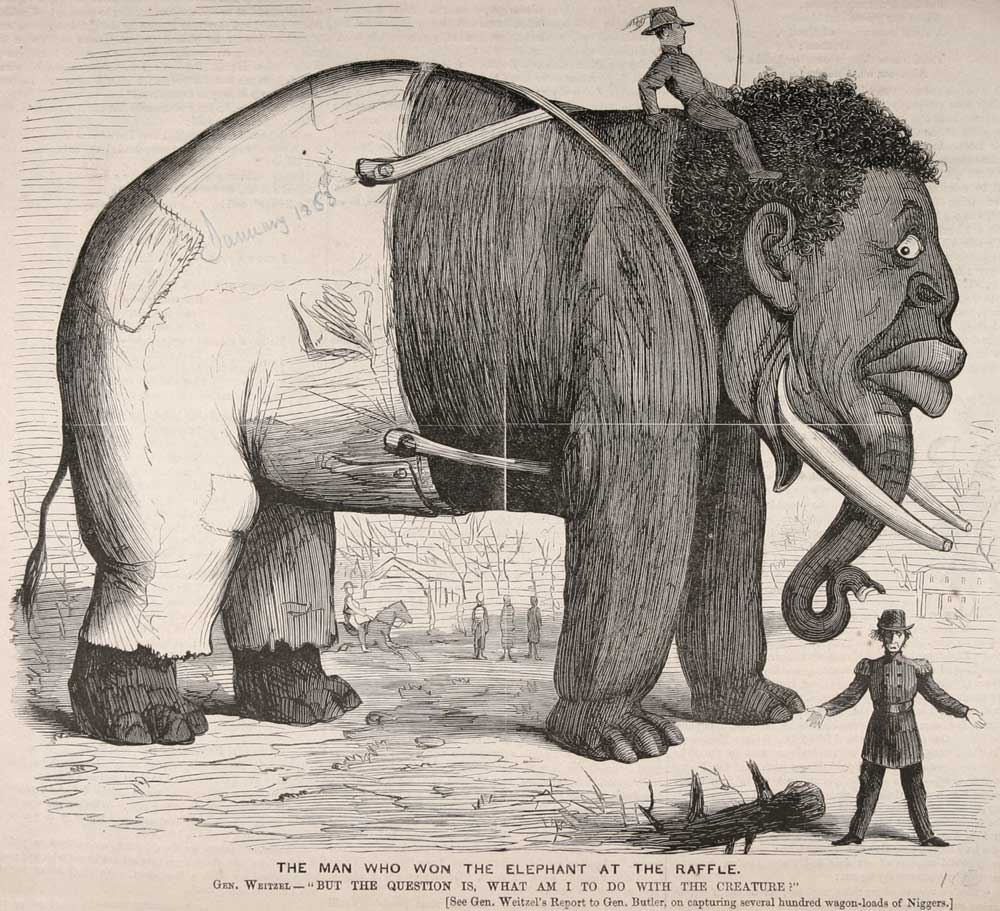
Many of the soldiers of the first African-American regiments to fight for the North enlisted long before they were officially mustered into the Union army. The Louisiana Native Guard started out in the service of the confederacy. The soldiers recruited in South Carolina by General Hunter in May of 1862 and then disbanded under orders from Lincoln ultimately became the First South Carolina (African-American) Volunteers under Thomas Wentworth Higginson in November, 1862, and the First Kansas Colored Volunteers were recruited against Lincoln's orders by an abolitionist senator beginning in July ,1862 and were only accepted into the army in January, 1863, two and a half months after their first battle.
The Louisiana Native Guard
In 1861, a group of free African-Americans living in New Orleans offered their services to the Confederate Army and became the Louisiana Native Guard. Never fully accepted, they were officially disbanded in 1862. However, when he needed reinforcements after capturing New Orleans, Union General Benjamin Butler issued General Orders No. 63 appealing to the Native Guard:
Now, therefore, the Commanding General, believing that a large portion of this militia force of the State of Louisiana are willing to take service in the Volunteer forces of the United States. . . . Appreciating their motives, relying upon their "well-known loyalty and patriotism," and with "praise and respect" for these brave men, it is ordered that all the members of the "Native Guards" aforesaid, and all other free colored citizens recognized by the first and late Governor and Authorities of the State of Louisiana as a portion of the Militia of the State, who shall enlist in the Volunteer Service of the United States, shall be duly organized by the appointment of proper officers, and accepted, paid, equipped, armed, and rationed as are other Volunteer Troops of the United States, subject to the approval of the President of the United States. 26
On September 27, 1862, the 1st Louisiana Native Guard became the first black regiment officially mustered into the Union army.
The Origins of the First Black Regiment in
the Union Army: |
The New Orleans Picayune, of Jan. 10th, gives an account of a grand review of the rebel troops in that city on the previous day, from which we copy the following significant paragraph: “We must also pay a deserved compliment to the companies of free colored men, all very well drilled and comfortably uniformed. Most of these companies, quite unaided by the Administration, have supplied themselves with arms without regard to cost or trouble. One of these presented, a little before the parade, with a fine war flag of the new style. This interesting ceremony took place at Mr. Cushing’s store, on Camp, near Common street. The presentation was made by Mr. Bigney, and Jordan made, on this occasion, one of his most felicitous speeches.} —"Negro Soldiers in New Orleans," Frank Leslie’s Illustrated Newspaper, March 8, 1862, 243 |
INTERESTING OCCASION--Several gentlemen in Boston extended a complimentary dinner, Tuesday, to two colored gentlemen from New Orleans, named John Baptiste Roudanez and captain Arnold Bertonneau. These gentlemen are men of property in New Orleans, Mr. Roundanez being a machinist and engineer, and captain Bertonneau a wine merchant. The latter was commissioned a captain in the first colored regiment that was formed in Louisiana. The fathers of these gentlemen were both French and their mothers African. Messrs. Roudanez and Bertonneau left New Orleans on a mission to the president, asking that the privilege of voting might be given to the colored people of Louisiana. Gov. Andrew presided, and eloquent speeches were made by the guests of the evening, Wm. Lloyd Garrison, John G. Palfrey, Frederick Douglass, and several other anti-slavery men. We quote from the Advertiser the following sketch of the remarks of captain Bertoneau:-- He said that before the outbreak of the rebellion there were 43,000 colored people in Louisiana and 312,000 held in slavery. In the city of New Orleans there were 30,000 free colored people; of these only 1000 could read or write. They always have been on the side of good order, peaceful, always loyal. They were taxed to support the schools, and yet their children were not allowed the privilege of attending these schools; their property has been taxed for the support of the state, yet they have always been prohibited from exercising the elective franchise. When the first shot was fired in this rebellion, Louisiana joined the rebels. With no arms, and educated to the belief that the colored man had no rights which the white man would respect, the condition of the colored people were truly perilous. Situated as we were, asked the speaker, could we do otherwise than volunteer in the rebel army, could we have adopted a better policy? In the city of New Orleans the colored people raised a regiment, and when Gen. Butler captured the city and drove the rebels from the state, the colored people were most loyal; he knew upon whom he could rely, in whose fidelity he could safely trust. The colored people of Louisiana venerate his name, with them it is a household word, they bless his memory and will always hold it in grateful remembrance. The speaker said, we were animated by new hopes and desires and felt as if there was a new life before us, and gave our imagination full play. The tyrant who punished the slave was before the general and received proper attention. When Gen. Butler was removed, the colored people were much disappointed, they regretted the removal of a general who was determined to bring Louisiana back into the Union as free as the state of Massachusetts. The speaker referred to the rebels, and to the raising of a colored regiment in forty-eight hours. He said the colored soldiers were promised the same pay as white soldiers, but it was cut down, and they were charged for their uniforms, making them indebted to the United States for $6 each. He spoke of the elective franchise, and said that to secure those rights which belong to every citizen the colored people ask the aid of every true loyal man all over the country. Slavery, the cause of this rebellion, he said, can never again exist in Louisiana, but with slavery abolished must vanish every prestige of oppression: the colored man must be allowed to vote, the doors of the public schools must be open to their children so they may study together. --"Interesting Occasion," The Massachusetts Spy, April 20, 1864 |
 |
|
|
While the illustration below seems to depict the members of the Louisiana National Guard as men whose elaborate uniforms, military bearing, and attention to duty distinguishes them as serious soldiers, the accompanying article caricatures them as "nigger soldiers" who enjoy spending time in "the home of the coon, the possum and the copperhead."
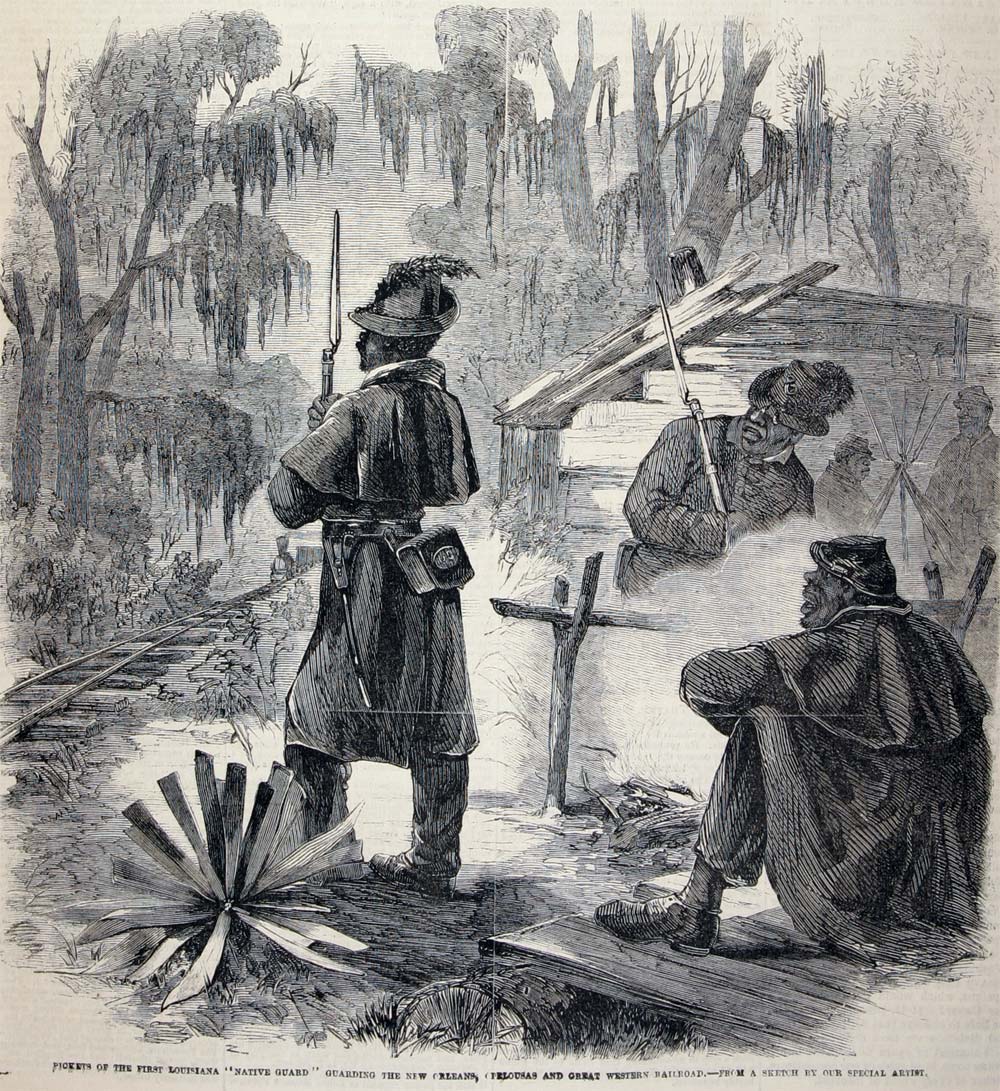 |
"In this swamp in the wilderness the 'nigger soldiers' are eminently useful. The melancholy solitude, with the speectral cypress trees, which seem to stand in silent despair, like nature's sentinels waving in the air wreaths of gray funereal moss, to warn all human beings of the latent pestilence around, though unendurable to our soldiers of the North, seems an elysium to these sable soldiers, for the swampy forest has no horrors to them. Impervious to miasma, they see only the home of the coon, the possum and the coperhead, so that with 'de gun dat Massa Sam gib'em," they have around them all the essential elements of colored happiness, except ladies' society." --excerpt from "Scenes in Louisiana," Frank Leslie's Illustrated Newspaper, March 7, 1863 |
First South Carolina (African-American) Volunteers
In November of 1862, Thomas Wentworth Higginson was given command of the First South Carolina Volunteers, which he described as "the first slave regiment mustered into the service of the United States during the late civil war." Higginson explained in his memoir:
It was, indeed, the first colored regiment of any kind so mustered, except a portion of the troops raised by Major-General Butler at New Orleans. These scarcely belonged to the same class, however, being recruited from the free colored population of that city, a comparatively self-reliant and educated race. "The darkest of them," said General Butler, "were about the complexion of the late Mr. Webster."
The First South Carolina, on the other hand, contained scarcely a freeman, had not one mulatto in ten, and a far smaller proportion who could read or write when enlisted. The only contemporary regiment of a similar character was the "First Kansas Colored," which began recruiting a little earlier, though it was not mustered in the usual basis of military seniority till later. . . These were the only colored regiments recruited during the year 1862. The Second South Carolina and the Fifty-Fourth Massachusetts followed early in 1863.
--Thomas Wentworth Higginson, "Introduction" Army Life in a Black Regiment, 1869
Higginson, an abolitionist, was extremely pleased with his assignment, regarding it as "a vast experiment of indirect philanthropy, and one on which the result of the war and the destiny of the negro race might rest." He was aware, however, that his troops were subject to the most extreme scrutiny by the press.
Those who look back to the newspaper correspondence of that period will see that this particular regiment lived for months in a glare of publicity, such as tests any regiment severely, and certainly prevents all subsequent romancing in its historian. As the scene of the only effort on the Atlantic coast to arm the negro, our camp attracted a continuous stream of visitors, military and civil. A battalion of black soldiers, a spectacle since so common, seemed then the most daring of innovations, and the whole demeanor of this particular regiment was watched with microscopic scrutiny by friends and foes. I felt sometimes as if we were a plant trying to take root, but constantly pulled up to see if we were growing. The slightest camp incidents sometimes came back to us, magnified and distorted, in letters of anxious inquiry from remote parts of the Union. It was no pleasant thing to live under such constant surveillance; but it guaranteed the honesty of any success, while fearfully multiplying the penalties had there been a failure. A single mutiny, such as has happened in the infancy of a hundred regiments, a single miniature Bull Run, a stampede of desertions, and it would have been all over with us; the party of distrust would have got the upper hand, and there might not have been, during the whole contest, another effort to arm the negro.
| The First South Carolina Volunteeers Described in the Atlantic Monthly |
The first regiment, as raised by General Saxton, numbered four hundred and ninety-nine men when Colonel Higginson took command of it on the 1st of December and on the 19th of January, 1863, it had increased to eight hundred and forty-nine. It has made three expeditions to Florida and Georgia, — one before Colonel Higginson assumed the command, described in Mrs. Stowe’s letter to the women of England, and two under Colonel Higginson, one of which was made in January up the St. Mary’s, and the other in March to Jacksonville, which it occupied for a few days until an evacuation was ordered from head quarters. The men are volunteers, having been led to enlist by duty to their race, to their kindred still in bonds, and to us, their allies. Their drill is good, and their time excellent. They have borne themselves well in their expeditions, quite equalling the white regiments in skirmishing. In morale they seemed very much like white men, and with about the same proportion of good and indifferent soldiers. Some I saw of the finest metal, like Robert Sutton, whom Higginson describes in his report as “the real conductor of the whole expedition at the St. Mary’s,” and Sergeant Hodges, a master carpenter, capable of directing the labors of numerous journeymen. Another said, addressing a meeting at Beaufort, that he had been restless, nights, thinking of the war and of his people, — that, when he heard of the regiment being formed, he felt that his time to act had come, and that it was his duty to enlist, — that he did not fight for his rations and pay, but for wife, children, and people. These men, as already intimated, are very much like other men, easily depressed, and as easily reanimated by words of encouragement. Many have been reluctant to engage in military service, — their imagination investing it with the terrors of instant and certain death. But this reluctance has passed away with participation in active service, with the adventure and inspiration of a soldier’s life, and the latent manhood has recovered its rightful sway. Said a superintendent who was of the first delegation to Port Royal in March, 1862,— a truthful man, and not given to rose-colored views, — “I did not have faith. in arming negroes, when I visited the North last autumn, but I have now. They will be not mere machines, but real tigers, aroused; and I should not wish to face them.” --Edward L. Pierce, "The Freedmen at Port Royal," Atlantic Monthly, September,1863, 291-315 |
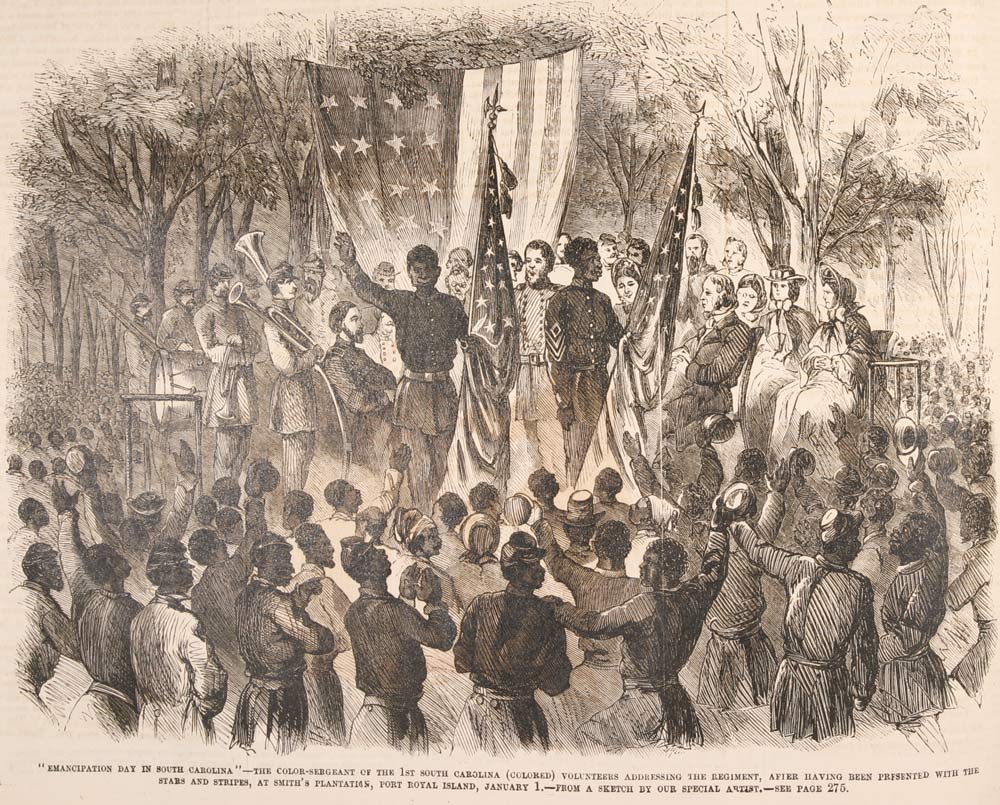
The African-American 1st South Carolina Volunteers were featured in a story about the celebration of emancipation in South Carolina published in Frank Leslie's Illustrated Newspaper. Interestingly, a second account of the same event survives in the memoir of their white commander, Thomas Wentworth Higginson, and a third in "Life in the Sea Islands," an autobiographical essay published in The Atlantic Monthly by African-American freedmen's teacher, Charlotte Forten.
Although the three narratives share many of the same details, they speak from very different perspectives. For example, while the Frank Leslie's reporter comments that "one of the chief rejoicers on the occasion was our old acquaintance Sambo, who, generally speaking, is always accompanied by the inevitable banjo," Higginson dryly notes that "the white ladies & dignitaries usurped the platform." The reporter's description of the soldiers's participation in the events as limited to applauding the white speakers contrasts sharply with Higginson's account of the spontaneous singing of the soldiers, which "made all other words cheap, it seemed the choked voice of a race, at last unloosed," and Charlotte Forten's comment on the short speech made by African-American Sergeant Robert Sutton as "simple, eloquent, and forcible." And yet, perhaps echoes of racism can even be found in the words of Forten, who describes the red pantaloons of the soldiers as giving them a "semi-barbaric splendor."
 |
|
Compare and/or contrast the three different accounts of the same event provided below. In what ways are their representations of African-Americans similar or different? In what ways does each one reenforce or contradict racial stereotypes?
|
The Status and Treatment of African-American Troops in the Union Army
THEIR PAY
Although African-Americans were mustered into the army in 1862, they did not receive the same status or treatment as their white comrades. The same Militia Act that declared African-Americans eligible for service also specified that they would receive lower compensation for their work. While Union privates at that time were earning $13 per month and received $3.50 for clothing, in Section 15 of Congress specified
That persons of African descent, who under this law shall be employed, shall receive ten dollars per month and one ration, three dollars of which monthly pay may be in clothing.
That means, in practical terms, that African-American soldiers received only a little more than half as much as white soldiers, once the cost of their uniforms was deducted.
Finally, in June 1864, a law was passed awarding equal pay to all African-American soldiers who had enlisted as free men, and that change was retroactive to the beginning of that year.
The Debate Over Pay |
There is one gross injustice to our soldiers which Congress should not lose a week in correcting, and that is the pay of the colored troops. If colored men are apes, don't enlist them. If the prejudice of race and color is insuperable, yield to it. But why should the American people do an unpardonably mean thing? If we are ashamed to acknowledge the heroism of the colored troops at Milliken's Bend, at Port Hudson, at Fort Wagner—upon every field, in fact, and in every battle where they have been tried—let us at least be manly enough to say to them, "We can not treat you honorably, so go home!" --"A Gross Injustice," Harper's Weekly, February 13, 1863, 98 The Senate has at length done its duty in providing for the equal payment of the colored troops, and for the fulfillment of the promises made by authority to those already enlisted. The House ought not to delay for a day to agree to the bill. For nothing is clearer than that the policy of employing colored troops should be renounced altogether, or that we should treat them honorably. Professor PECK, of Oberlin College, who has investigated the condition of these troops on the Atlantic coast, reports that the difference of pay between them and white soldiers is rapidly demoralizing them. Chaplain CONWAY writes to the same effect. At Fort Esperenza, in Texas, a colored battalion of the Fourteenth Rhode Island Artillery refused to receive their pay, and declared themselves out of the service; and the sad case of Sergeant WALKER in Florida, who was shot because he would not submit to be cheated by the authority of the United States, is fresh in our memories, and will always be shameful for our name. And while we refuse to treat these brave men honorably the rebels massacre them like dogs. The rebel conduct is fiendish, but at least it is consistent. If men, because they are of a certain color, may justly be deprived of liberty and all the other rights of human nature, they may certainly be deprived of life at the will of their captors. Massacre, barbarism, the most shocking inhumanity, are to be expected in a people who have been unfortunately bred under the slave system. But we have the right to require manliness and honor and justice of those who have been more fortunate. Shall we sacrifice the good name of our native land to the indulgence of a wretched prejudice? --from "Reluctant Justice," Harper's Weekly, May 7, 1864, 290 |
Our soldiers are constantly twitted by their families and friends with their prospect of risking their lives in the service, and being paid nothing; and it is in vain that we read them the instructions of the Secretary of War to General Saxton, promising them the full pay of soldiers. They only half believe it.* *With what utter humiliation were we, their officers, obliged to confess to them, eighteen months afterwards, that it was their distrust which was wise, and our faith in the pledges of the United States Government which was foolishness! --Thomas Wentworth Higginson, "Camp Diary," Army Life in a Black Regiment, 1869 |
THEIR RANK
Segregated into their own regiments, black troopswere typically led by white officers, as is suggested by the illustration below.
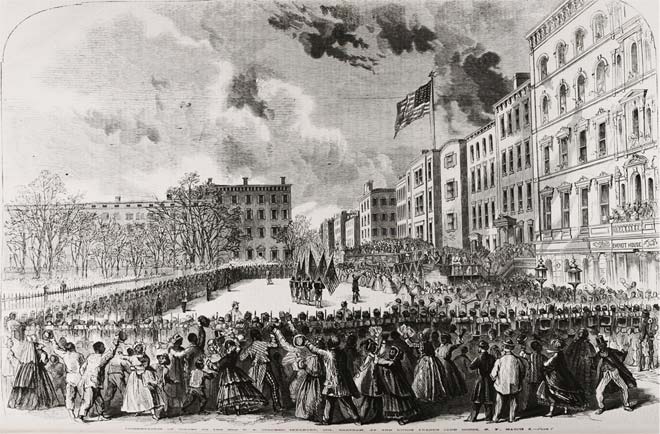 |
While the rank-and-file members of the company shown in the picture above are black, their officers are white.
 |
Similarly, while many of the people in the cheering crowd are African-American, the people who have been given pride of place on and in front of the reviewing stand are white.
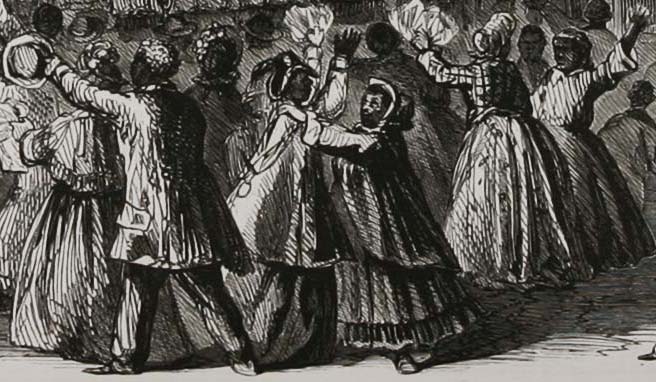 |
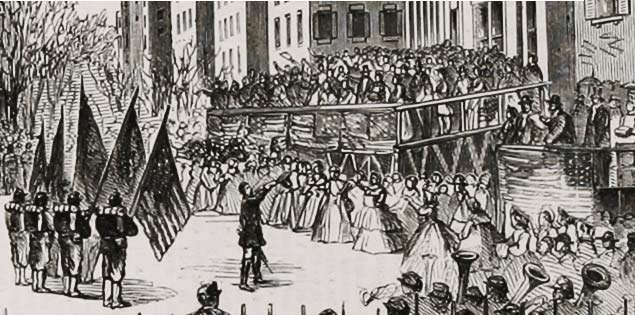 |
Unlike most other black regiments, the 1st Louisiana Native Guards had African-American officers. This may have been due, at least in part, to the fact that many members of the regiment had been free before the war, and in some cases had enjoyed positions of standing within the free black community of New Orleans. The fact that many of the men were mulattoes also may have made it easier for Northerners to accept them in leadership positions.
"I understood you, Colonel," said I, " that all your line officers were colored men: there goes one, at any rate, who is white." The Colonel turned to me with a sarcastic smile:
"And do you really think him white? Well you may, Sir; but that man is a 'negro'—one who carries the so-called curse of African blood in his veins." I was literally amazed. Often as my senses had been deceived in this matter, they never had been so completely before. This officer, Captain E. Davis, of Company A [his portrait is given in our group.—Ed.], was a fine-looking young man, not unlike General M'Clellan in mould of features, with light blue eyes, ruddy complexion, soft, silky hair, and a splendid mustache, of a sandy color, nearly approaching red. I would have defied the most consummate expert in Niggerology, by the aid of the moat powerful microscope, to discover the one drop of African blood in that man's veins. Still there it was upon the record against him.
THE ROLES THEY WERE ASSIGNED
In discussions of how African-Americans could be used to support the war effort, even some of the strongest proponents of emancipation seemed to assume that blacks would inevitably be assigned to menial positions. Although frequently caricatured for as a radical abolitionist, Horace Greeley argued in his famous open letter to President Lincoln:
We cannot conquer Ten Millions of People united in solid phalanx against us, powerfully aided by the Northern sympathizers and European allies. We must have scouts, guides, spies, cooks, teamsters, diggers and choppers from the Blacks of the South, whether we allow them to fight for us or not, or we shall be baffled and repelled.
--Horace Greeley, "A Prayer for Twenty Millions," New York Tribune, August 20, 1862
And, indeed, freedmen were often assigned work tending to mules, horses, cooking, or washing. The fact that the men in the picture immediately below were referred to as "washerwomen" suggests how far such roles were from the kind of honor and dignity usually associated with being a soldier.
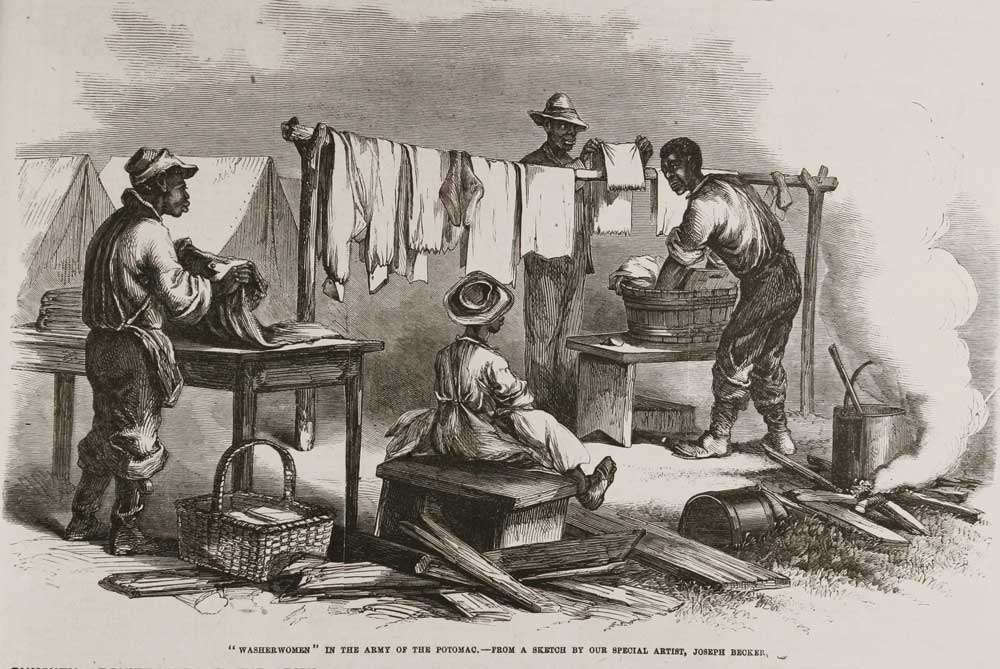 |
|
.
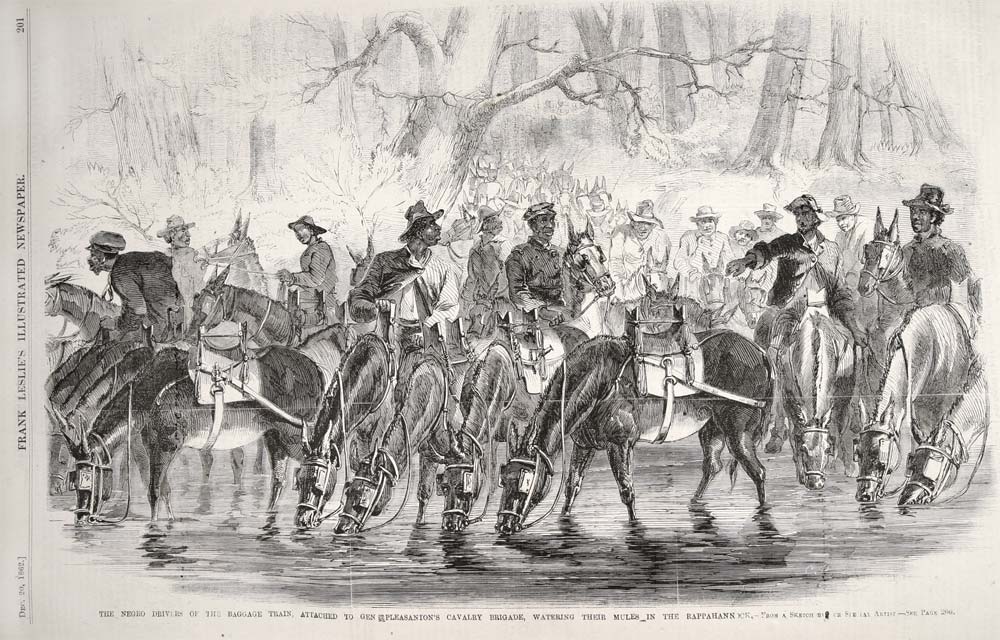 |
|
 |
|
|
 |
||
 |
||
 |
||
 |
||
All of the images immediately above are from Edwin Forbes' Life Studies of the Great Army : A Historical Work of Art, in Copper-Plate Etching, Containing Forty Plates, Illustrating the Life of the Union Armies During the Late Rebellion, New York: 1876. From top to bottom, they are as follows: "The Old Campaigner," one of the images from Plate 32; "A Watched Pan Never Boils," one of the images from Plate 29; " The Supply Train," Plate 31; and "The Reliable Contraband," Plate 23.
The RESPONSE OF WHITE SOLDIERS TO BLACK SOLDIERS
The achievements of black regiments won them the respect of some of their white comrades, but African-Americans were sometimes victimized by members of the Union army. A letter from freedmen's teacher Lucy Chase, for example, describes an episode in 1865 in which soldiers of the New York 13th Artillery attacked black citizens of Norfolk, Virginia, killing some of their victims and hanging others from lamp posts.
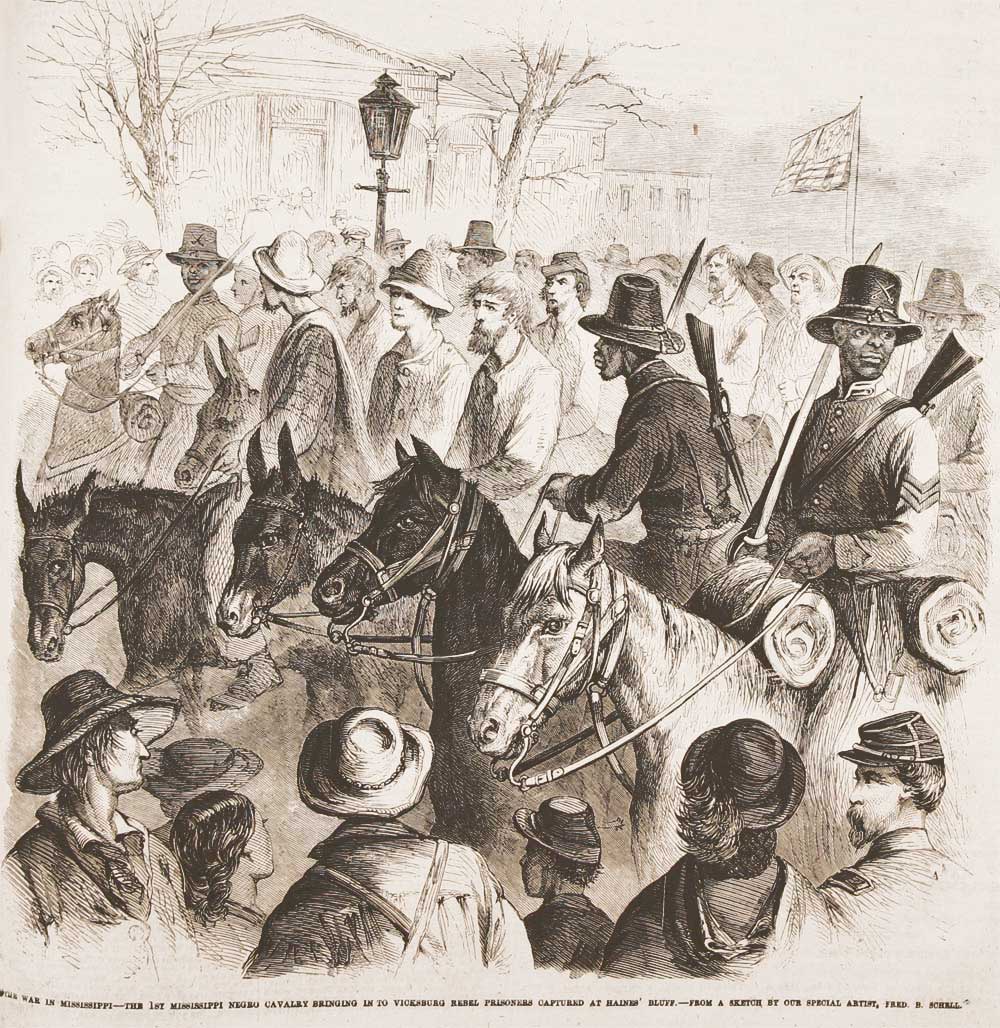 |
|
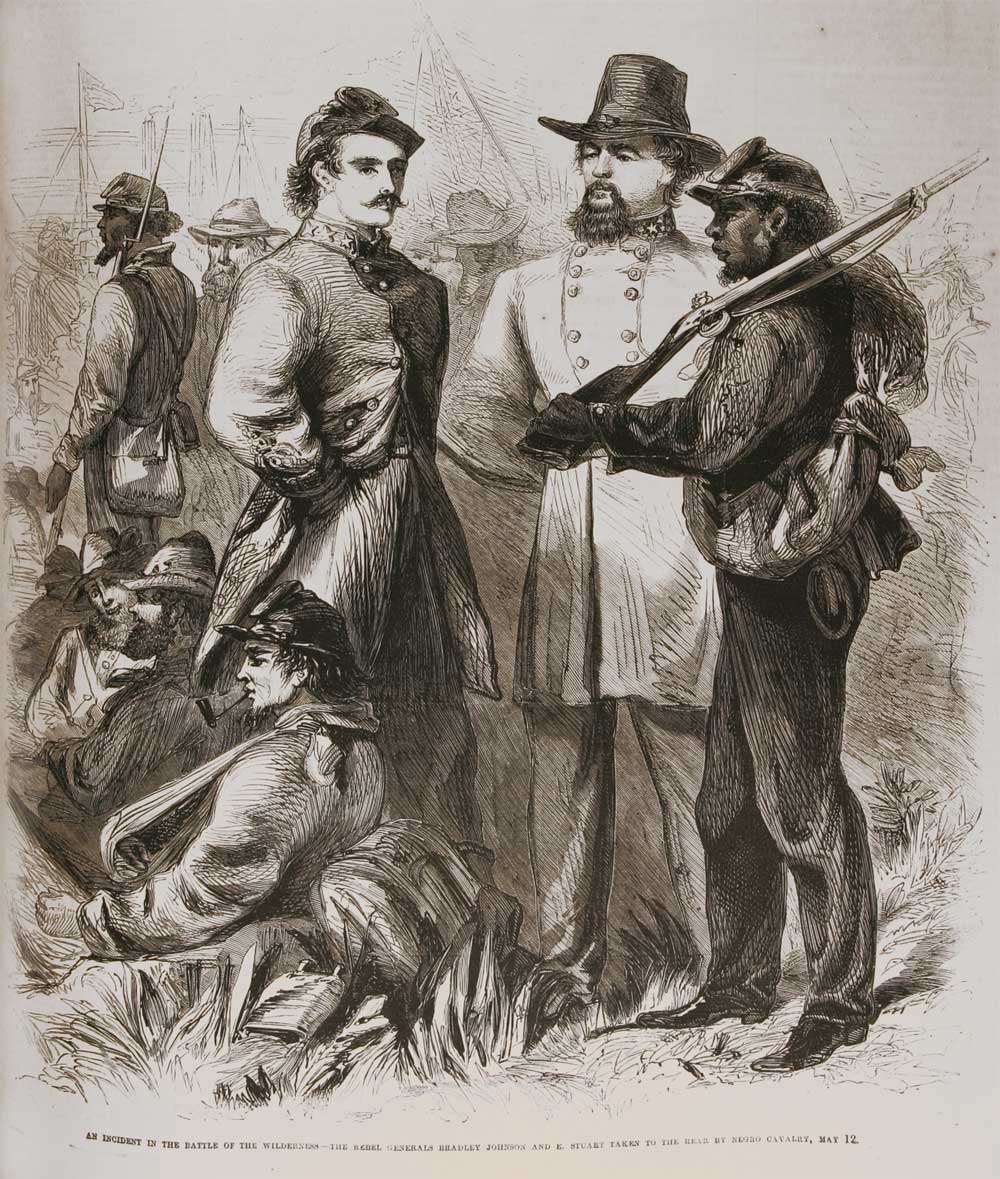 |
|
| The Reaction of White Troops to African-American Troops with Confederate Prisoners |
Said a superintendent who was of the first delegation to Port Royal in March, 1862,— a truthful man, and not given to rose-colored views, — “I did not have faith. in arming negroes, when I visited the North last autumn, but I have now. They will be not mere machines, but real tigers, aroused; and I should not wish to face them.” One amusing incident may be mentioned. A man deserted from the regiment, was discovered hidden in a chimney in the district where he had lived, was taken back to camp, went to Florida in Higginson’s first expedition, bore his part well in the skirmishes, became excited with the service, was made a sergeant, and, receiving a furlough on his return, went to the plantation where he had hid, and said he would not take five thousand dollars for his place. But more significant, as showing the success of the experiment, is the change of feeling among the white soldiers towards the negro regiment, a change due in part to the just policy of General Saxton, in part to the President’s Proclamation of January 1st, which has done much to clear the atmosphere everywhere within the army-lines, but more than all to the soldierly conduct of the negroes themselves during their expeditions. I had one excellent opportunity to note this change. On the 6th of April, Colonel Higginson’s regiment was assigned to picket-duty on Port Royal Island, — the first active duty it had performed on the Sea Islands, — and was to relieve the Pennsylvania Fifty-Fifth. When, after a march of ten miles, it reached the advanced picket station, there were about two hundred soldiers of the Pennsylvania Fifty-Fifth awaiting orders to proceed to Beaufort. I said, in a careless tone, to one of the Pennsylvania soldiers, who was looking at Higginson’s regiment as it stood in line, — “Is n’t this rather new, to be relieved by a negro regiment?” “All right,” said he. “ They ‘ye as much right to fight for themselves as I have to fight for them.” A squad of half a dozen men stood by, making no dissent, and accepting him as their spokesman. Moving in another direction, I said to a soldier, — “What do you think of that regiment?” The answer was, — “All right. I ‘d rather they ‘d shoot the Rebels than have the Rebels shoot me”; and none of the by-standers dissented. As one of the negro companies marched off the field to picket a station at the Ferry, they passed within a few feet of some twenty of the Pennsylvania soldiers, just formed into line preparatory to marching to Beaufort. The countenances of the latter, which I watched, exhibited no expression of disgust, dislike, or disapprobation, only of curiosity. Other white soldiers gave to the weary negroes the hominy left from the morning meal. The Major of the Fifty-Fifth, highest in command of the relieved regiment, explained very courteously to Colonel Higginson the stations and duties of the pickets, and proffered any further aid desired. This was, it is true, an official duty, but there are more ways than one in which to perform even an official duty. I rode back to Beaufort, part of the way, in company with a captain of the First Massachusetts Cavalry, who was the officer of the day. He said “he was n’t much of a negro-man, but he had no objection to their doing our fighting.” He pronounced the word as spelled with two gs; but I prefer to retain the good English. Colonel Montgomery, who had a partly filled regiment, most of whom were conscripts, said that on his return from Jacksonville he sent a squad of his men ashore in charge of some prisoners he had taken. Some white soldiers seeing them approach from the wharf, one said, — “What are those coming?” “Negro soldiers,” (word pronounced as in the former case,) was the answer. “Damn ‘em!” was the ejaculation. But as they approached nearer, “What have they got with ‘em?” was inquired. “Why, some Secesh prisoners.” “Bully for the negroes!” (the same pronunciation as before,) was then the response from all. So quick was the transition, when it was found that the negroes had demonstrated their usefulness! It is, perhaps, humiliating to remember that such an unreasonable and unpatriotic prejudice has at any time existed; but it is’ never worth while to suppress the truth of history. This prejudice has been effectually broken in the Free States . . . --from Edward L. Pierce's "The Freedmen at Port Royal," The Atlantic Monthly, September, 1863, 291-315 |
| A Freedmen's Teacher Describes Union Soldiers Assaulting African-Americans |
On Thursday last, two or three Southern gentlemen succeeded in infusing Southern sentiments into the hearts of some of the New York 13th Artillery by dosing them with drugged whiskey; and, leading themselves, they encouraged the soldiers to destroy the wares on the stand of a colored man. On from the stand, crying, "Clear out all the niggers," they passed to a ball-room, through which they dashed, driving all before them, and destroying whatever came in their way. On Friday night, a body of colored men, wishing to see a circus performance, deemed it prudent to go in a body, and, protecting themselves with canes, they went forth quietly, but were fired upon as they drew near the circus. Two or three were shot; and all withdrew without offering resistance. Colored men were attacked, that night, in various parts of the city. One man was hung upon a lamp-post. Another, going home from a mission house with a letter which had been written for him there, was seized and put into prison, where he remained until the next day, when his kind amanuensis obtained his release. A worthy exhorter was knocked down, and severely injured, on his way home from church. Another was woefully bruised, while crossing the street from the house of a sick sister to his own home. On Saturday night, the wood-wharf men were attacked, and the stores of two Union white men were broken into, and much of the property destroyed. Finding the declaration, "I am a Union man," no defence against the attack of New York soldiers, one man resorted to his pistol, and, after wounding two of his assailants, succeeded in making his escape. Last night many shots were fired in Portsmouth. The demonstrations there are more violent than here. On Sunday, two colored men were found hanging dead upon trees, this side of Suffolk. And a young man leaving a church in this city, was shot through the side, and robbed. He still lies, a panting sufferer, on an attic floor; bare of every comfort, save the inestimable one of a devoted mother, who leaves him neither night nor day. . . .I have just come from the bedsides of two wounded men. One of them was quietly passing to his home, when three soldiers run after him and fired three shots, neither of which took effect. They then cried "Halt!" but, as the man knew their order was not to be respected, he walked on. Another shot fired, and the ball passed through his month. "Finish him, finish him," some one cried. Two men overtook him, and each pointed a revolver at his breast; he turned their hands aside, and said, "You don't shoot me again." "Very well," they said, "come into the guardhouse." There he was received without investigation. In the morning, when the officer of the guard came, he inquired what brought him there, and after hearing the man's story, he said : "Pity they did not kill you." The other man is badly wounded in the leg. He was hobbling home from his day's work at the government commissary when he was overtaken by a howling crowd. His co-laborers were with him, and eleven shots were fired at them. Only one took effect. "You must fight it out, I can do nothing for you," the Mayor of Norfolk said to a committee of colored men who sought his protection. The rioters are taking advantage of the divided, and somewhat obscurely defined, responsibilities resting upon the associated military and civil authorities; responsibilities which the civil authorities shirk, when the interests of the colored man or of Union citizens are at stake. The Mayor of Portsmouth, whose city is more disturbed than our own, requests Col. Howard to "relieve Portsmouth of its military guard!" Col. Howard is abroad, with the will of an army in his breast, and we are confident he will speedily restore quiet again. The disturbance is maintained through the day-time.. . . Day and night, men, boys and soldiers cry "Nig !" " Nig !" at sight of a colored man, and hasten to molest him. Several have said to me, "We're having again what we suffered when the Union forces first came into Norfolk." One man said : " We rejoiced to see the Northern soldiers; there was nothing we would not do for them; and they knew it, too. We were humble, grateful and respectful. But the New York 99th destroyed our property, shot us down, and injured us in every possible way. They got men from their beds at night, saying, 'The general has important work for you to do,' and then took the men so willing to work for the government, and sent them over the lines, and sold them as slaves.. . " |
Representations of the Heroism of Individual African-Americans in the Press
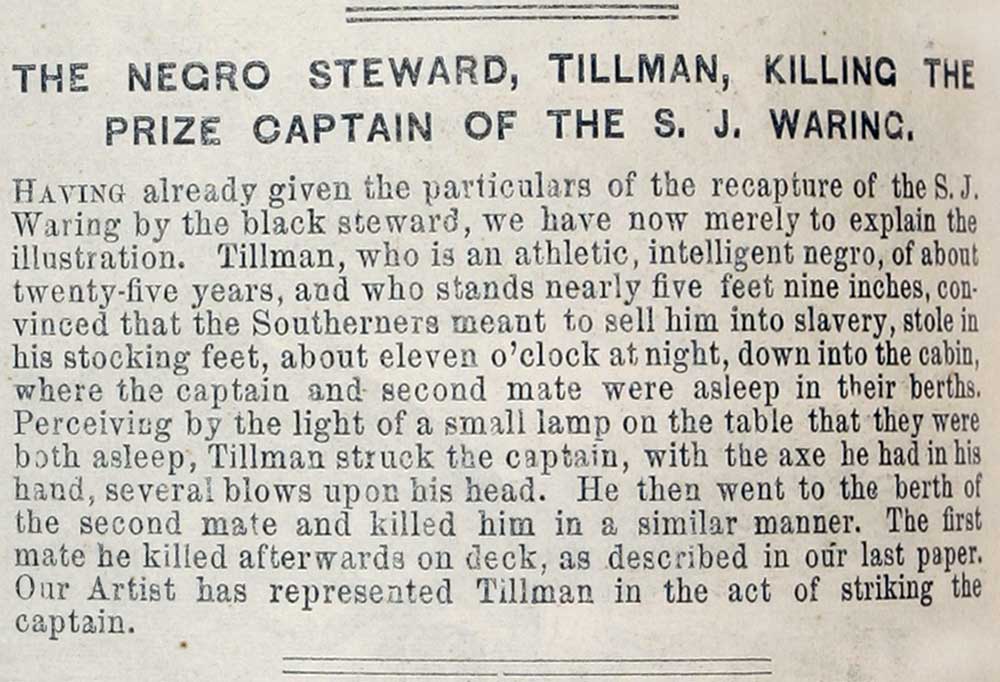
Although African-Americans were not permitted to enlist in the army during the early months of the war, Northern newspapers did carry stories of the heroic exploits of Southern slaves or freemen who managed to take control of confederate ships or territory and deliver them into the hands of the Union forces. Press accounts generally offered positive depictions of the individuals at the center of the stories, often emphasizing their intelligence, skill, and courage. However, both the illustration and text of the Frank Leslie's report on "William Tillman, the Colored Steward" (see below) suggest that even "heroic" African-Americans could be depicted in a way that reinforced negative steretotypes. While newspaper readers would have been accustomed to seeing depictions of acts of violence during a war, the image of a black man in the act of striking a sleeping white man with an axe would probably have conveyed an impression of savagery.
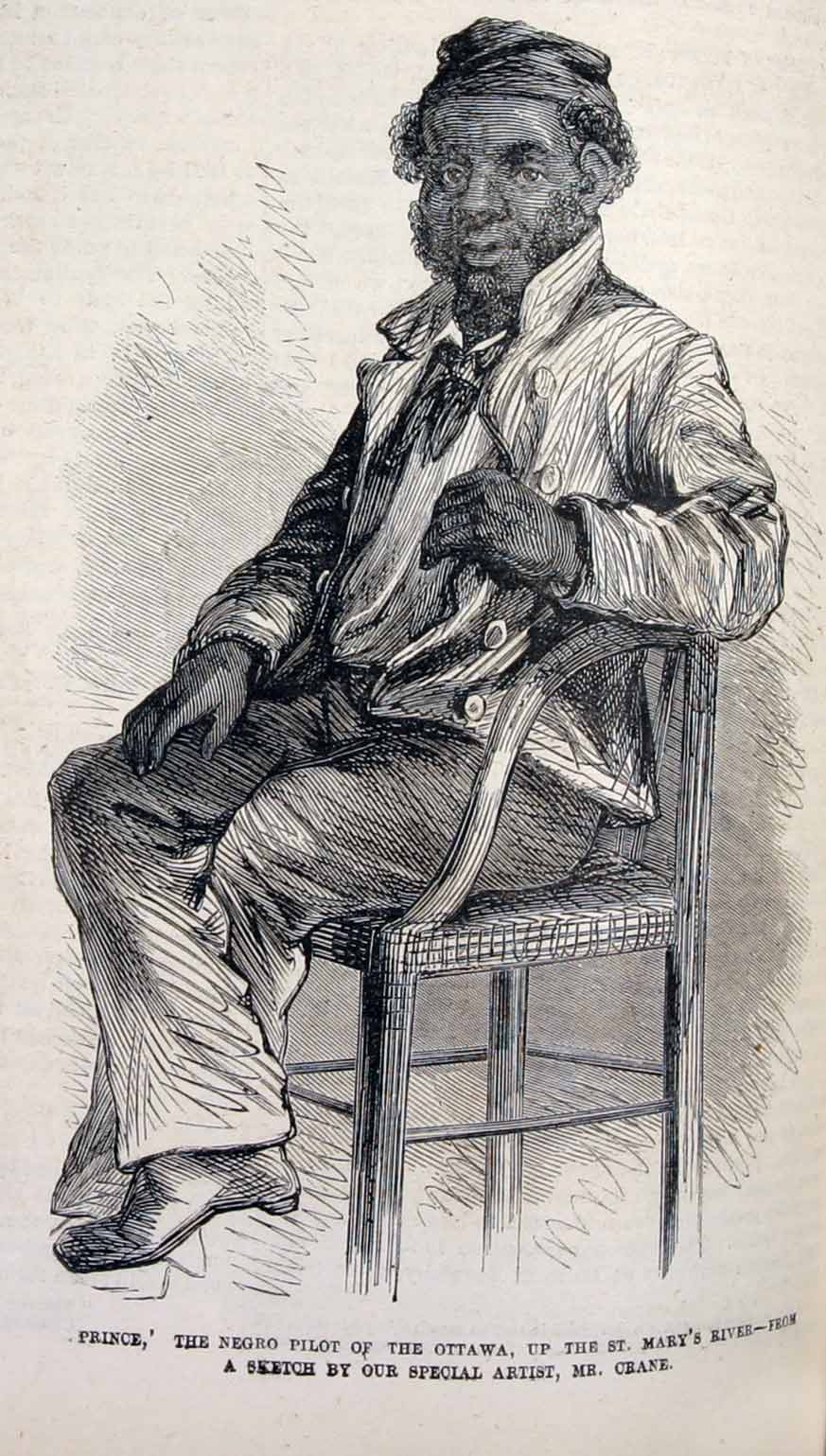
In our last number we published a sketch of the Darlington, a steamer captured by Capt. Rodgers. Our Artist, Mr. Crane, relates a very afecting incident connected with it. Owing to the usual brutality of the rebel officers, they had not hoisted a white flag, although the vessel was an unarned one, and had on board 40 women and children. He says: "Most fortunately, the shot fired at her did no damage; and, as it was not returned, Capt. Rodgers took the launch and cutter of the Wabash, and went on board of her. He found the vessel deserted by all her 'gallant defenders' except Prince, a contraband. Upon descending into the cabin a most distressing scene met his eyes. In that contracted place, upon their knees, engaged in prayer, and evincing the greatest state of fear and despair, were between 30 and 40 women and children, who thought their last hour had come. It was some time before Capt. Rodgers could engage the attention of anyof them, so as to assure them of their safety and his protection. Finally they became more calm, and listened to Capt. Rodgers. They stated that they had been assured that if captured by us they would suffer every indignity and outrage at our hands, and if they escaped wit their lives it would be very fortunate. So you may well imagine they were not in the most cheerful state of mind when our men took possession of the steamer. However, as no outrage was offered, and every attention shown them, they became quite resigned and slightly cheerful during the evening. Lieut. Barnes was placed in charge, with 20 men, and he succeeded in bringing her down in safety to the city, where she anchored. "Prince, the contraband, of whom I send you a capital portrait, is a most intelligent gentlement of the 'colored persuasion,' and well deserves the praise my friend Mr. Sawyer bestowed upon whim who pronounced him "an intelligent and witty fellow.' He has acted as pilot here for many years, and knows the inland waters like a book. Under his pilotage the Ottawa went up the St. Mary's river, a very tortuous and difficult bit of navigation resembling a series of letter S's. St. Mary's is about 10 miles west from Frenandina, and contains about 500 inhabitants. It is the residence of many wealthy Georgians, most of whom had fled. We had no difficulty in getting an abundant supply of duck and green peas, for all of which we most religiously paid." --“Prince, the Contraband Pilot,” Frank Leslie's Illustrated Newspaper, April 5, 1862, 324 |
"The Gallant Act of the Contrabands in Charleston Harbor," |
|---|
[From the New York Herald, May 19] The following interesting report from Commander Parrot has been received at the Navy Department, having been forwarded by Commander Dupont: UNITED STATES STEAMSHIP AUGUSTA, Off Charleston, May 16, 1862. SIR--I have the honor to inform you that the rebel armed steamer Planter was brought out to us this morning from Charleston by eight contrabands, and delivered up to the squadron. Five colored women and three children were also on board. She carries one 32 pounder and one 24 pounder howitzer, and has also on board four large guns, which she was engaged in transporting. I sent her to Port Royal at once, in order to take advantage of the present good weather. I sent Charleston papers of the 12th, and the very intelligent contraband, who was in charge, will give you the information which he has brought off. I have the honor to request that you will send back, as soon as convenient, the officer and crew sent on board. Commander Dupont, in forwarding this dispatch, said in relation to the rebel steamer Planter:--She was the armed despatch and transportation steamer attached to the Engineer department at Charleston, under Brigadier General Ripley, whose bark a short time since was brought to the blockading fleet by several contrabands. The bringing out of the steamer, under all the circumstances would have done credit to any one. At four in the morning, in the absence of the captain, who was on shore, she left her wharf, close to the government office and headquarters, with the Palmetto and Confederate flags flying – passed the successive forts, saluted as usual by blowing the steam whistle. After getting beyond the range of the last gun she hauled down the rebel flag and hoisted a white one. The Onward was the inside ship of the blockading squadron in the main channel, and was preparing to fire when her commander made out the white flag. The armament of the steamer is a 32-pounder or pivot, and a fine 24-pounder howitzer. She has, beside, on her deck four other guns – one 7-inch rifle – which were to be taken on the morning of the escape to the new fort on the middle ground. One of the four belonged to Fort Sumter, and had been struck on the muzzle. Robert Small, the intelligent slave and pilot of the boat who performed this bold feat so skillfully, informed me of this fact, presuming it would be a matter of interest to us to have possession of this gun. This man, Robert Small, is superior to any who have come into our lines, intelligent as many of them have been. His information has been most interesting and portions of it of the utmost importance. The steamer is quite a valuable acquisition to the squadron, by her good machinery and very light draught. The officer in charge brought her through St. Helena Sound, and by the inland passage down Beaufort River, arriving here at ten last night. On board the steamer when she left Charleston were eight men, five women and three children. I shall continue to employ Small as a pilot on board the Planter, for inland waters, with which he appears to be very familiar. I do not know whether, in the views of the government, the vessel will be considered a prize, but if so, I respectfully submit to the department the claims of the man Small and his associates. Very respectfully, your obedient servant, S.F. Du Pont, Flag-Officer, Commanding, &c. For another account of Small's exploits, see William Wells Brown, "Robert Small," The Black Man, His Antecedents, His Genius, and His Achievements, 1863
|
 |
|---|
|
 |
 |
|---|---|
| A detail from the picture above. |
Representations of the Achievements of African-American Regiments
Approximately 180,000 African Americans served in the Union army during the Civil War, and they participated in some of the bloodiest battles of that conflict. Each time an African-American regiment distinguished itself in battle, supporters would cite the bravery of the troops as evidence that black men could make good soldiers. However, the fact that this argument was made so many times, and in connection with so many battles, suggests that the debate in the North over the wisdom of enlisting African-Americans (and the racial prejudice that was the source of the doubts) continued long after black troops had fought and died for the Union cause.Ironically, Northern prejudice against African-American soldiers was probably offset in some cases by Northern prejudice against Confederate soldiers. While blacks were frequently stereotyped as "savages," when Northern accounts of battles characterized Southern troops as savage, then African-American soldiers were sometimes seen as sympathetic victims. Examples of this can be found in the account below of the Battle of Pea Ridge and the descriptions of Confederate troops using bloodhounds to attack black soldiers. Further fueling this sympathy were Jefferson Davis's announcement that captured African-American soldiers would be killed, the fact that the South refused to exchange any black prisoners, and frequent reports of atrocities against black soldiers.
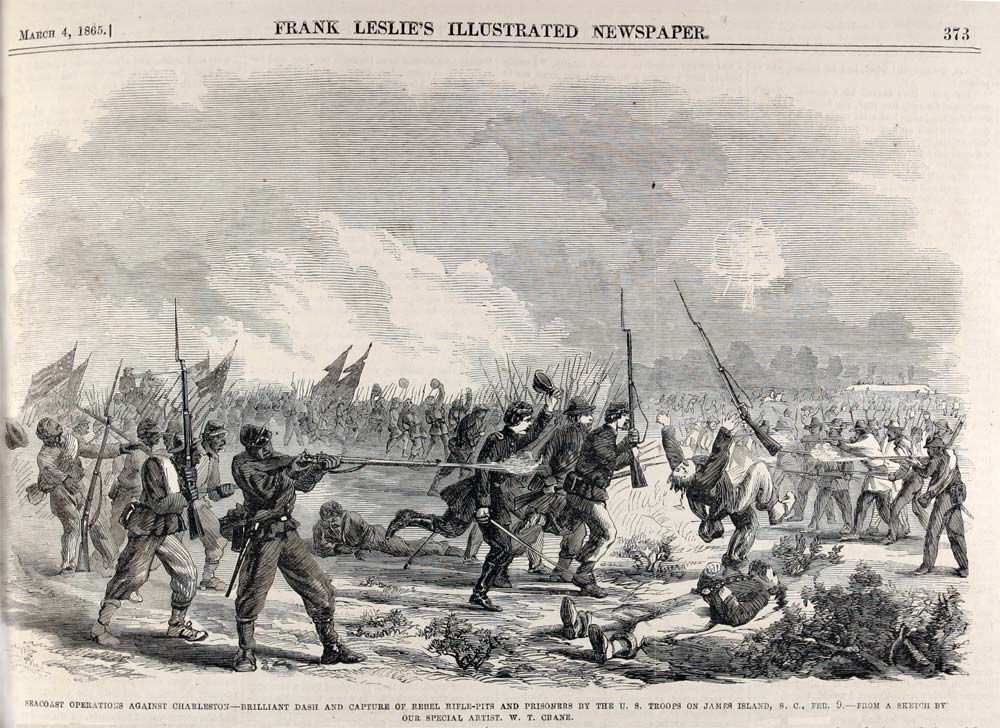 |
|
KEY BATTLES
The Battle of Port Hudson, Spring, 1863
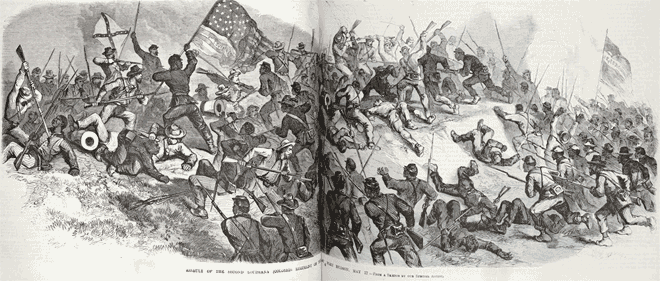
|
|
The first battle of the Civil War to include African-American troops was fought at Port Hudson on May 27, 1863. Although heavily outnumbered, the Confederates were protected by four-and-one-half-miles of fortifications and a series of earthenwork entrenchments. As a result, the battle was one of the bloodiest of the war and Union forces, including the 1st and 3rd Louisiana Native Guards, took heavy casualties. It was only after a forty-eight day seige and the fall of Vicksburg that Confederate forces at Port Hudson surrendered. However, the battle was cited by many as proof of the courage of African-Americans soldiers.
Accounts of The Battle of Port Hudson |
Two black regiments, enlisted some months before in Louisiana under the order of Major-General Butler, both with line and one with field officers of their own lineage, made charge after charge on the batteries of Port Hudson, and were mown down like summer’s grass, the survivors, many with mutilated limbs, closing up the thinned ranks and pressing on again, careless of life, and mindful only of honor and duty, with a sublimity of courage unsurpassed in the annals of war, and leaving there to all mankind an immortal record for themselves and their race. --from Edward L. Pierce's "The Freedmen at Port Royal," The Atlantic Monthly, September, 1863, 291-315 When the Fifty-fourth Massachusetts Regiment stormed Fort Wagner July 18, 1863, only to be driven back with the loss of its colonel, Robert Gould Shaw, and many of its rank and file, it established for all time the fact that the colored soldier would fight and fight well. This had already been demonstrated in Louisiana by colored regiments under the command of General Godfrey Weitzel in the attack upon Port Hudson on May 27 of the same year. On that occasion regiments composed for the greater part of raw recruits, plantation hands with centuries of servitude under the lash behind them, stormed trenches and dashed upon cold steel in the hands of their former masters and oppressors. After that there was no more talk in the portion of the country of the "natural cowardice" of the negro. -- Oswald Garrison Villard, "The Negro in the Regular Army, " Atlantic Monthly, 91, 1903, 721-729 |
| The Battle of Port Hudson Described in William Wells Brown's Novel,
Clotelle, Or the Colored Heroine. A Tale of the Southern States |
The "General Order No. 63," issued on the 22nd of August, 1862, by Gen. Butler, recognizing, and calling into the service of the Federal Government, the battalion of colored men known as the "Native Guard," at once gave full scope to Jerome's military enthusiasm; and he made haste to enlist in the organization. The "Native Guard" did good service in New Orleans and vicinity, till ordered to take part in the siege of Port Hudson, where they appeared under the name of the "First Louisiana," and under the immediate command of Lieut.-Col. Bassett. The heroic attack of this regiment, made on the 27th of May, 1863, its unsurpassed "charge," its great loss, and its severe endurance on the field of battle, are incidents which have passed into history. The noble daring of the First Louisiana gained for the black soldiers in our army the praise of all Americans who value Republican institutions. There was, however, one scene, the closing one in the first day's attack on Port Hudson, which, while it reflects undying credit upon the bravery of the negro, pays but a sorry tribute to the humanity of the white general who brought the scene into existence. The field was strewn with the dead, the dying, and the wounded; and as the jaded regiments were leaving the ground, after their unsuccessful attack, it was found that Capt. Payne, of the Third Louisiana, had been killed; and his body, which was easily distinguished by the uniform, was still on the battle-field. The colonel of the regiment, pointing to where the body lay, asked, "Are there four men here who will fetch the body of Capt. Payne from the field?" Four men stepped out, and at once started. But, as the body lay directly under the range of the rebel batteries, they were all swept down by the grape, canister, and shell which were let loose by the enemy. The question was again repeated, "Are there four men who will go for the body?" The required number came forth, and started upon a run; but, ere they could reach the spot, they were cut down. "Are there four more who will try?" The third call was answered in the affirmative, and the men started upon the double-quick. They, however, fell before getting as far as the preceding four. Twelve men had been killed in the effort to obtain the body of the brave Payne, but to no purpose. Humanity forbade another trial, and yet it was made. "Are there four more men in the regiment who will volunteer to go for Capt. Payne's body?" shouted the officer. Four men sprang forward, as if fearful that they would miss the opportunity of these last: one was Jerome Fletcher, the hero of our story. They started upon the run; and, strange to tell, all of them reached the body, and had nearly borne it from the field, when two of the number were cut down. Of these, one was Jerome. His head was entirely torn off by a shell. The body of the deceased officer having been rescued, an end was put t the human sacrifice. --from William Wells Brown's "Chapter XXXVI. The Return Home," Clotelle, The Colored Heroine, 1864 |
The Battle of Milliken's Bend, June 7, 1863
Although small, the Battle of Milliken's Bend won Northern sympathy and respect for African-American troops. Milliken's Bend was used by Grant as his supply depot while he layed seige to Vicksburg. On June 7, 1863, confederate troops attempted to cut off Grant's supply line by attacking Milliken's Bend. African-American soldiers of the 13th Louisiana Infantry Regiments and the 1st Mississippi Infantry were among the outnumbered Union forces defending the post. Many of the black soldiers were recently recruited, poorly trained, and poorly equipped. Yet, despite the long odds, Union forces were successful in fending off the raid. Stories of the brave fighting done by African-American soldiers won them new supporters in the North, while stories that confederates had murdered black soldiers who attempted to surrender inspired sympathy and outrage.
| Reports of Milliken's Bend |
Mr. Davis also sends us a sketch of the sharp fight at Milliken's Bend, where a small body of negro troops with a few whites were attacked by a larger force of rebels. A letter from Vicksburg says: Twenty-second Day in Rear of Vicksburg, June 9, 1868. Two gentlemen from the Yazoo have given me the following particulars of the fight at Milliken's Bend, in which negro troops played so conspicuous a part. My informant states that a force of about 1000 negroes and 200 men of the Twenty-third Iowa, belonging to the Second Brigade, Carr's Division (the Twenty-third Iowa had been up the river with prisoners, and was on its way back to this place), was surprised in camp by a rebel force of about 2000 men. The first intimation that the commanding officer received was from one of the black men, who went into the colonel's tent, and said: "Massa, the secesh are in camp." The colonel ordered him to have the men load their guns at once. He instantly replied: "We have done did dat now, massa." Before the colonel was ready the men were in line, ready for action. As before stated, the rebels drove our force toward the gun-boats, taking colored men prisoners and murdering them. This so enraged them that they rallied and charged the enemy more heroically and desperately than has been recorded during the war. It was a genuine bayonet charge, a hand-to-hand fight, that has never occurred to any extent during this prolonged conflict. Upon both sides men were killed with the butts of muskets. White and black men were lying side by side, pierced by bayonets, and in some instances transfixed to the earth. In one instance, two men -- one white and the other black -- were found dead, side by side, each having the other's bayonet through his body. If facts prove to be what they are now represented, this engagement of Sunday morning will be recorded as the most desperate of this war. Broken limbs, broken heads, the mangling of bodies, all prove that it was a contest between enraged men; on the one side from hatred to a race, and on the other, desire for self-preservation, revenge for past grievances, and the inhuman murder of their comrades. One brave man took his former master prisoner, and brought him into camp with great gusto. A rebel prisoner made a particular request that his own negroes should not be placed over him as a guard. Dame Fortune is capricious! His request was not granted. The rebels lost five cannon, 200 men killed, 400 to 500 wounded, and about 200 prisoners. Our loss is reported to be 100 killed and 500 wounded; but few of this number were white men. --"The Fight at Milliken's Bend," Harper's Weekly, July 4, 1863, 428 "We publish below a very interesting letter of Capt. M. M. Miller, of this city, of the Ninth Louisiana (colored) Regiment. Captain M. is a son of W. H. Miller, esq., for many years a citizen of Galena. At the time of the breaking out of the rebellion he was a student in Yale College, and had nearly completed his course. He left his studies, however, and returned home; enlisted as a private in the celebrated Washburne Lead Mine Regiment, from whence he was taken and made captain of a colored company. His statement can be relied on as literally true, and we venture to say the history of the world shows no more desperate fighting than that done by his company at Milliken's Bend. Every man but one in his company was either killed or wounded, and many of them in a hand-to-hand bayonet struggle: 'MILLIKEN'S BEND, June 10, 1863. 'DEAR AUNT: We were attacked here on June 7, about 3 o'clock in the morning; by a brigade of Texas troops, about 2,500 in number. We had about 600 men to withstand them. 500 of them negroes. I commanded Company I, Ninth Louisiana. We went into the fight with 33 men. I had 16 killed and 11 badly wounded, 4 slightly. I was wounded slightly on the head, near the right eye, with a bayonet, and had a bayonet run through my right band near the forefinger; that will account for this miserable style of penmanship. 'Our regiment had about 300 men in the fight. We had 1 colonel wounded, 4 captains wounded, 2 first and 2 second lieutenants killed, 5 lieutenants wounded, and 3 white orderlies killed and 1 wounded in the hand and two fingers taken off. The list of killed and wounded officers comprises nearly all the officers present with the regiment, a majority of the rest being absent recruiting. 'We had about 50 men killed in the regiment and 80 wounded, so you can judge of what part of the fight my company sustained. I never felt more grieved and sick at heart than when I saw how my brave soldiers had been slaughtered, one with six wounds, all the rest with two or three, none less than two wounds. Two of my colored sergeants were killed, both brave, noble men; always prompt, vigilant, and ready for the fray. I never more wish to hear the expression. "The niggers wont fight." Come with me 100 yards from where I sit and I can show you the wounds that cover the bodies of 16 as brave, loyal, and patriotic soldiers as ever drew bead on a rebel. . . . 'Not one of them offered to leave his place until ordered to fall back; in fact, very few ever did fall back. I went down to the hospital three miles to-day to see the wounded. Nine of them were there, two having died of their wounds. A boy I had cooking for me came and begged a gun when the rebels were advancing, and took his place with the company, and when we retook the breast-works I found him badly wounded with one gunshot and two bayonet wounds. A new recruit I had issued a gun to the day before the fight was found dead, with a firm grasp on his gun, the bayonet of which was broken in three pieces. So they fought and died defending the cause that we revere. They met death coolly, bravely; not rashly did they expose themselves, but all were steady and obedient to orders. 'So God has spared me again through many dangers. I cannot tell how it was I escaped. Your affectionate nephew, |
A Depiction of the Battle of Milliken's Bend
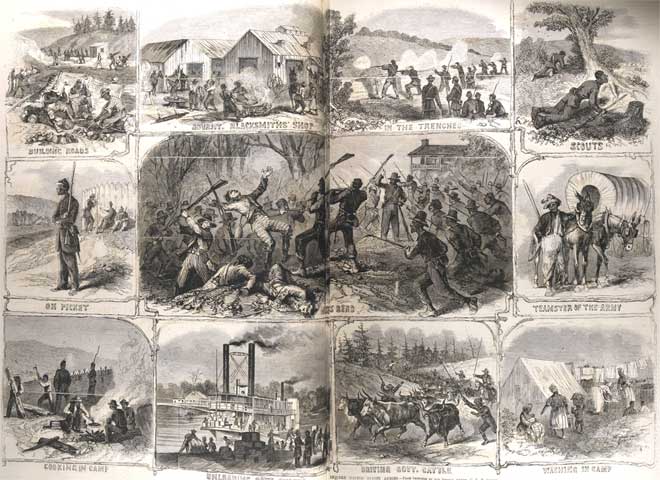
|
|
The Battle of Fort Wagner, July, 1863
After an initial assault on the Confederate battery at Charleston's Fort Wagner had failed on July 11, 1863, the 54th Massachusettts, an African-American regiment led by Robert Shaw, volunteered to lead a second attack on July 18th. Among the reserves was another black regiment, the 2nd Carolina. Union losses were heavy from the approach across an open beach, hand-to-hand fighting in the parapets of the fort, and "friendly fire" as members of the artillery firing from a distance were unable to distinguish the members of the attacking force. Like the first, the second assault was a failure. Once again, however, African-American troops were recognized in the North for having distinguished themselves by heroism in battle.
Harper's Weekly Describes the Attack |
Just as darkness began to close in upon the scene of the afternoon and the evening, General Strong rode to the front and ordered his brigade, consisting of the 54th Massachusetts, Colonel Shaw (colored regiment); the 6th Connecticut, Colonel Chatfield; the 48th New York, Colonel Barton; the 3d New Hampshire, Colonel Jackson; the 76th Pennsylvania, and the 9th Maine, Colonel Emery, to advance to the assault. At the instant the line was seen slowly advancing in the dusk toward the fort, and before a double-quick had been ordered, a tremendous fire from the barbette guns on Fort Sumter, from the batteries on Cummings’ Point, and from all the guns on Fort Wagner, opened upon it. The guns from Wagner swept the beach, and those from Sumter and Cummings’ Point enfiladed it on the left. In the midst of this terrible shower of shot and shell they pushed their way, reached the fort, portions of the 54th Massachusetts, the 6th Connecticut, and the 48th New York dashed through the ditches, gained the parapet, and engaged in a hand-to-hand fight with the enemy, and for nearly half an hour held their ground, and did not fall back until nearly every commissioned officer was shot down. As on the morning of the assault of the 11th inst., these brave men were exposed to a most galling fire of grape and canister, from howitzers, raking the ditches from the bastions of the fort, from hand-grenades and from almost every other modern implement of warfare. The rebels fought with the utmost desperation, and so did the larger portion of General Strong’s brigade, as long as there was an officer to command it. When the brigade made the assault General Strong gallantly rode at its head. When it fell back, broken, torn, and bleeding, Major Plimpton of the 3d New Hampshire was the highest commissioned officer to command it. General Strong, Colonel Shaw, Colonel Chatfield, Colonel Barton, Colonel Green, Colonel Jackson, all had fallen. The 54th Massachusetts (negro), whom Copperhead officers would have called cowardly if they had stormed and carried the gates of hell, went boldly into battle, for the second time, commanded by their brave Colonel, but came out of it led by no higher officer than the boy, Lieutenant Higginson. --from "The Attack on Fort Wagner," Harper's Weekly, August 8, 1863, 510 |
An African-American Freedmen's Teacher
Describes Shaw and the Soldiers Who Survived the Battle of Ft. Wagner |
Among the visitors present was the noble young Colonel Shaw, whose regiment was then stationed on the island. We had met him a few nights before, when he came to our house to witness one of the people’s shouts. We looked upon him with the deepest interest. There was something in his face finer, more exquisite, than one often sees in a man’s face, yet it was full of courage and decision. The rare and singular charm of his manner drew all hearts to him. He was deeply interested in the singing and appearance of the people. A few days afterwards we saw his regiment on dress-parade, and admired its remarkably fine and manly appearance. After taking supper with the Colonel we sat outside the tent, while some of his men entertained us with excellent singing. Every moment we became more and more charmed with him. How full of life and hope and lofty aspirations he was that night! how eagerly he expressed his wish that they might soon be ordered to Charleston! “I do hope they will give us a chance,” he said. It was the desire of his soul that his men should do themselves honor, — that they should prove themselves to an unbelieving world as brave soldiers as though their skins were white. And for himself, he was like the Chevalier of old, “without reproach or fear.” After we had mounted our horses and rode away, we seemed still to feel the kind clasp of his hand, — to hear the pleasant, genial tones of his voice, as he bade us good- bye, and hoped that we might meet again. We never saw him afterward. In two short weeks came the terrible massacre at Fort Wagner, and the beautiful head of the young hero and martyr was laid low in the dust. Never shall we forget the heart-sickness with which we heard of his death. We could not realize it at first, — we, who had seen him so lately in all the strength and glory of his young manhood. For days we clung to a vain hope; then it fell away from us, and we knew that he was gone. We knew that he died gloriously, but still it seemed very hard. Our hearts bled for the mother whom he so loved, — for the young wife, left desolate. And then we said, as we say now, —“ God comfort them! He only can.” During a few of the sad days which followed the attack on Fort Wagner, I was in one of the hospitals of Beaufort, occupied with the wounded soldiers of the Fifty- Fourth Massachusetts. The first morning was spent in mending the bullet-holes and rents in their clothing. What a story they told! Some of the jackets of the poor fellows were literally cut in pieces. It was pleasant to see the brave, cheerful spirit among them. Some of them were severely wounded, but they uttered no complaint; and in the letters which they dictated to their absent friends there was no word of regret, but the same cheerful tone throughout. They expressed an eager desire to get well, that they might “go at it again.” Their attachment to their young colonel was beautiful to see. They felt his death deeply. One and all united in the warmest and most enthusiastic praise of him. He was, indeed, exactly the person to inspire the most loyal devotion in the hearts of his men. And with everything to live for, he had given up his life for .them. Heaven’s best gifts had been showered upon him, but for them he had laid them all down. I think they truly appreciated the greatness of the sacrifice. May they ever prove worthy of such a leader! Already, they, and the regiments of freedmen here, as well, have shown that true manhood has no limitations of color. --Charlotte Forten, "Life on the Sea Islands" Atlantic Monthly, May and June, 1864 |
The Battle of Fort Pillow, April 12, 1864
On April 12, 1864, approximately 1,500 Confederate troops successfully attacked Fort Pillow. Garisoning the fort were approximately, about 550 Union soldiers, including 262 members of the 2nd U.S. Colored Light Artillery and the 6th U.S. Colored Heavy Artillery. The episode became known as "The Massacre of Fort Pillow " after reports circulated that Union soldiers had been burned or buried alive after surrendering. Although contemporary accounts described atrocities against both black and white soldiers, it seems likely that race was a factor in the treatment of Union soldiers. At the end of the day, only about 60 of the African-American soldiers survived. While they had originally made up more than half of the men defending the fort, they comprised only about one-fifth of the soldiers kept as prisoners. "Remember Fort Pillow" subsequently became a rallying cry for African-American soldiers. (For one example, see the statement of General Butler below on this page.)
| Fort Pillow in the Northern Press |
We give on page 284 a sketch of the horrible Massacre at Fort Pillow. The annals of savage warfare nowhere record a more inhuman, fiendish butchery than this, perpetrated by the representatives of the “superior civilization” of the States in rebellion. It can not be wondered at that our officers and soldiers in the West are determined to avenge, at all opportunities, the cold-blooded murder of their comrades; and yet we can but contemplate with pain the savage practices which rebel inhumanity thus forces upon the service. The account of the massacre as telegraphed from Cairo is as follows: On the 12th inst. the rebel General Forrest appeared before Fort Pillow, near Columbus, Kentucky, attacking it with considerable vehemence. This was followed up by frequent demands for its surrender, which were refused by Major Booth, who commanded the fort. The fight was then continued up until 3 P.M., when Major Booth was killed, and the rebels, in large numbers, swarmed over the intrenchments. Up to that time comparatively few of our men had been killed; but immediately upon occupying the place the rebels commenced an indiscriminate butchery of the whites and blacks, including the wounded. Both white and black were bayoneted, shot, or sabred; even dead bodies were horribly mutilated, and children of seven and eight years, and several negro women killed in cold blood. Soldiers unable to speak from wounds were shot dead, and their bodies rolled down the banks into the river. The dead and wounded negroes were piled in heaps and burned, and several citizens, who had joined our forces for protection, were killed or wounded. Out of the garrison of six hundred only two hundred remained alive. Three hundred of those massacred were negroes; five were buried alive. Six guns were captured by the rebels, and carried off, including two 10-pound Parrotts, and two 12- pound howitzers. A large amount of stores was destroyed or carried away. --"The Attack on Fort Pillow," Harper's Weekly, April 30, 1864, 283 The lst sergeant of Company D, Melville Jenks, was shot while bearing a flag of truce to the Rebels, in token of his and his squad of men's surrender. He had got nearly up to them before they fired on him, then they murdered the squad of men that had thrown down their arms. The whole number killed will exceed 250; all but about 75 or 100 were murdered in cold blood after they were overpowered. They never surrendered, as has been published , but were taken by storm, fighting until completely crowded out of the little fort by the Rebels coming in --Excerpt from "The Fort Pillow Massacre," The New York Herald Tribune, May 2, 1864 |
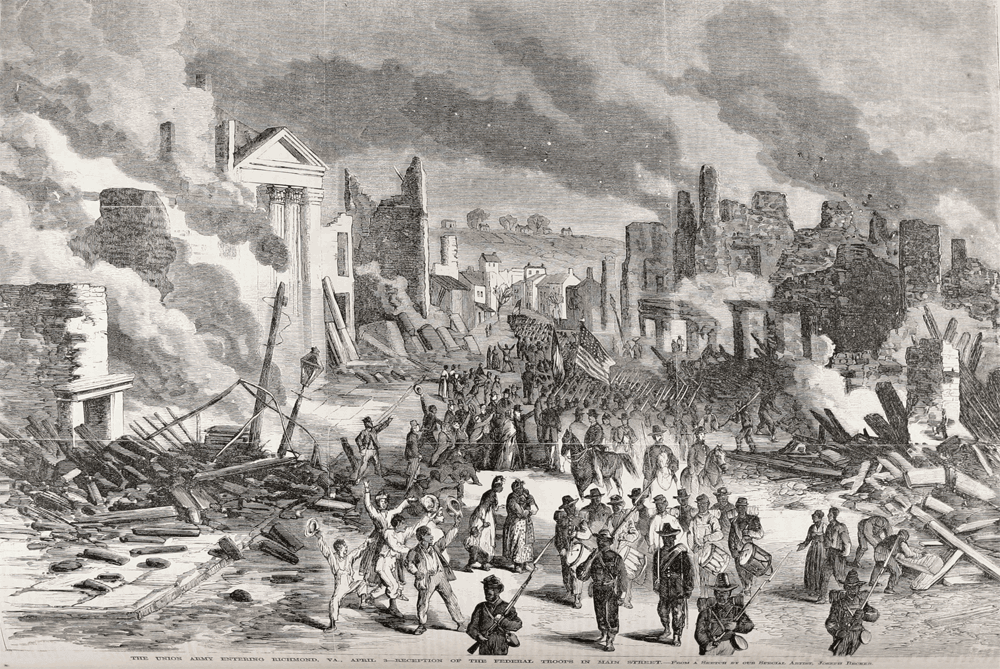 |
|
SYMPATHETIC DEPICTIONS OF AFRICAN-AMERICAN SOLDIERS
WITH NEGATIVE DEPICTIONS OF CONFEDERATES
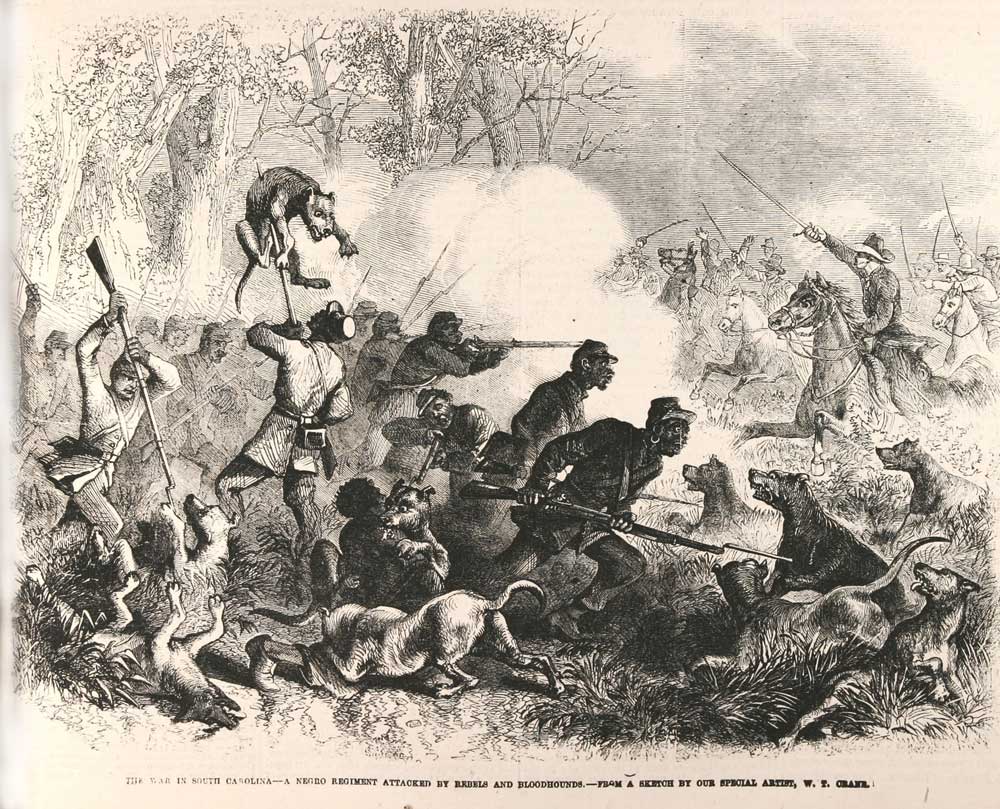 |
|
A Description of the Assault of a "Dog-Company" on African-American Troops
|
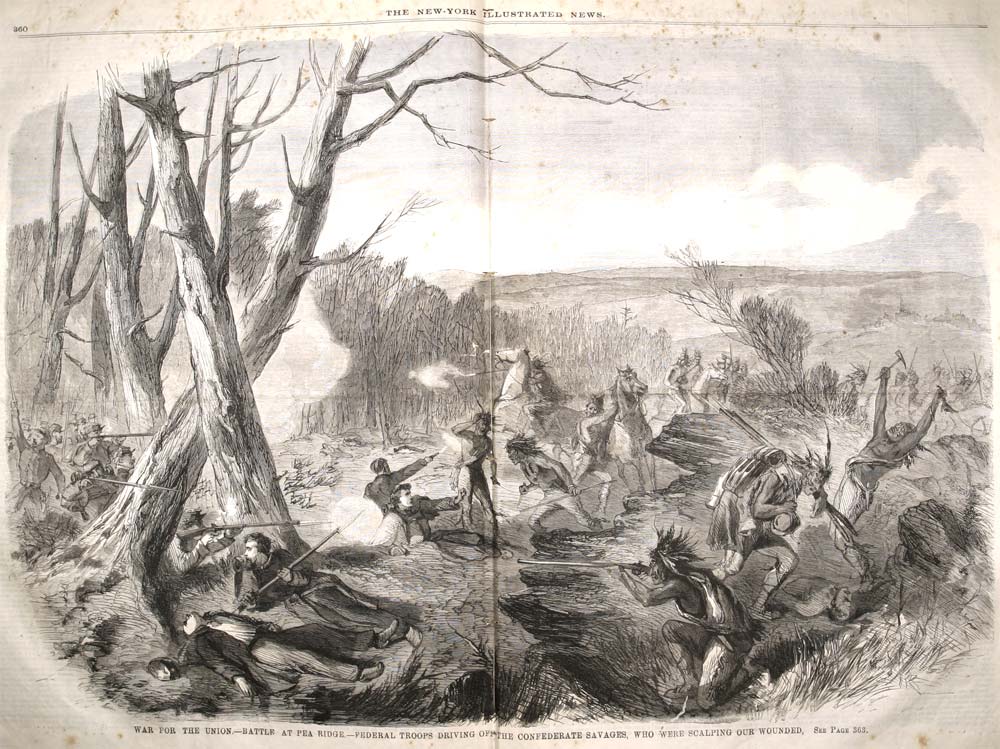 |
|
Racism in the Representation of and Response to African-American Soldiers
Racial, ethnic, and gender stereotypes were a standard part of 19th century american humor, and even Northern newspapers that glorified the heroic achievements of African-American soldiers often published racist jokes or stereotyped depictions of black soldiers. The illustration below of "Camp Life in the West" appeals to prejudices against African-Americans, Native-Americans, and Irish-Americans. The layout of the picture seems to suggest that the dances of the African-American and Irish-American, while comic, share something of the savagery Americans probably associated with the dances of Native-Americans.
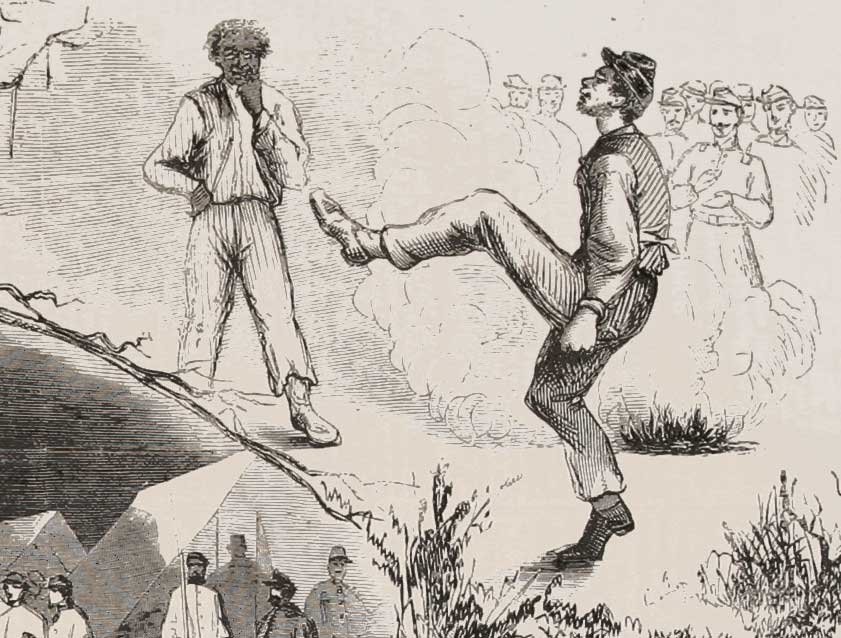
|
Two
Contrasting Representations of African-Americans |
ODD BITS OF WIT AND STRAY WAIFS
OF HUMOR
HE WAS O.K.--A contraband was lately sworn in as cook by a corporal of the 1st Iowa Cavalry. Among other things he swore to do was the following: “You do solemnly swear that when this war is over you’ll make tracks for Africa almighty fast.” “Yes, massa, I do dat; I always wanted to go to Cheercargo.” --The New-York Illustrated News, Nov. 15, 1862, 23SYNOPSIS OF WAR MATTERS FOR THE WEEK Negro soldiers, under Gen. Saxton, have been tsted under fire in Georgia, and found to be good soldiers. --The New-York Illustrated News, Nov. 29, 1862,
51 |
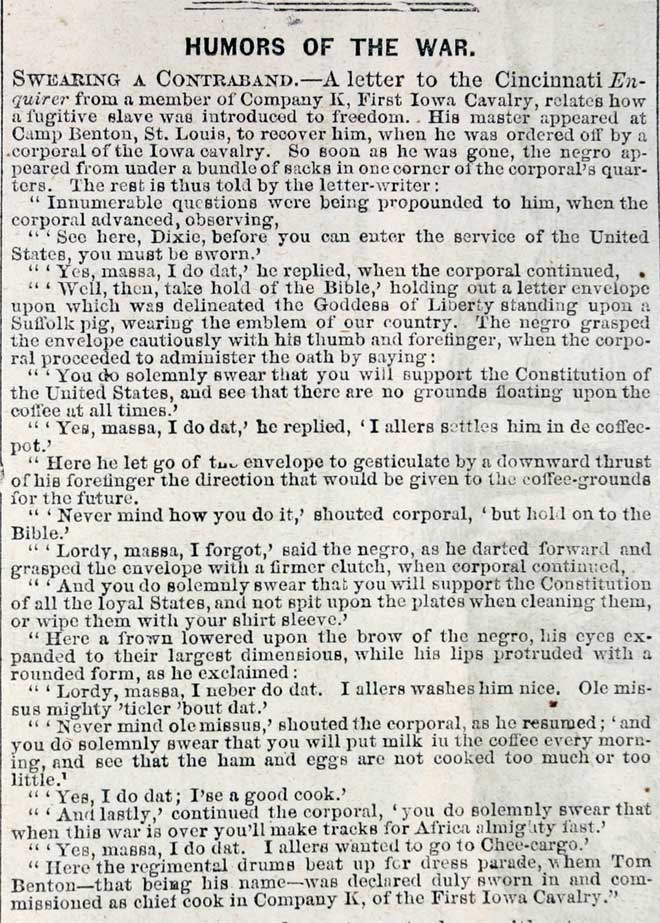
Conflicting Messages: A Heroic "Sambo" |
“Fun for the Family” The siege of Nashville was the occasion of some laughable incidents, as the following paragraph from a correspondence written in that city shows: During the skirmish in the little reconnaissance made by Gen. Steedman on our left, a couple of soldiers of the colored brigade came upon three rebels, whose guns were unloaded, and demanded their surrender. One of the Johnnies indignantly refused to surrender to a “d—d nigger.” “Berry sorry, massa,” said Sambo, bringing his piece to a “ready;” “but we’s in a great hurrty, and hain’t got no time to send for a white man!" The ominous click that accompanied this remark brought the scion of chivalry to time, and he was brought in, crying and swearing all the way that his father would kill him if he ever heard that he had surrendered to a nigger. --Frank Leslies Illustrated Newspaper, Feb 25, 1865, 359 |
African-American Soldiers Described by Their White Officers
General
Benjamin Butler Uses First-Hand Description of the Bravery |
|||||
|
|||||
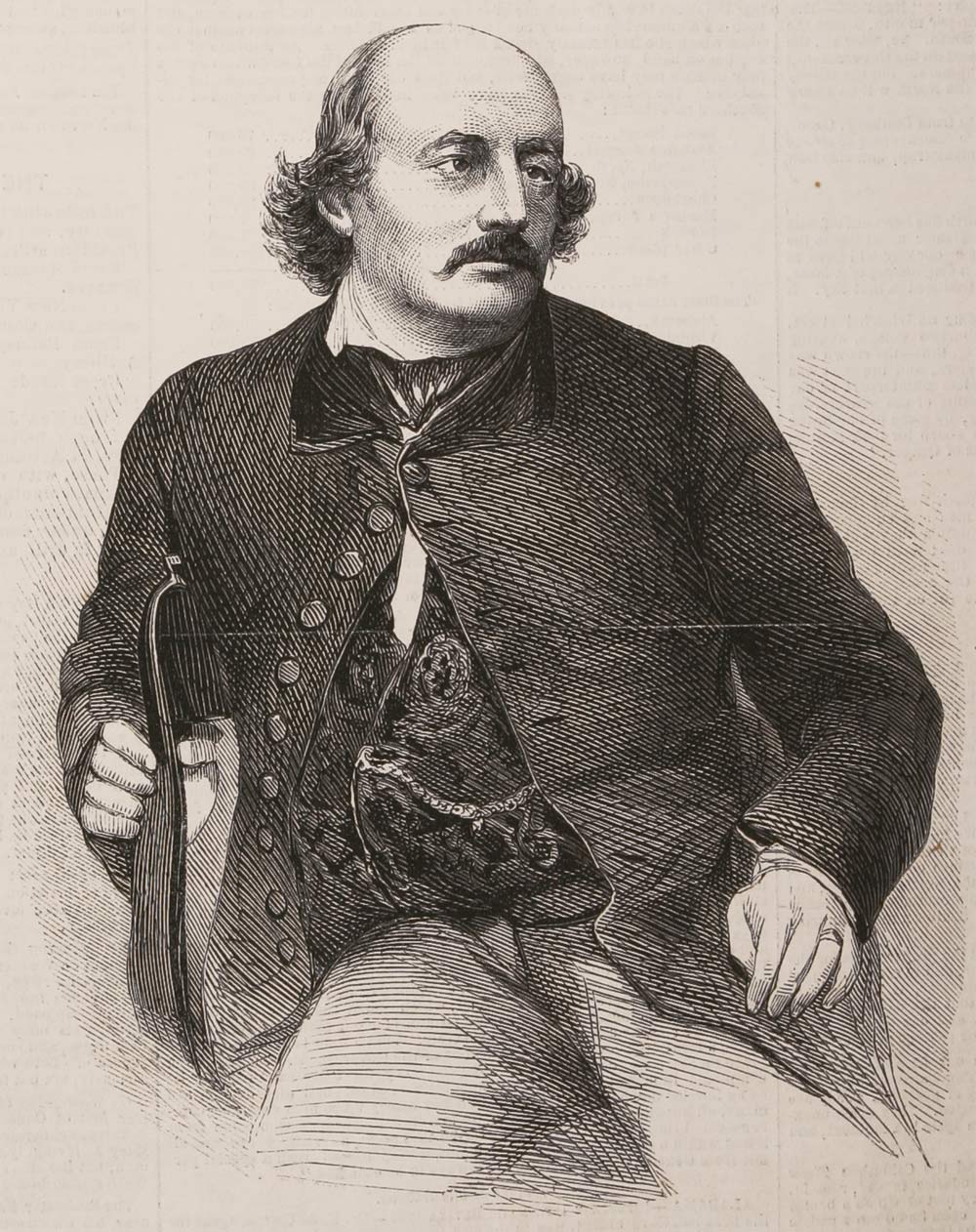
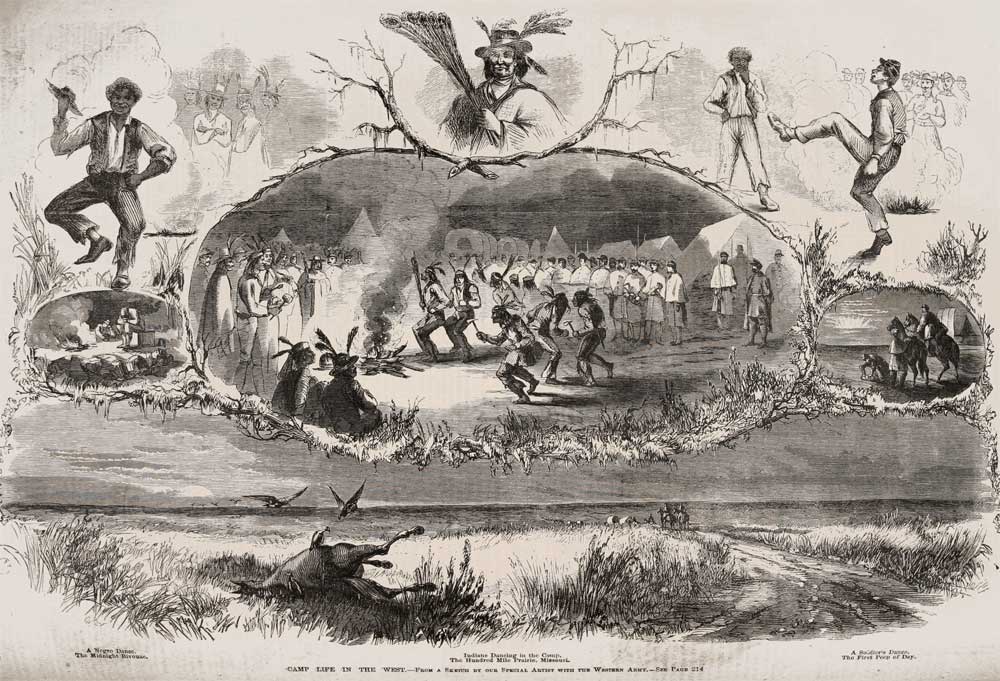
Comments of Other Officers |
|---|
Nobody knows any thing about these men who has not seen them in battle. I find that I myself knew nothing. There is a fiery energy about them beyond any thing of which I have ever read, unless it be the French Zouaves. It requires the strictest discipline to hold them in hand. During our first attack on the river, before I got them all penned below, they crowded at the open ends of the steamer, loading and firing with inconceivable rapidity, and shouting to each other, "Never give it up!" --Brigadier-General Saxton quoted in "Negroes as Soldiers," Harper's Weekly, March 14, 1863, 174 Perhaps the best proof of a good average of courage among them was in the readiness they always showed for any special enterprise. I do not remember ever to have had the slightest difficulty in obtaining volunteers, but rather in keeping down the number. The previous pages include many illustrations of this, as well as of then: endurance of pain and discomfort. For instance, one of my lieutenants, a very daring Irishman, who had served for eight years as a sergeant of regular artillery in Texas, Utah, and South Carolina, said he had never been engaged in anything so risky as our raid up the St. Mary's. But in truth it seems to me a mere absurdity to deliberately argue the question of courage, as applied to men among whom I waked and slept, day and night, for so many months together. As well might he who has been wandering for years upon the desert, with a Bedouin escort, discuss the courage of the men whose tents have been his shelter and whose spears his guard. We, their officers, did not go there to teach lessons, but to receive them. There were more than a hundred men in the ranks who had voluntarily met more dangers in their escape from slavery than any of my young captains had incurred in all their lives. --from Thomas Wentworth Higginson, "The Negro as a Soldier," Army Life in a Black Regiment, 1869 They had more to fight for than the whites. Besides the flag and the Union, they had home and wife and child. They fought with ropes round their necks, and when orders were issued that the officers of colored troops should be put to death on capture, they took a grim satisfaction. It helped their esprit de corps immensely. With us, at least, there was to be no play-soldier. Though they had begun with a slight feeling of inferiority to the white troops, this compliment substituted a peculiar sense of self-respect. And even when the new colored regiments began to arrive from the North my men still pointed out this difference,--that in case of ultimate defeat, the Northern troops, black or white, would go home, while the First South Carolina must fight it out or be re-enslaved. --from Thomas Wentworth Higginson, "The Negro as a Soldier," Army Life in a Black Regiment, 1869 |
African-American Soldiers Described by Freedmen's Teachers
Soldiers as Students |
Far out, on a sandy point, stretching into the ocean, stands Cape Henry lighthouse. Opposite it lies the dark point of Cape Charles, whose lighthouse was destroyed, not long ago, by the rebels. A plan to destroy Cape Henry lighthouse, and to murder its guard, was recently detected, so increased vigilance is maintained there night and day. A colored company is stationed there—isolated, solitary, and inactive. It is officered by noble men who are ambitious for the welfare and reputation of their company. One of them appealed to my sister and myself, some time ago, for books, and we determined to visit them so that we might learn their actual wants. On the very day of our arrival, their captain received some primmers [sic], from a tract society, and he declared to us his intention to put one into each man’s hands. We gathered the men and found their zeal needed no quickening. They were very apt, and those who knew no letters, learned a number of words, in the one lesson we gave them. To one of the men, my sister said, “Are you free now to run and do just as you please?” “Oh no,” he said, “I’m free to hold myself, to learne [sic], to show my best behavior to everybody, to serve my country, and to 1e always a gentleman but I ‘m not free to do anything else. I want to do all I can to show the white people our race is of some account.” Books and teachers find the colored man, even if his home is the wilderness, and I know they will brighten the days of the soldiers on Cape Henry, like blooming flowers in its sandy waste. -- Lucy Chase, July 1, 1864A regiment of colored soldiers have recently encamped a short distance from us; they attend our evening school, and evince a great desire to learn; they are new recruits, and were slaves previous to Sherman's march through Georgia, and capture of Atlanta and Savannah. They are a fine-looking set of men, much superior in intellect to the South Carolina negro. When evening comes they crowd around our house anxiously waiting for the school to open, and when the lamps are lighted they hasten in, eager to commence their reading. We have had sixty or seventy soldiers present beside our usual number. About half of them can read a little, just know their letters, and are commencing easy words. For two evenings past the soldiers have been prevented from coming to our evening school by order of their officers; as, under pretence of coming to school, many have only left camp to commit depredations on the poultry yards, &c. in the village. Some of the friends of the colored who have assisted us in teaching here gained permission of their officers to allow them to come out on Monday eve under the care of a guard. I think no further trouble need be anticipated. It is unfortunate for those who wish to learn to be deprived of the privilege of so doing for the misbehavior of a few. --"Extracts from Teachers' Letters," The Freedmen's Record, March, 1865 The chaplain at the L'Ouverture has opened a school for the soldiers. It is well attended. They need a building for this purpose. Could you see the young men with one arm and leg, with their book and slate, crowded into a small room, I know you would suggest something better for these brave boys. Yours truly, H. Jacobs. --Harriet Jacobs, "Jacobs School," The Freedmen's Record, March, 1865 |
African-Americans in the Civil War: A Timeline
Nov. 6, 1860 |
Lincoln is elected president. |
| Dec. 10, 1860 | South Carolina is first state to secede. |
| Feb. 9, 1861 | Confederate States unite under Jefferson Davis. |
| March 2, 1861 | Congress adopts and sends to the states a "Joint Resolution to amend the Constitution of the United States" as a signal that the federal government has no intention of eliminiating slavery. The resolution states: "No amendment shall be made to
the Constitution which will authorize or give to Congress the
power to abolish or interfere, within any State, with the domestic
institutions thereof, including that of persons held to labor
or service by the laws of said State." |
| March 4, 1861 | Lincoln is sworn in as president. In his first innaugural, Lincoln states: ""I have no purpose, directly or indirectly, to interfere with the institution of slavery in the States where it exists. I believe I have no lawful right to do so, and I have no inclination to do so." |
| April 12, 1861 | Fort Sumter is attacked. |
| June 8, 1861 | General Butler declares slaves who come within Union lines at Fortress Monroe "contrabands of war." |
| July 21, 1861 | Battle of Bull Run |
| July 22, 1861 | Congress issues a "Joint Resolution on the War" declaring that the war is being fought to preserve the union rather than to destroy slavery. "Resolved: . . . That this war is not being prosecuted upon our part in any spirit of oppression, nor for any purpose of conquest or subjugation, nor purpose of overthrowing or interfering with the rights or established institutions of those states, but to defend and maintain the supremacy of the Constitution and all laws made in pursuance thereof and to preserve the Union, with all the dignity, equality and rights of the several states unimpaired; and that as soon as these objects are accomplished the war ought to cease." |
Aug. 6, 1861 |
Congress passes the "Confiscation Acts" absolving slaves who had fought or worked for confederate army of further obligations to their masters and authorizing union forces to seize rebel property |
| Aug. 30, 1861 | General Freemont extends freedom to all slaves owned by Confederates in Missouri, with a proclamation that states:
Lincoln later overturns this decision and removes Freemont from command. |
Dec.1, |
Secretary of the Treasury, Simon Cameron isues a revised version of his annual report after Lincoln requires the deletion of passages calling for emancipation and arming of the slaves. The original version stated: "If it shall be found that the men who have been held by the rebels as slaves are capable of bearing arms and performing efficient military service, it is the right, and may become the duty, of this Government to arm and equip them, and employ their services against the rebels, under proper military regulations, discipline, and command." |
| March,13, 1862 | Congress adopts an additional act of war, declaring: "All officers or persons in the military or naval service of the United States are prohibited from employing any of the forces under their respective commands for the purpose of returning fugitives from service or labor, who may have escaped from any persons to whom such service or labor is claimed to be due, and any officer who shall be found guilty by a court-martial of violating this article shall be dismissed from the service." |
| March 6, 1862 | Lincoln sends A Message to Congress Requesting a Joint Resolution on Compensated Emancipation. |
| April, 1862 |
On April 10 Congress passes a joint resolution declaring it will "cooperate" with "any State which may adopt gradual abolishment of slavery, giving to such State pecuniary aid, to be used by such State in its discretion, to compensate for the inconveniences, public and private, produced by such change of system. On April 16 "Lincoln signs the the "Compensated Emancipation Act,"guaranteeing $300 dollars for each slave liberated by loyal union masters in the District of Columbia to release their slaves. Slaves who agreed to emigrate outside the country arepaid up to $100 each. This is the only program of compensated emancipation put into practice in the U.S. |
| May 9, 1862 | General Hunter issues "General Order No. 11" declaring martial law in Florida, Georgia, and South Carolina and freeing slaves in those states. In the same month, Hunter begins recruiting African-American soldiers for his "1st South Carolina" regiment. |
| May 19, 1862 | Lincoln revokes Hunter's May 9 proclamation. |
| July 17, 1862 | Congress adopts the Second Confiscation Act. It includes a section stating: "That no slave escaping into any State, Territory, or the District of Columbia, from any other State, shall be delivered up, or in any way impeded or hindered of his liberty, except for crime, or some offence against the laws, unless the person claiming said fugitive shall first make oath that the person to whom the labor or service of such fugitive is alleged to be due is his lawful owner, and has not borne arms against the United States in the present rebellion, nor in any way given aid and comfort thereto . . . ." The same act establishes that slaves of traitors "shall be declared and made free." On the same day, Congress also passes the Militia Act of 1862, authorizing the president " to receive into the service of the United States, for the purpose of constructing intrenchments, or performing camp service, or any other labor, or any military or naval service for which they may be found competent, persons of African descent, and such persons shall be enrolled and organized under such regulations, not inconsistent with the Constitution and laws, as the President may prescribe." |
| July, 1862 |
General John W. Phelps begins equipping "three regiments of Africans" in Louisiana but resigns after meeting with objections from his superior, General Butler. |
Aug 21, 1862 |
General Order issued by the Confederate War Department stating: "That Major-General Hunter and Brigadier-General Phelps be no longer held and treated as public enemies of the Confederate States, but as outlaws; and that in the event of the capture of either of them, or that of any other commissioned officer employed in drilling, organizing or instructing slaves, with a view to their armed service in this war, he shall not be regarded as a prisoner of war, but held in close confinement for execution as a felon at such time and place as the President shall order." |
| August 22, 1862 | General Butler, needing reinforcements, authorizes the recruiting of black soldiers in New Orleans |
| August 22, 1862 | Horace Greeley publishes "A Prayer for Twenty Thousand" in the New York Tribune, taking Lincoln to task for his rejection of Hunter's emancipation attempts. |
| August 25, 1862 | Abraham Lincoln responds to Greeley with an open letter in the New York Times entitled, "Emancipation or Preservation of the Union?" He asserts: "My paramount object in this struggle is to save the Union, and is not either to save or to destroy slavery." |
| Sept. 23, 1862 | The Emancipation Proclamation is published. |
| September 27, 1862 | The 1st Regiment, Louisiana Native Guards, becomes the first black regiment to be officially mustered into the Union Army. |
| Jan. 1, 1863 | The Emancipation Proclamation takes effect. |
| March 3, 1863 | Lincoln signs the Conscription Act of 1863 instituting a draft for males between the ages of twenty and forty-five. |
| March 21, 1863 | Frederick Douglass writes "Men of Color, To Arms!" urging African-Americans to enlist. |
| May 22, 1863 | General Order 143 creates the Bureau of Colored Troops is created to recruit and organize black regiments. |
| May 27, 1863 | Black troops participate in the successful attack on Port Hudson, opening the Mississippi to Union shipping from the source of the river all the way to New Orleans. Included in the fighting were the First and Third Louisiana Native Guards; The First Louisiana Engineers, Corps d'Afrique; and, the Sixth, Seventh, Eighth, Ninth and Tenth Infantry, Corps d'Afrique. |
| June 7, 1863 | African-American soldiers fight in the Battle of Milliken’s Bend.. A fort garrisoned by only three black regiments successfully repells an attack which includes intense hand-to-hand fighting with bayonets and clubs. Charles Dana, assistant secretary of war, comments: "The bravery of the blacks completely revolutionized the sentiment of the army with regard to the employment of negro troops." |
| July 13, 1863 | The New York Draft Riots begin. |
| July 18, 1863 | 54th Massachusetts Colored Infantry leads the attack on Fort Wagner, South Carolina and loses two-thirds of their officers and half their troops. |
| Apr. 12, 1864 | Confederate General Nathan Forrest captures Fort Pillow, which contains 262 African American and 295 white soldiers. Only 62 of the black soldiers survive, and an inquiry after the war concludes that "the Confederates were guilty of atrocities which included murdering most of the garrison after it surrendered, burying Negro soldiers alive, and setting fire to tents containing Federal wounded." Forest goes on to become the first imperial wizard of the Ku Klux Clan. |
| April 18, 1864 | At Poison Spring, Arkansas, members of the 1st Kansas Colored Volunteers who are wounded or wish to surrender are shot by the Confederates. "Remember Poison Spring" became a rallying cry for black troops. |
| June 15, 1864 | Congress raises the pay of black soldiers to make it equal to that of whites. |
| March 3, 1865 | Congress passes " Resolution to encourage Enlistments and to promote the Efficiency of the military Forces of the United States" emancipating the wives and children of African-American soldiers. |
| March 13, 1865 | The Confederacy approves arming slaves as soldiers, as long as their masters approve. |
| April 2, 1865 | Richmond falls. After the departure of Confederate troops, much of the city destroyed by fires set by retreating soldiers and rioting and looting by remaining populace. |
| April 9, 1865 | Civil War ends. Over 186,000 African-Americans had served in the Union army; more than 38,000 had died. |

An American Antiquarian
Society Online Resource
Curated by Lucia Z. Knoles, Professor of English, Assumption College