| |
|

See detail here.
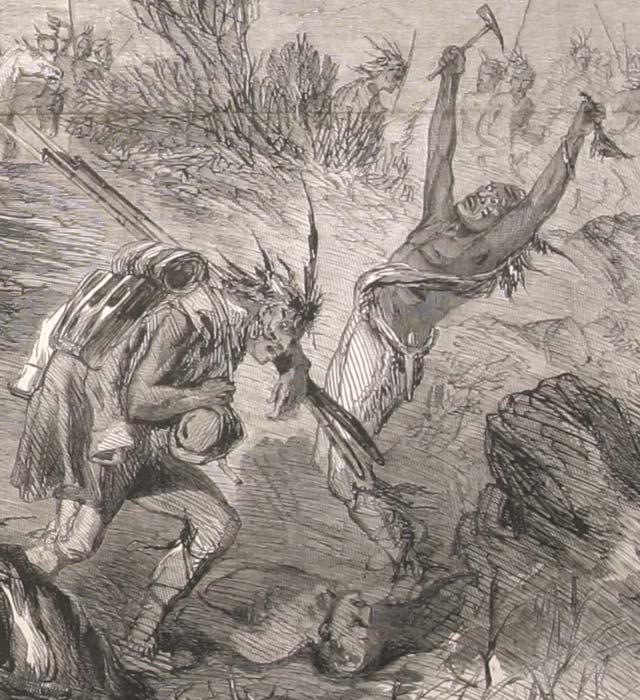
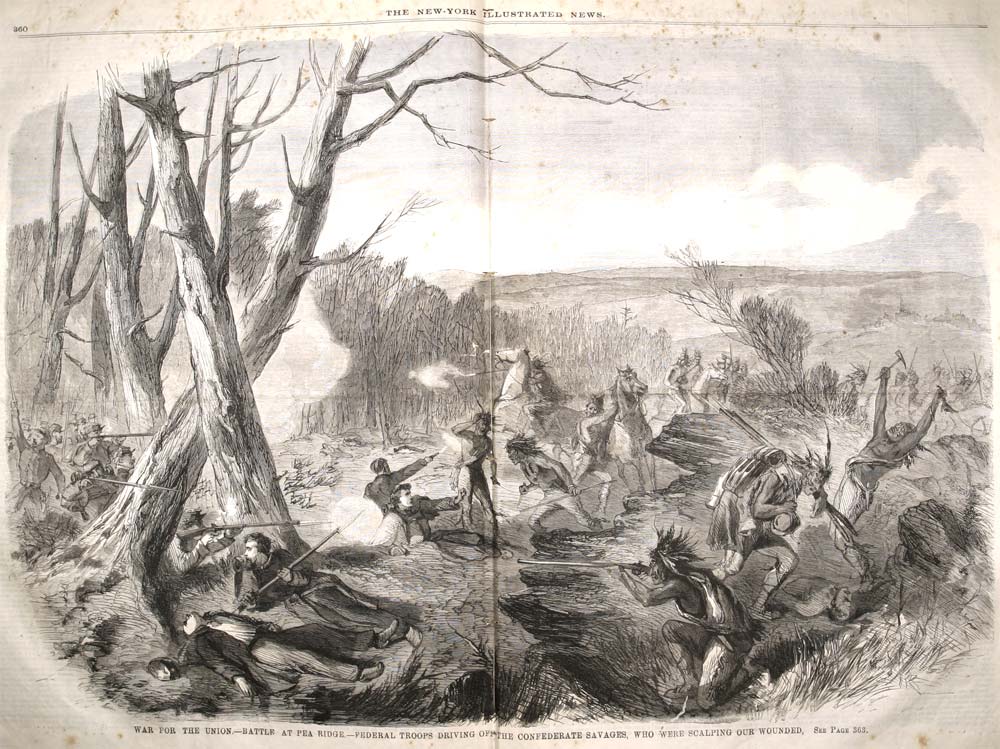
In presenting to our readers a picture representing one terrible scene of battle and bloodshed in the great victory achieved by the Union army under Gen. Curtis at Pea Ridge, we shall avail ourselves of the description given by the special correspondent of the New York World:INDIAN ATROCITIES
You will of course have heard of the fact that the rebels had some three thousand Indians under the command of Albert Pike. Also that some twenty of our men who fell in the engagement under Col. Osterhaus on Friday, and under Gen. Davis on Saturday, and had the misfortune to be left on the field, were foully and fiendishly scalped, murdered, and robbed by these red-skinned wretches. So far as the fighting was concerned the Indians were not to be taken into account. Notwithstanding the frantic excitement of Pike and others they could not be made to stand the fire of our men for more than a single round. Our artillery sent them howling back as quickly as they made their appearance in a body. It is related, and with some grounds, that these savages seized upon a quantity of whiskey belonging to the Confederates on Friday, and becoming furiously drunk began to fight amongst themselves. The Arkansans were called upon to quell the riot, when a promiscuous and bloody battle ensued among the Indians and Arksansans, in which several hundred must have been killed and wounded. The Indians who have thus been so wickedly pressed into the service of insurrection, became a scourge to their masters and a punishment to themselves.
NATURE OF THE CONTEST.
It only remains for me to notice the character of the struggle out of which we have just come with victory. Probably there never was such a motley assemblage of warriors colleted together under one head as met under this traitor Van Dorn. They represented the scum of the whole Southwest, from the filibusters of New Orleans to the rude savages of the Indian Nation. Texan Rangers, whose boast it has been that they would rather fight than eat, and whose life has been one long predatory warfare of plunder and cruelty. Uncouth and brutal Arkansans, who have grown up amid murders and homicides. Ignorant and infatuated Missourians, led on by designing and intriguing politicians. These were the men which formed the staple of the Southern army, and these are the men who prate of high-toned chivalry, who talk contemptuously of the Northern mudsills. Men who are crying like blind maniacs for "their rights." Take the whole rebel army as we saw it, and it was one vast congregation of the reckless, vicious, ignorant and embruted devils.
Opposed to them were the gallant sons of Iowa, descended mainly from the Puritan fathers. Immortal Iowa! what a page in the volume of American history is reserved for thee! Long, long will a nation remember how her champions of freedom, like their sires of the Revolution, ragged and barefooted, remained after the expiration of their term of service to lay their lives a sacrifice upon the altar of their country at Wilson's Creek: how they left their mark upon the foe at Belmont; how they scaled the heights of Donelson; and last, but not least, how they crushed, with the might of Spartans, the advancing hordes at Sugar Creek in the wilds of Arkansas. There, too, stood the patient, courageous sons of Germany, face to face with an insolent and unprincipled foe, contending for those principles of liberty and justice for which they have until now striven in vain. Honor to these men and their great leader for the part they sustained in this momentous day. Illinois, Indiana, and Ohio were represented there, and nobly will they bear the wreaths of triumph. For the first time the loyal Missourians have given an unequivocal and decided test of their ability to cope with the braggart traitors under the banner of Gen. Price. They have deserved well of their country.
The Indians under the command of Albert Pike, are not the only aborigines who take part in this sad war. We hear that Col. Coffin arrived at Leavenworth on the 14th inst. from the southern part of Kansas, in the immediate vicinity of the loyal Indians who have been driven from their homes by the rebellion. There are about eight thousand of these altogether; and they are being removed from the Verdigris t the Neosho. Their sufferings, on account of the insufficiency of foot and raiment, are represented as terrible; many of them having frozen their feet had to undergo amputation in consequence. The agents are doing all within their power to supply them with the necessaries of life; but nevertheless they must undergo much hardship from the cold. Sickness and death has prevailed among them extensively. The effort made to remove a portion of the Creeks to the Sac and Fox reservation was not successful, as they preferred not to be separated, but to remain with Opothleyoholo, their chief. These Indians have suffered much in behalf of government, but heir loyalty is not diminished thereby.
It is said that the Commander of the redskin rebels, Albert Pike, of Arkansas, hails from New England, though for many years he has been a Southern slaveowner and an earnest advocate of Southern interest and institutions. In his career, then, we find no exception to the rule; but he appears to have imbibed, with the change of place, a ferocity of nature and a disregard for all the qualities of mercy for which, heretofore, there has been no parallel. He has earned the reputation of a fair poet, an accomplished speaker, a good lawyer and an able political writer. To all this versatility of talent he has added now a genius for bloodthirsty and cowardly deeds from which human nature shrinks with horror. Of this now notorious person the New York Tribune says:
The Albert Pike who led the Aboriginal Corps of Tomahawkers and Scalpers at the Battle of Pea Ridge, formerly kept school in Fairhaven, Mass, where he was indicted for playing the part of Squeers, and cruelly beating and starving a boy in his family. He escaped by some hocus-pocus of law, and emigrated to the West, where the violence of his nature has been admirably enhanced. As his name indicates, he is a ferocious fish, and has fought duels enough to qualify himself to be a leader of savages. We suppose that upon the recent occasion he got himself up in good style, war paint, nose ring, and all. This new Pontiac is also a poet, and wrote "Hymns to the Gods" in Blackwood; but he has left Jupiter, Juno, and the rest, and betaken himself to the culture of the Great Spirit, or rather of two Great Spirits--whisky being the second. So much for Pike!

An American Antiquarian Society Online Exhibition
Curated by Lucia Z. Knoles, Professor of English, Assumption College