Browse Items (116 total)
Sort by:
Poor Richard, 1739. An Almanack for the Year of Christ 1739.

Throughout the colonial period, almanacs were the best-selling product of the American press. The almanac was one of the first imprints of the Cambridge Press—the first press in British North America—in the 1640s; by the 1760s tens of…
Regimental Album of the 24th Massachusetts
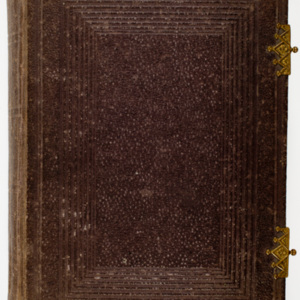
Although tintypes and ambrotypes were both used to capture images of soldiers, by far the most popular form soldier portraits took were cartes-de-visites. Unlike the former two processes, whose glass and metal foundations made them delicate, bulky,…
Rivington's New-York Gazetteer; or The Connecticut, New-Jersey, Hudson's-River, and Quebec Weekly Advertiser
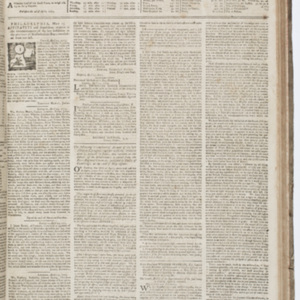
James Rivington (1724-1802), publisher of Rivington’s New-York Gazetteer, was born in London and was a bookseller in his native land before immigrating to the colonies in 1760. He eventually established a bookstore in New York and then ventured into…
Soldier's Letter
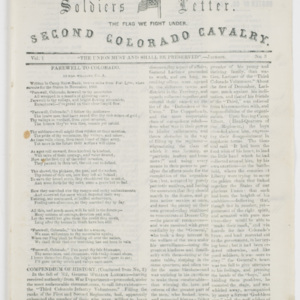
The Soldier’s Letter was a military camp newspaper published in Kansas City, Missouri, and Fort Riley, Kansas.It was issued by the Second Colorado Cavalry and edited by Private Oliver F. Wallace with contributions by other enlisted men and a few…
The Akron Buzzard

The Akron Buzzard from Akron, Ohio, targeted several different but related audiences, devoting itself to “Temperance, Morality, Mechanic Arts, Satire, News of the Day, and Amusement.” The rise of precision metal manufacturing and the…
The American Anti-Slavery Almanac, for 1837
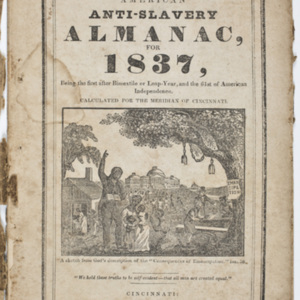
As with many other reform movements of the day, abolitionists used all available forms of mass communication to disseminate their message, including almanacs. Antebellum reform organizations published almanacs that included—among their charts…
The American Weekly Mercury

The first newspaper to appear in America outside Boston was the American Weekly Mercury, launched by Andrew Bradford (1686-1742) in Philadelphia in 1719. His father, William Bradford (1663-1752), had opened the first print shop in the new city of…
The Anti-Slavery Alphabet
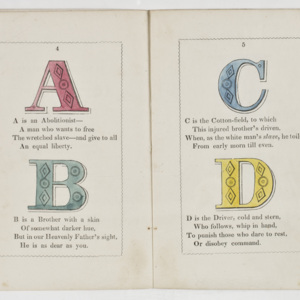
The Anti-Slavery Alphabet is a reader that was published in 1846 for the purpose of being sold at the Anti-Slavery Fair in Philadelphia. The fair was organized by the Philadelphia Female Anti-Slavery Society (PFASS) and raised money for abolitionism…
The Bloody Massacre perpetrated in King - Street Boston on March 5th 1770 by a party of the 29th Regt.
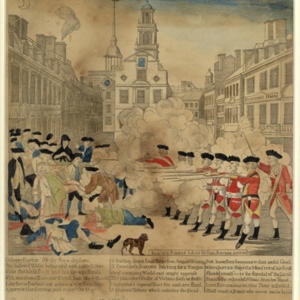
Paul Revere (1734-1818) was a silversmith and engraver born and raised in Boston. Though The Bloody Massacre, often referred to as “The Boston Massacre,” was not Paul Revere’s first foray into using engraving as commentary on news events and…
The Boston News-Letter

The Boston News-Letter was the first newspaper in America to survive beyond its first issue. Indeed, it survived for seventy-two years as a fixture of the Boston publishing scene. The founding editor and publisher was John Campbell (1653-1728), who…