Browse Items (116 total)
Sort by:
Boston Daily Journal
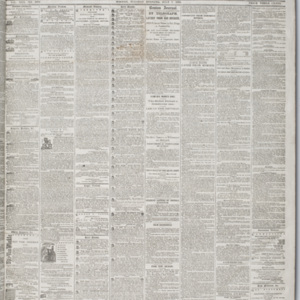
One of the few battlefield reporters to cover the Civil War from beginning to end—from Bull Run to the fall of Richmond—was C.C. Coffin (1823-96) of the Boston Journal. After the Battle of Gettysburg, when the outcome was assured by late…
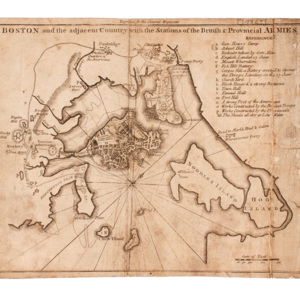
Bloody Butchery, by the British Troops: or, The Runaway Fight of the Regulars.
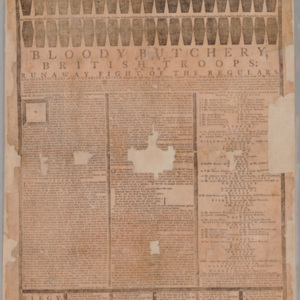
The American account of the events at Lexington and Concord is recounted in this dramatic broadside. Note the heavy black borders and the coffins that adorn the top of the broadside. Both the graphics and the inflammatory prose are designed to incite…
Bird's Eye View of the Seat of War
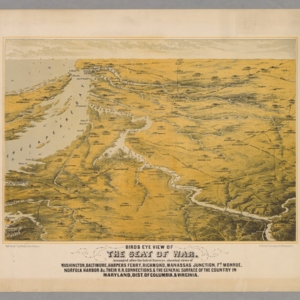
Among the visual ways in which people tried to make sense of the Civil War were maps. Maps helped people visualize the places where their loved ones were fighting, places most of them had never seen. Though few newspapers outside of the illustrated…
Battle of Antietam
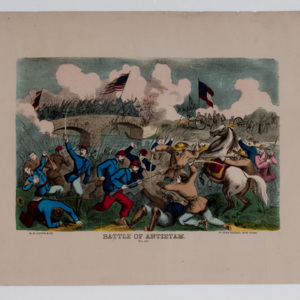
Though lithography gained in popularity in the years leading up to and during the Civil War, relief printing was still a commonly used process for illustration. This hand-colored wood engraving of the Battle of Antietam, which took place on September…
Attack On the Post Office, Charleston, S.C.
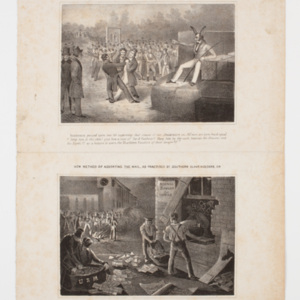
As veterans of the Bible and religious tract movements, the founders of the American Anti-Slavery Society (AASS) believed in the power of the printed word to convert sinners, including those whose sin was slaveholding. Immediately after its founding…
Anthony Burns
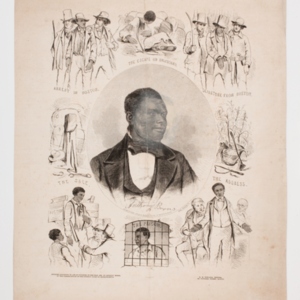
This large broadside, printed by R. M. Edwards of Boston in 1855, features woodcuts portraying scenes from the life of Anthony Burns (1834-62), a former fugitive and then freed slave whose story sparked fierce abolitionist reaction throughout…
An Amalgamation Polka
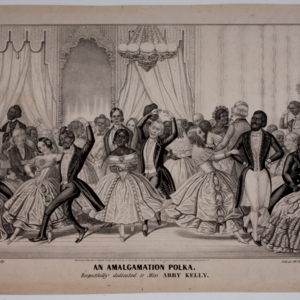
Mid-nineteenth-century visuals of African Americans were largely characterized by satire, an overexaggeration of features, and stereotypes. This lithograph is one of several in an entire Amalgamation Series created by Edward Williams Clay…
Ambrotype of unidentified soldier in Union uniform
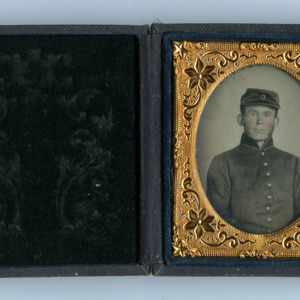
Among the photographic processes available to a widening public and used by Civil War soldiers were ambrotypes. Ambrotypes became popular in the mid-1850s, due in large part to their shorter exposure times (as compared to daguerreotypes), which also…
Advertisements for stereographs

The stereograph sensation is evident in these advertisements on the last page of the April 29, 1865, issue of Frank Leslie’s Illustrated Newspaper. With the war now over, stereograph publishers began to focus on the medium’s use as…