Browse Items (116 total)
Sort by:
Civil War Stereographs
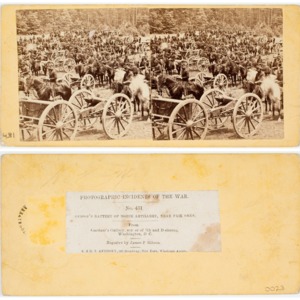
Stereography, an early form of three-dimensional photography, was a major vehicle for popular education and entertainment in the latter part of the nineteenth century. Otherwise known as the stereogram, stereopticon, or stereo view, the stereograph…
"Look Upon This Picture and On This." Intemperance & Temperance.
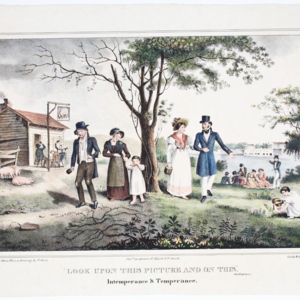
Just as the temperance movement harnessed the power of the printed word in newspapers, periodicals, tracts, and almanacs to spread statistics and facts about the effects of alcohol, it also utilized printed images. Temperance images were pervasive…
War Telegram Marking Map
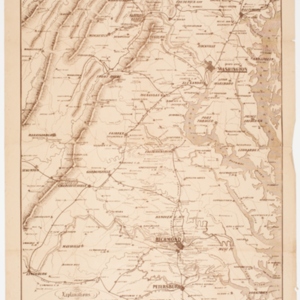
Maps were one tool people used to make sense of the war and visualize the places where their loved ones were fighting, places most of them had never seen. Though few newspapers outside of the illustrated press carried graphics at this time, many…
Anthony Burns
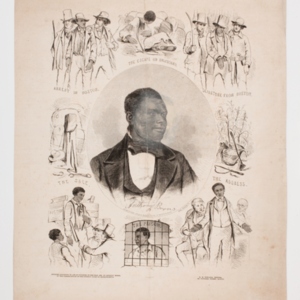
This large broadside, printed by R. M. Edwards of Boston in 1855, features woodcuts portraying scenes from the life of Anthony Burns (1834-62), a former fugitive and then freed slave whose story sparked fierce abolitionist reaction throughout…
Ambrotype of unidentified soldier in Union uniform
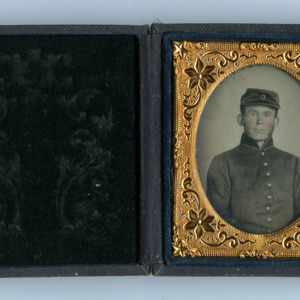
Among the photographic processes available to a widening public and used by Civil War soldiers were ambrotypes. Ambrotypes became popular in the mid-1850s, due in large part to their shorter exposure times (as compared to daguerreotypes), which also…
My Days and Nights On the Battle-Field
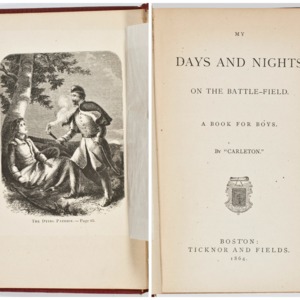
A new sense of professional identity as journalists and writers emerged within the brotherhood of battlefield reporters during the American Civil War. More than a few newspaper correspondents imagined and then achieved careers in literature. One of…
Lecture On the War: C. C. Coffin, Esq. Known as "Carleton" of the Boston Journal

Charles Carleton Coffin (1823-96) was one of a dozen or so battlefield correspondents whose work during the Civil War made them into something new in American journalism: celebrity reporters. Writing under the penname “Carleton” for the…
"An extensively read News paper"

In the 1840s and 1850s, thanks to steam-powered and rotary presses, newspaper dimensions were often enormous. The size of the printing presses, their ability to print evenly over a large surface area, and the speed with which they could print…
Bird's Eye View of the Seat of War
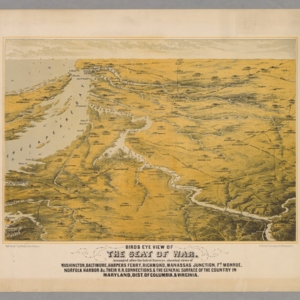
Among the visual ways in which people tried to make sense of the Civil War were maps. Maps helped people visualize the places where their loved ones were fighting, places most of them had never seen. Though few newspapers outside of the illustrated…
Regimental Album of the 24th Massachusetts
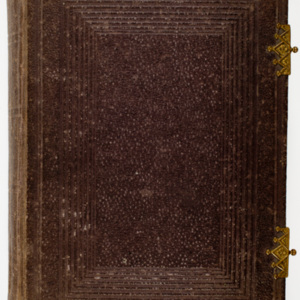
Although tintypes and ambrotypes were both used to capture images of soldiers, by far the most popular form soldier portraits took were cartes-de-visites. Unlike the former two processes, whose glass and metal foundations made them delicate, bulky,…