Browse Items (116 total)
Sort by:
The American Anti-Slavery Almanac, for 1837
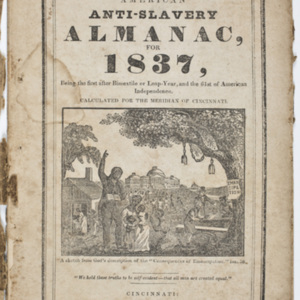
As with many other reform movements of the day, abolitionists used all available forms of mass communication to disseminate their message, including almanacs. Antebellum reform organizations published almanacs that included—among their charts…
The Akron Buzzard

The Akron Buzzard from Akron, Ohio, targeted several different but related audiences, devoting itself to “Temperance, Morality, Mechanic Arts, Satire, News of the Day, and Amusement.” The rise of precision metal manufacturing and the…
Soldier's Letter
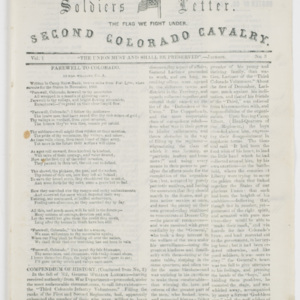
The Soldier’s Letter was a military camp newspaper published in Kansas City, Missouri, and Fort Riley, Kansas.It was issued by the Second Colorado Cavalry and edited by Private Oliver F. Wallace with contributions by other enlisted men and a few…
Rivington's New-York Gazetteer; or The Connecticut, New-Jersey, Hudson's-River, and Quebec Weekly Advertiser
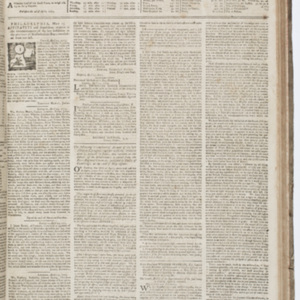
James Rivington (1724-1802), publisher of Rivington’s New-York Gazetteer, was born in London and was a bookseller in his native land before immigrating to the colonies in 1760. He eventually established a bookstore in New York and then ventured into…
Regimental Album of the 24th Massachusetts
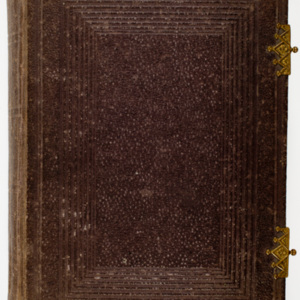
Although tintypes and ambrotypes were both used to capture images of soldiers, by far the most popular form soldier portraits took were cartes-de-visites. Unlike the former two processes, whose glass and metal foundations made them delicate, bulky,…
Poor Richard, 1739. An Almanack for the Year of Christ 1739.

Throughout the colonial period, almanacs were the best-selling product of the American press. The almanac was one of the first imprints of the Cambridge Press—the first press in British North America—in the 1640s; by the 1760s tens of…
Politics In an Oyster-House. Les Politiques au Cabaret.
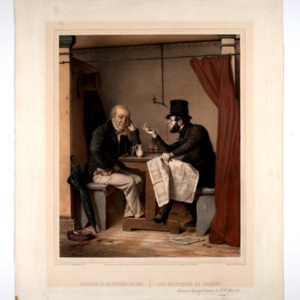
This 1851 lithograph, after an 1848 painting by Richard Caton Woodville (1825-55), encapsulates the central role the newspaper played in American politics. In the image, two men sit across the table from each other in an oyster house, an…
Plan of the Siege of York Town in Virginia
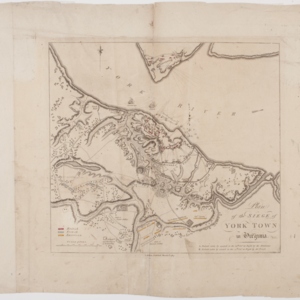
This engraved map was published in London in March 1787. It details the siege of Yorktown in 1781, the last great battle of the American Revolution. It clearly shows the American and French forces as they surround the British forces under the command…
Penfield Extra: Little Nellie's Little Paper
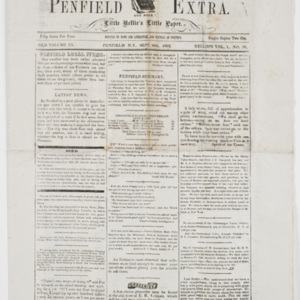
With the ubiquity and voracious appetite for news throughout the country, it is no surprise that the publication of amateur newspapers became a popular hobby in the nineteenth century. Though the first amateur newspaper in the United States is…
New-York Commercial Advertiser

The New-York Commercial Advertiser was perhaps the most prosperous of the half dozen or so mercantile dailies that dominated journalism in New York in the 1820s and 1830s before the rise of penny papers such as the New York Sun. These papers were…