Browse Items (116 total)
Sort by:
The Daily Citizen
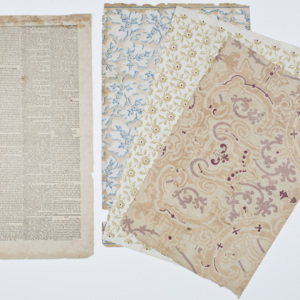
Among the shortages faced in the South as the war progressed was paper. To combat the problem, Southerners began to repurpose paper in any form they could, including wallpaper. Though in most instances wallpaper repurposing was for home use, in rare…
"News by Telegraph. Finance at New Orleans."

Aside from advances in printing technology and the development of the steam railroad, the telegraph was the biggest technological influence on news media in antebellum America. From 1844, when the first message was sent by Samuel F. B. Morse…
New-York Commercial Advertiser

The New-York Commercial Advertiser was perhaps the most prosperous of the half dozen or so mercantile dailies that dominated journalism in New York in the 1820s and 1830s before the rise of penny papers such as the New York Sun. These papers were…
Flash

The proliferation of newspapers targeted at specific audiences did not stop with language, religion, or reform. Also included were “racy” or “sporting” newspapers, aimed at men, particularly young bachelors. Reaching their…
Hampden Washingtonian
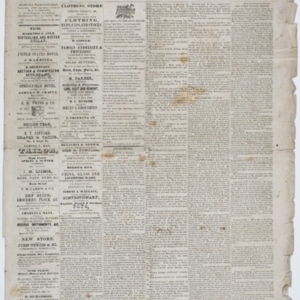
Among the print media reform movements used to spread their messages were newspapers. This temperance newspaper was printed in Springfield, Massachusetts, and distributed throughout Hampden County, providing a unifying voice for the local…
The Akron Buzzard

The Akron Buzzard from Akron, Ohio, targeted several different but related audiences, devoting itself to “Temperance, Morality, Mechanic Arts, Satire, News of the Day, and Amusement.” The rise of precision metal manufacturing and the…
The Somerset Whig

While big dailies were beginning to dominate the newspaper markets of the urban centers in the first half of the nineteenth century, smaller newspapers began to pop up in more rural areas. These small local papers carried news from around the…
Freedom's Journal
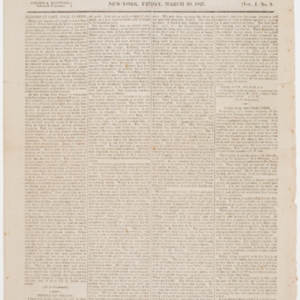
African Americans and abolitionists were among the voices that gained a new outlet during the antebellum newspaper boom. The first newspaper published by African Americans was the Freedom’s Journal, beginning in March 1827. Cofounded by…
Advertisements for stereographs

The stereograph sensation is evident in these advertisements on the last page of the April 29, 1865, issue of Frank Leslie’s Illustrated Newspaper. With the war now over, stereograph publishers began to focus on the medium’s use as…
Completely Silenced! Dead Confederate Artillery Men, As they lay around their battery after the Battle of Antietam.
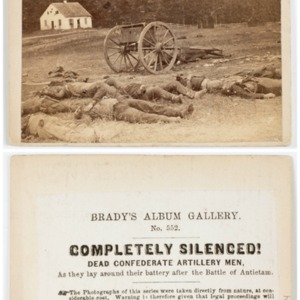
The affordability of the carte-de-visite form meant that it was used in a wide variety of ways, including to reproduce works of art and photography. During and after the Civil War, this included the work of the most famous photographers of the…