Browse Items (116 total)
Sort by:
A Plan of the Town and Harbour of Boston. and the Country adjacent with the Road from Boston to Concord Shewing the Place of the late Engagement
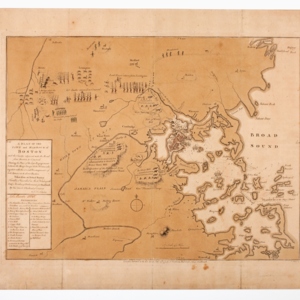
Maps were an important form of news gathering and reporting during the American Revolution. Most were created by engineers in the British army and often they depicted military campaigns or battles, providing not only important intelligence about the…
A Poem Occasioned by the untimely Death of Hugh Henderson, alias John Hamilton, who was Hangd at Worcester for House-Breaking. Nov. 24. 1737.

Public executions had long been popular news events in Europe, and they fit well into the news environment of Puritan New England. They were sensational, which appealed to the voyeurism of audiences, but they were also morally instructive, which…
A Poem, Spoken Extempore, by a Young Lady, on hearing the Guns firing and Bells chiming on account of...the Surrender of York Town

As they had been in the pre-war years, broadsides continued to be a way to spread and provide commentary on the news. This broadside features two poems about the surrender of Yorktown. The first is “A Poem Spoken Extempore, by a Young Lady, on…
A Record of the War of Secession, Vol. I
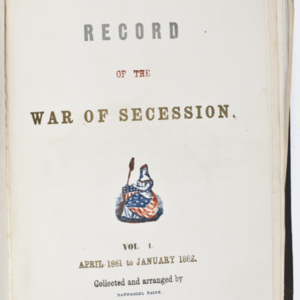
Nathaniel Paine (1832-1917) was a prominent Worcester banker and civic leader who counted among his friends and mentors Edward Everett Hale (1822-1909) and Senator George Frisbie Hoar (1826-1904). An avid lifelong collector, he was a member of the…
A sermon...Occasioned by the capture of the British Army, under the command of Earl Cornwallis
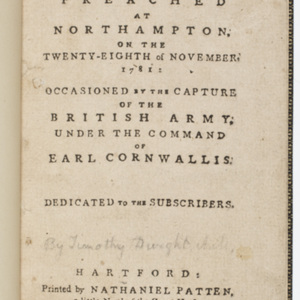
Just as before the war, sermons were still an important means of reflecting on and spreading news. This sermon, preached by Timothy Dwight (1752-1817) at Northampton, Massachusetts, on November 28, 1781, puts news of the British surrender at Yorktown…
A View of Part of the Town of Boston in New-England and Brittish Ships of War: Landing Their Troops! 1768
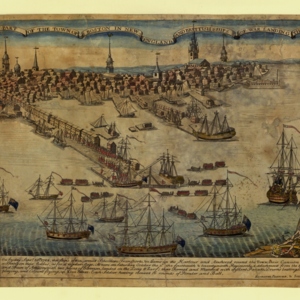
While newspapers decried in print the occupation of Boston by British troops beginning in 1768, Paul Revere (1734-1818), a silversmith and engraver in Boston, also did so visually. This engraving shows Boston Harbor facing the north part of town,…
Advertisements for stereographs

The stereograph sensation is evident in these advertisements on the last page of the April 29, 1865, issue of Frank Leslie’s Illustrated Newspaper. With the war now over, stereograph publishers began to focus on the medium’s use as…
Ambrotype of unidentified soldier in Union uniform
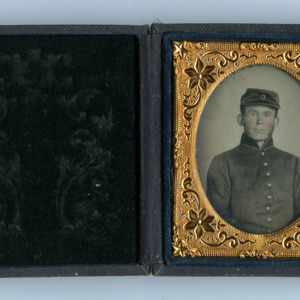
Among the photographic processes available to a widening public and used by Civil War soldiers were ambrotypes. Ambrotypes became popular in the mid-1850s, due in large part to their shorter exposure times (as compared to daguerreotypes), which also…
An Amalgamation Polka
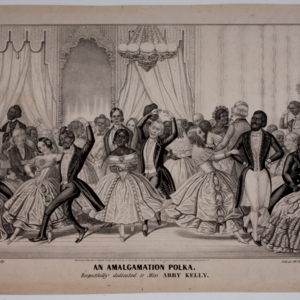
Mid-nineteenth-century visuals of African Americans were largely characterized by satire, an overexaggeration of features, and stereotypes. This lithograph is one of several in an entire Amalgamation Series created by Edward Williams Clay…
Anthony Burns
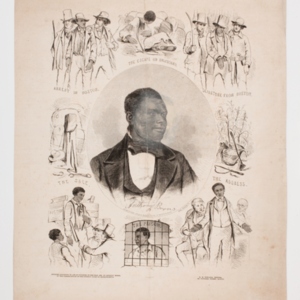
This large broadside, printed by R. M. Edwards of Boston in 1855, features woodcuts portraying scenes from the life of Anthony Burns (1834-62), a former fugitive and then freed slave whose story sparked fierce abolitionist reaction throughout…