Browse Items (116 total)
Sort by:
Extraordinary Events the Doings of God, and Marvellous in Pious Eyes

Thomas Prince (1687-1758), the senior minister of Old South Church in Boston from 1718 until his death in 1758, was a leading American proponent of the new natural sciences and the British Enlightenment. Yet he was a theological conservative who…
Thomas Prince Diary
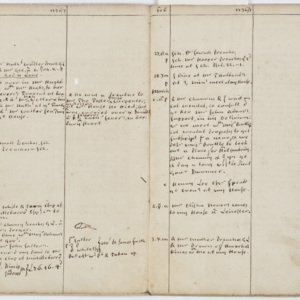
Thomas Prince (1687-1758), born in Sandwich, Massachusetts, was a leading public figure in Boston as senior minister of Old South Church from 1718 until his death. During that forty-year career, Prince was an avid news consumer as well as an…
Bird's Eye View of the Seat of War
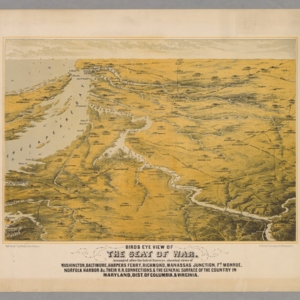
Among the visual ways in which people tried to make sense of the Civil War were maps. Maps helped people visualize the places where their loved ones were fighting, places most of them had never seen. Though few newspapers outside of the illustrated…
A Record of the War of Secession, Vol. I
Nathaniel Paine (1832-1917) was a prominent Worcester banker and civic leader who counted among his friends and mentors Edward Everett Hale (1822-1909) and Senator George Frisbie Hoar (1826-1904). An avid lifelong collector, he was a member of the…
By His Excellency Jonathan Belcher, Esq;...A Proclamation.

The most formal medium of news dissemination in colonial New England was the government proclamation, issued by the governor or other high official and printed elegantly in broadside form. Proclamations often announced special days of thanksgiving…
By His Excellency William Shirley, Esq;...A Proclamation.

In colonial America the surest way for a printer to achieve financial stability was to secure government contracts for printing the laws and other official documents. Usually, the government printer also ran his newspaper as a kind of sycophantic…
By the Governour & Council. Whereas some have lately presumed to Print and Disperse a Pamphlet, Entituled, Publick Occurrences

In 1690, a recent immigrant to Boston, Benjamin Harris (d. 1716), decided the time was right to launch a newspaper. In the wake of the Glorious Revolution of 1688 and the royal regime change in England, colonists longed for news from home. Harris,…
The last Speech and dying Advice of poor Julian, Who was Executed the 22d of March, 1733. for the Murder of Mr. John Rogers of Pembroke.

One genre of news broadside in colonial America, quite different in quality from the elegantly printed government proclamation, was the confession or “last speech” of a condemned criminal. These were typically small sheets, printed quickly on cheap…
Mexican News

This 1853 engraving by Alfred Jones (1819-1900), called Mexican News, is based on a popular 1848 painting by Richard Caton Woodville (1825-55) titled War News from Mexico. The image places the newspaper at center stage and illustrates how ingrained…
"An extensively read News paper"

In the 1840s and 1850s, thanks to steam-powered and rotary presses, newspaper dimensions were often enormous. The size of the printing presses, their ability to print evenly over a large surface area, and the speed with which they could print…