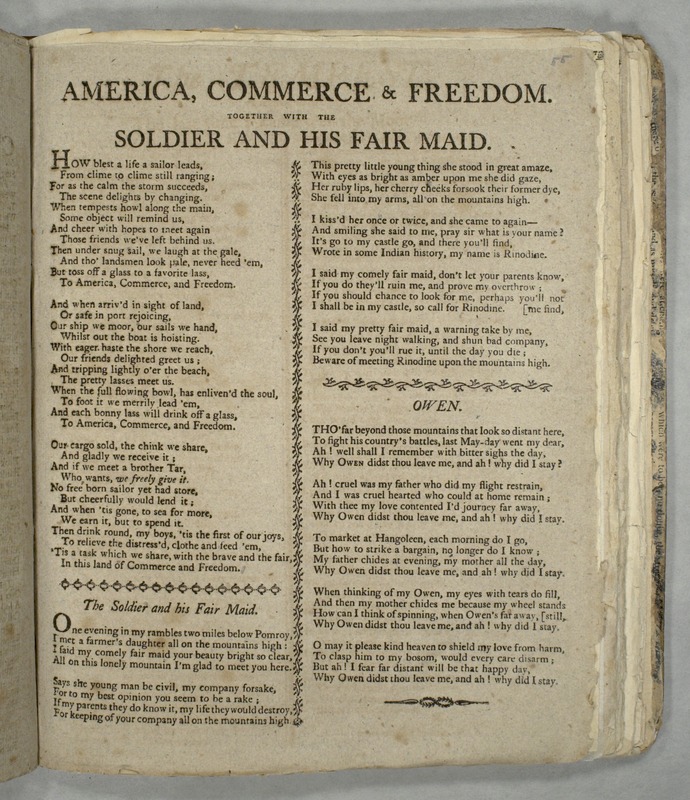
If there had been a Chamber of Commerce for the United States in 1794, this patriotic “America, Commerce, and Freedom” would have been its theme song. It is the second song in the Thomas collection by English actress, Susannah Haswell Rowson, who had immigrated to America in the 1790s (see Truxton’s Victory and The Sailor Boy). Here she expresses a Federalist point of view. Except for the last line toasting American interests, it rivals some of Dibdin’s sea songs in spirit and elan. Written as though by a sailor, verse 3 suggests a mutual aid brotherhood among the men of the sea.
The text was set to music in Philadelphia by Alexander Reinagle (1756-1809) and was added to his score for the pantomime The Sailor’s Landlady (1794) (Porter, With An Air 485; Sonneck, Bibliography 15). By 1813, this piece had been expanded to a one-act entertainment, a “favorite piece,” that was performed in Boston on April 19. The emblematic characters were the Genius of Columbia, Liberty, and Commerce (Porter 22). It is interesting to note that on the playbill for this performance are listed several other items in Thomas’s collection such as Thimble’s Scolding Wife and several “mad” songs. Also featured were a series of transparent paintings showing various sea battles between Constitution and Guerriere, Wasp and Frolic, and Constitution and Java, battles that found expression in songs also printed on Coverly’s broadsides. Performances in the nearby theater undoubtedly helped bring traffic to Coverly’s shop and sales for his products on the streets. A very popular song, “America, Commerce, and Freedom” was released in several sheet music editions and the text appeared in sixty-three songsters between 1795 and 1820 (Wolfe, Secular Music #7412-14; R. Keller, Early American Secular Music and Its European Sources).
There are two more texts on this broadside. “The Soldier and His Fair Maid” appears under a different title on Ranordine, and “Owen,” on Mary’s Dream.