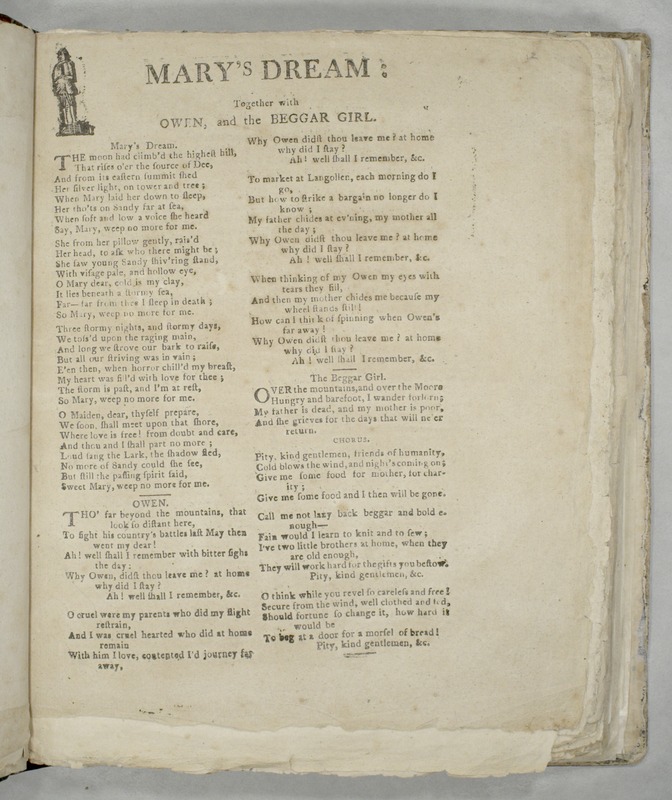
In “Mary’s Dream,” the lovers are faithful and the ghost is taken seriously. Sandy has drowned in a storm at sea and his ghost comes to notify Mary to cease her mourning for his absence. As dawn breaks and the lark sings, the ghost flees, saying “Sweet Mary, weep no more for me.”
The setting is a high hill, “o’er the source of Dee,” which is the River Dee in Scotland. The author of the lyrics was John Lowe (1750-98), a minor poet born near New Galloway, Scotland. A graduate of Edinburgh University, he was teaching in the McGhie family when he “was inspired by the [1772] death at sea of the lover [named Alexander Miller] of a sister of his betrothed to compose a melodious and affecting ballad called ‘Mary’s Dream,’ by which his fame as a poet has been preserved.” He immigrated to Virginia in 1773 (Appleton’s Cyclopedia; Huntington and Herrmann 144-45).
Lowe’s text appeared in several British sources, most notably in the Edinburgh Musical Miscellany to a minor-mode tune (1:131-32). But the song’s real success came in America, where it appeared in the 1790s set to a new tune by John Relfe (1763-1837), a tune that was copied into a number of manuscript collections (Laws 150 K20; R. Keller; Wolfe, Secular Music #7446-50, #10321). The text appeared in seventy-two songsters between 1788 and 1820 (R. Keller, Early American Secular Music and Its European Sources).
In “Owen,” a young lover in Llangollen, Wales, bemoans her love’s absence “to fight his country’s battles.” The burden, “at home why did I stay,” suggests that she had an opportunity to accompany her love, a decision that was prevented by her parents. The selection of the name “Owen” may reflect Owen Glendower in Shakespeare’s Henry IV, Part 1, or the song itself may be Welsh in origin. The text appeared in forty-three songsters between 1798 and 1818, and the song on period sheet music (R. Keller, Early American Songsters; Wolfe, Secular Music #6686-89).
“The Beggar Girl” is described in another broadside, Truxton’s Victory.