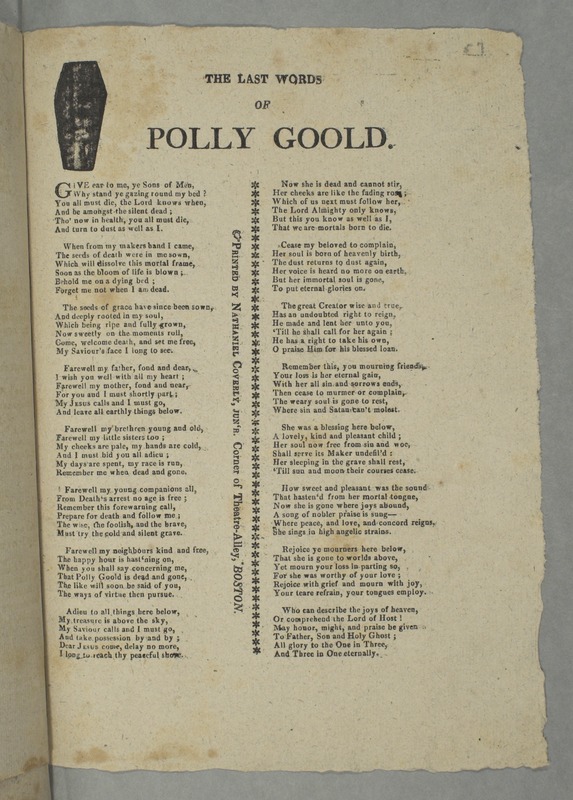
Polly Gould evidently died in Weare, New Hampshire, and her elegy is credited to a local man, Deacon Wells Currier (1770-1850), although the only document tying Currier to this text, Elegy on the Death of Miss Gould by Mr. Wells Currier, could not be located as of June 2006. The text is in two parts. In the first eight stanzas Polly Gould (Goold) speaks from her deathbed. She is dying young and innocent; the didactic lesson in the text is that the sinful reader still has time to repent. The second half is a funeral hymn in which Polly becomes a third-person subject. The second and third verses of this part suggest that the lyric is written as if spoken by Polly’s father, here addressing his wife, Polly’s mother: “Cease my beloved to complain. . . he made and lent her unto you.”
From the number of different broadsides that included this evangelical hymn, it must have been one of the most popular elegies of the 1790s and early 1800s (Ford, Broadsides #2522, #3212-20). With The Happy Child, it was one of Coverly’s bestsellers. For another version, added to the Thomas collection later, see The Last Words of Polly Goold. An issue from the Coverly press in Amherst, perhaps one of the earliest versions of the poem and a unique format for Coverly in this period, varies slightly from later ones—the final lines of verses 14 and 15 are entirely different and a few other phrases were changed after this issue. The lyric with Polly’s last name spelled Gould has the same basic text as the Amherst broadside, and was printed with two other elegies on a broadside without any identification, A Short and Brief Account of the Shipwreck of Captain Joshua Winslow (1795).
In his study of the Vermont Congregationalist singing master Jeremiah Ingalls (1764-1838), David Grover Klocko concludes that Ingalls composed music for this text, perhaps the “very mournful tune” mentioned on an edition of the song published in Boston by Thomas Fleet (134, 204, 679, 1226).