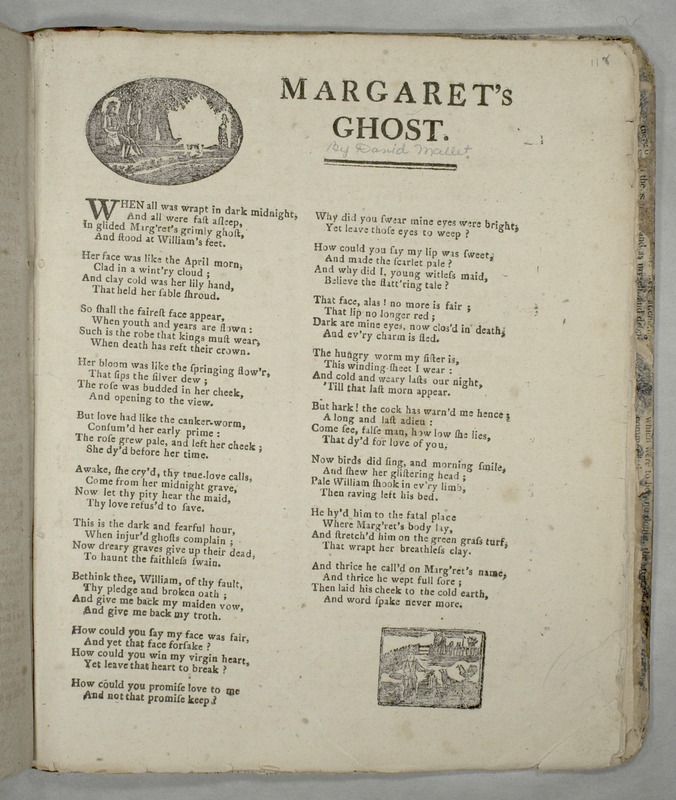
In this song of unfaithful love, a vengeful female ghost drives her unfaithful lover mad and into decline. Some versions of the ballad begin “’Twas at the silent solemn hour / when night and morning meet,” with the remainder of the verses being the same. Usually credited to Scotsman David Mallet (1700?-1765), “The Ballad of William and Margaret” is discussed by William Lyon Phelps, who states that Mallet’s literary reputation is chiefly due to a piece of poetry that he never wrote (Simpson 785-87). The ballad was known long before Mallet was born. In Beaumont’s Knight of the Burning Pestle (ca. 1611), Merry-Thought sings passages from it twice. The more important of these comes in act 2, scene viii.
When it was growne to darke midnight,
And all was fast asleepe,
In came Margarets grimely Ghost,
And stood at Williams feete. (Bronson, Singing Tradition 189)
Several sheet music editions of this song were published between 1720 and 1730 (Schnapper 1071). The lyric was published in The Plain Dealer on July 24, 1724 (Phelps 177-82). In The Plain Dealer the source is cited as “a garland” and the editor claims to have made some alterations “for clearer explanation of the author’s meaning.” On August 28, 1724, Mallet claimed authorship in a letter also published in The Plain Dealer. Allan Ramsay then included the text, marked “D. M.,” in volume 2 of The Tea-Table Miscellany (1724). By 1726, Mallet was generally considered the author and in 1728 he published a collection of his own poetry and included the text. The attribution was not questioned for 150 years. In 1878, a black-letter broadside was located with a text nearly identical to Mallet’s. On the sheet is a stamp dating from around 1711, during the reign of Queen Anne, at which time Mallet was eleven or twelve years old, certainly too young to write or even adapt such poetry (Bronson, Singing Tradition 189). Phelps believes that, independent of its authorship, “William and Margaret had an importance as contributing to the early hidden growth of the English Romantic movement. Its great popularity in ‘the age of prose and reason’ shows that there was a love for poetry of this kind, however much fashion condemned it in the abstract” (182). So deeply had the song entered people’s minds that Isaac Bickerstaff included a reference to it in his Love in a Village (1762). On hearing the tale of the lover’s escapades, Hawthorne responds to Sir William:
Why, Sir William, it is a romance; a novel; a pleasanter history by half, than the loves of Dorastus and Faunia: we shall have ballads made of it within these two months, setting forth, how a young ’squire became a serving man of low degree; and it will be stuck up with Margaret’s Ghost and the Spanish Lady, against the walls of every cottage in the country. (44-45)
The text was printed in two newspapers in 1813, the Wilkesbarre (PA) Gleaner on September 10 and in the Goshen (NY) Orange County Patriot on October 5. In the Gleaner, the editor included a note: “Every reader of sensibility and taste, we are confident will approve of our extracting the following beautiful old ballad, into our poet’s corner.” The text appeared in four songsters between 1789 and 1793 (R. Keller, Early American Songsters).