Browse Items (116 total)
Sort by:
"Journal of Occurrences"

Although the repeal of the Stamp Act led many to briefly believe the Crown would leave the colonies alone, the institution of the Townshend Acts in 1767 erased that hope. The colonists’ resistance to these acts led to the establishment of…
The North Star

The most famous African American in antebellum America was Frederick Douglass (ca. 1818-95), an escaped slave from Maryland who achieved renown in the North as an antislavery lecturer and writer. Douglass began his abolitionist career in league with…
The Southern Illustrated News
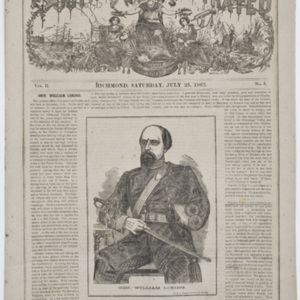
Before the Civil War, Southerners were also consuming the popular Harper’s Weekly and Frank Leslie’s Illustrated Newspaper. After the commencement of the war, however, readers in the Confederate states were cut off from these papers. In…
"A Typical Negro"

As the war progressed, Harper’s Weekly changed from toeing the middle political (or even apolitical) ground to a more outright Union stance. This was also the case for its attitude toward African Americans. By 1863, especially after the…
"Santa Claus in Camp"

Harper’s Weekly became such a mainstay of popular news culture during the Civil War, that the newspaper could make references to its own popularity within its illustrations. Copies of Harper’s are among the presents Santa Claus is…
Harper's Weekly
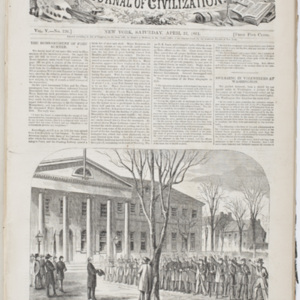
Harper Brothers publishing house in New York set the standard for illustrated magazines with the inauguration of its very popular Harper’s Monthly Magazine in1850, a staid literary magazine aimed at a broad but genteel reading public. This…
"Negroes As Soldiers"

Though much of the imagery surrounding African Americans was full of stereotypes and caricatures throughout the war, even in the North, positive depictions of African Americans began to appear more often as the war progressed. Though some unofficial…
Frank Leslie's Illustrated Newspaper
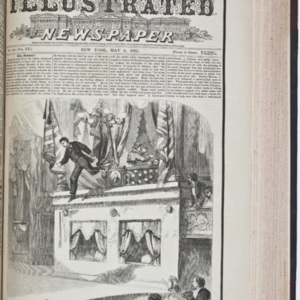
Frank Leslie’s Illustrated Newspaper, established in 1855,was the first successful pictorial newspaper in the United States. Before immigrating to the United States in 1848, Frank Leslie (born Henry Carter; 1821-80) had worked for six years in…
Confederate Scrap-Book
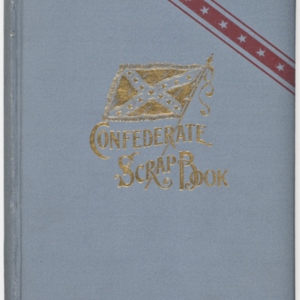
Scrapbooks were a common way for people in both the North and the South to process and keep a record of the war. Thus, they provide insights into what people were reading, what they were feeling, and what kinds of information they found important. A…
Jeff. Sees the Elephant
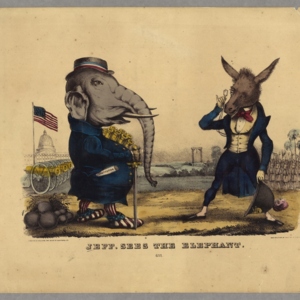
This color lithograph published by E. B. & E. C. Kellogg of Hartford, Connecticut, and George Whiting of New York City dates from 1861 or 1862. It is believed to be the first time that the elephant and donkey appear together depicting the…