Browse Items (116 total)
Sort by:
The Akron Buzzard

The Akron Buzzard from Akron, Ohio, targeted several different but related audiences, devoting itself to “Temperance, Morality, Mechanic Arts, Satire, News of the Day, and Amusement.” The rise of precision metal manufacturing and the…
Hampden Washingtonian
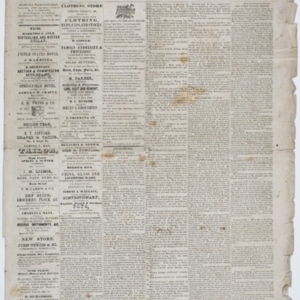
Among the print media reform movements used to spread their messages were newspapers. This temperance newspaper was printed in Springfield, Massachusetts, and distributed throughout Hampden County, providing a unifying voice for the local…
Flash

The proliferation of newspapers targeted at specific audiences did not stop with language, religion, or reform. Also included were “racy” or “sporting” newspapers, aimed at men, particularly young bachelors. Reaching their…
New-York Commercial Advertiser

The New-York Commercial Advertiser was perhaps the most prosperous of the half dozen or so mercantile dailies that dominated journalism in New York in the 1820s and 1830s before the rise of penny papers such as the New York Sun. These papers were…
"News by Telegraph. Finance at New Orleans."

Aside from advances in printing technology and the development of the steam railroad, the telegraph was the biggest technological influence on news media in antebellum America. From 1844, when the first message was sent by Samuel F. B. Morse…
The Daily Citizen
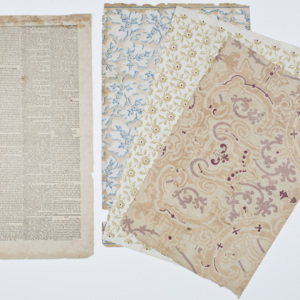
Among the shortages faced in the South as the war progressed was paper. To combat the problem, Southerners began to repurpose paper in any form they could, including wallpaper. Though in most instances wallpaper repurposing was for home use, in rare…
The Halifax Gazette, or The Weekly Advertiser
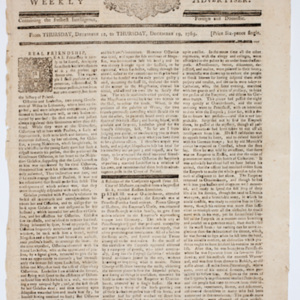
Isaiah Thomas (1749-1831) would become a prominent Patriot printer during the American Revolution and eventually one of the wealthiest men in the United States, but at sixteen he illegally left his apprenticeship in Boston with a poor printer named…
The LAD who carries The Massachusetts Spy, Wishes all his kind Customers A Merry Christmas, and a Happy New Year!

In colonial America, newspapers were delivered to their readers in a variety of ways. In the cities, customers often picked up their papers at the printing office. In the countryside, post riders delivered newspapers. Having free access to the postal…
John Burt Diary
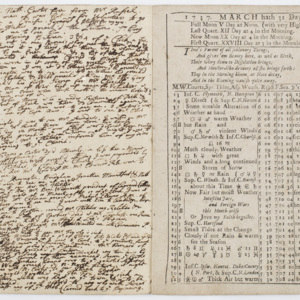
John Burt (1716-75) was born in Boston and graduated from Harvard College in 1736. At the time he kept his diary, he was reading theology with a local minister in Boston. He later accepted a call to the pulpit in Bristol, Rhode Island, and spent his…
The New England Weekly Journal
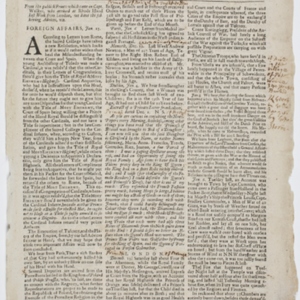
The New England Weekly Journal was founded in 1727 as a literary paper, along the lines of the Spectator in London and New England Courant in Boston, the newspaper that launched the career of Benjamin Franklin. But the Weekly Journal was more aligned…