Browse Items (116 total)
Sort by:
In Congress, July 4, 1776. A Declaration by the Representatives of the United States of America, in general Congress assembled.
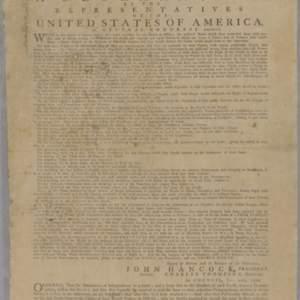
Although it is now the calligraphic version of the Declaration—commissioned by Congress and signed by all the members after it had been accepted by the colonies—that is most familiar today, it was actually through the printed version that the…
The American Weekly Mercury

The first newspaper to appear in America outside Boston was the American Weekly Mercury, launched by Andrew Bradford (1686-1742) in Philadelphia in 1719. His father, William Bradford (1663-1752), had opened the first print shop in the new city of…
Glorious News. Boston, Friday 11 o'Clock, 16th May 1766.

This broadside proclaims the “Glorious News” that on March 18, 1766, the king had given his assent to Parliament’s act to repeal the Stamp Act. In order to authenticate the news, the broadside explains exactly where it came from: a ship of John…
The New-Hampshire Gazette, and Historical Chronicle
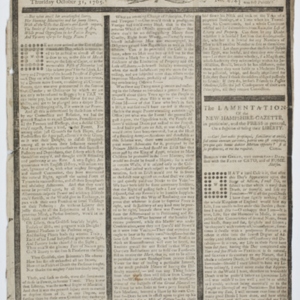
The New-Hampshire Gazette, published by Daniel Fowle (ca. 1715-87), was typical of many newspapers throughout the colonies that protested the steep taxes instituted by the Stamp Act on virtually every aspect of a printer’s business. Printers…
A Narrative, of the Excursion and Ravages of the King's Troops
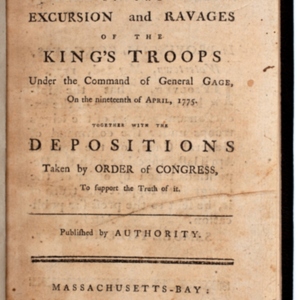
This book, commissioned by the new Provincial Congress, was one of the first items printed in Worcester, Massachusetts, after printer Isaiah Thomas’s arrival in April 1775. As the title explains, it is A Narrative, of the Excursion and Ravages of the…
Bloody Butchery, by the British Troops: or, The Runaway Fight of the Regulars.
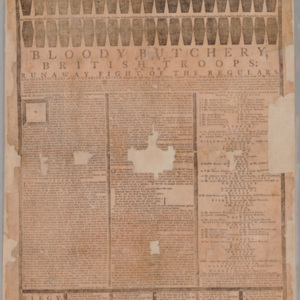
The American account of the events at Lexington and Concord is recounted in this dramatic broadside. Note the heavy black borders and the coffins that adorn the top of the broadside. Both the graphics and the inflammatory prose are designed to incite…
"Worcester, May 3. Americans! forever bear in mind the Battle of Lexington!"
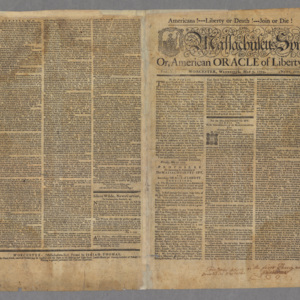
While most colonial newspapers had circulations of between 300 and 600, theMassachusetts Spyhad a circulation of 3,500 from subscribers throughout the thirteen colonies, making it the most popular American newspaper at the time. Designed specifically…
Cincinnati Post and Anti-Abolitionist
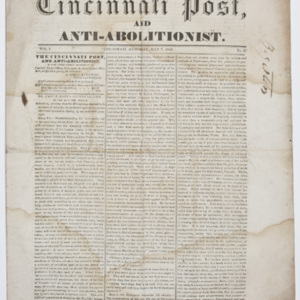
Cincinnati had a powerful pro-slavery faction that published the Cincinnati Post and Anti-Abolitionist, edited by L. Greely Curtiss, from 1841 to 1842. By 1842 the paper boasted that it had the largest circulation of any newspaper in the West.…
The Liberator
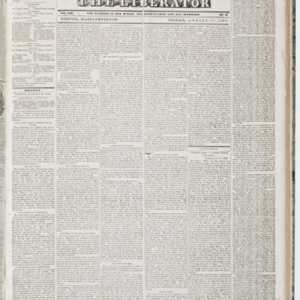
An important category of newspapers in antebellum America was the organizational paper. Every religious or reform movement seemed to have its national and state associations and every association its newspaper. That certainly was true of the…
A Circumstantial Account Of an Attack that happened on the 19th of April 1775, on his Majesty's Troops
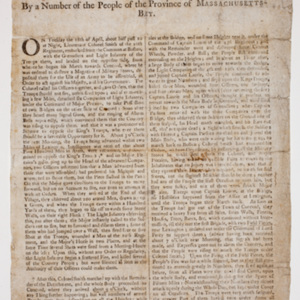
The British version of the events leading to and including the Battles of Lexington and Concord is presented in this broadside. The calm tone of the language and the lack of any graphic images is an intentional attempt to downplay the significance of…