Browse Items (116 total)
Sort by:
Harper's Weekly
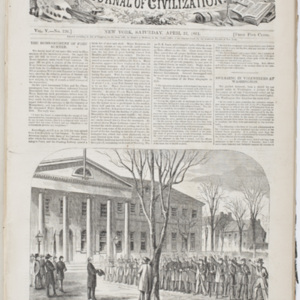
Harper Brothers publishing house in New York set the standard for illustrated magazines with the inauguration of its very popular Harper’s Monthly Magazine in1850, a staid literary magazine aimed at a broad but genteel reading public. This…
Horseneck Truth-Teller and Gossip Journal
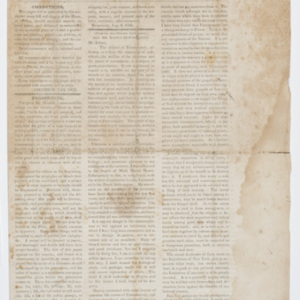
This is the first volume of the Horseneck Truth-Teller, and Gossip’s Journal, an example of a popular genre of newspaper new in the antebellum era: the gossip and moral-exposure paper. The publisher was given as Diedrich van Tod, but it was…
Important Intelligence of PEACE! Between America and Great-Britain

This broadside announcing the Treaty of Paris was published by Isaiah Thomas (1749-1831) in Worcester, Massachusetts. The subtitle—”Sure and Certain”—immediately tries to dispel any worries about the treaty being a rumor. But…
In Congress, July 4, 1776. A Declaration by the Representatives of the United States of America, in general Congress assembled.
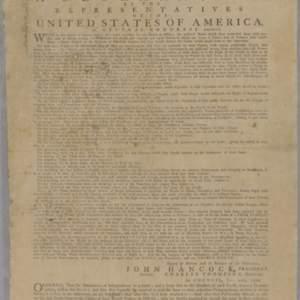
Although it is now the calligraphic version of the Declaration—commissioned by Congress and signed by all the members after it had been accepted by the colonies—that is most familiar today, it was actually through the printed version that the…
It Is of the Lord's Mercies That We Are Not Consumed. A Sermon.
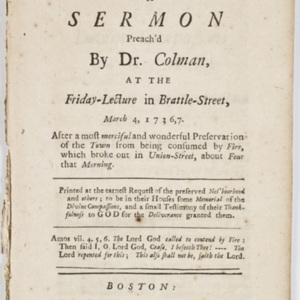
In New England, even in the age of newspapers, which began modestly in 1704 with the launch of the Boston News-Letter, the sermon remained a vital public communication medium for the discussion of news. Though most sermons, especially Sunday sermons,…
Jeff. Sees the Elephant
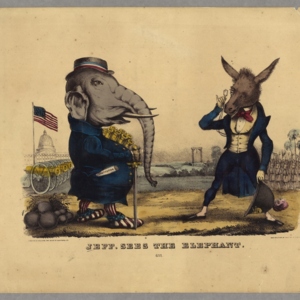
This color lithograph published by E. B. & E. C. Kellogg of Hartford, Connecticut, and George Whiting of New York City dates from 1861 or 1862. It is believed to be the first time that the elephant and donkey appear together depicting the…
John Burt Diary
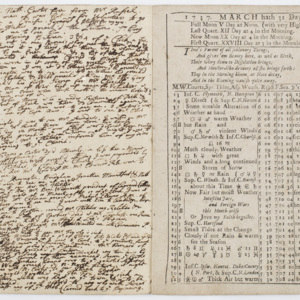
John Burt (1716-75) was born in Boston and graduated from Harvard College in 1736. At the time he kept his diary, he was reading theology with a local minister in Boston. He later accepted a call to the pulpit in Bristol, Rhode Island, and spent his…
Lecture On the War: C. C. Coffin, Esq. Known as "Carleton" of the Boston Journal

Charles Carleton Coffin (1823-96) was one of a dozen or so battlefield correspondents whose work during the Civil War made them into something new in American journalism: celebrity reporters. Writing under the penname “Carleton” for the…
Letter from Samuel Salisbury to Stephen Salisbury, April 20, 1775
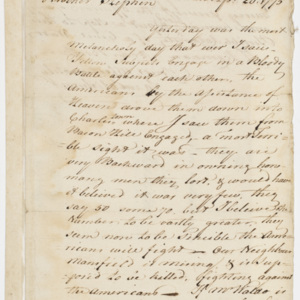
Samuel Salisbury (1739-1818) and his brother Stephen Salisbury (1746-1829) were in business together importing and selling merchandise from England and the West Indies. Samuel was located in Boston while Stephen came to the central Massachusetts…
Letter from Timothy Bigelow to Stephen Salisbury, October 7 and 14, 1777
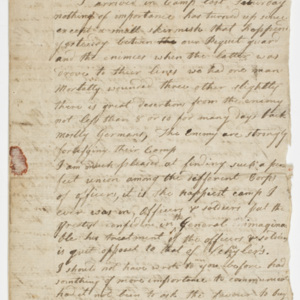
Throughout the Revolution, war news was conveyed through personal letters, as is evident by these two letters written by Timothy Bigelow (1739-90) to Stephen Salisbury (1746-1829). At this time Bigelow was a colonel in command of the Fifteenth…