Browse Items (116 total)
Sort by:
Tippecanoe Banner and Spirit of Democracy

This paper is an example of a presidential campaign newspaper, a form that became very popular during the 1840s and 1850s. This one supports the election of William Henry Harrison (1773-1841). The hotly contested presidential election of 1840…
Cherokee Phoenix

The Cherokee Phoenix was the first newspaper published by Native Americans. In 1825 the Cherokee Council pledged $1,500 for the purchase of a printing press and type; the American Board of Commissioners for Foreign Missions also pledged assistance.…
The Temperance Family Almanac for the Year of Our Lord 1835
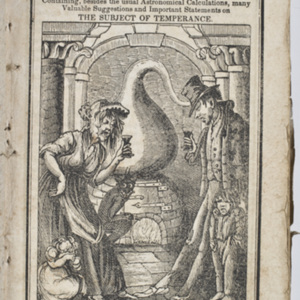
As with many other reform movements of the day, temperance activists made use of a variety of print media to further their cause, including the long-popular genre of almanacs. It became common for antebellum reform organizations to publish almanacs…
The American Anti-Slavery Almanac, for 1837
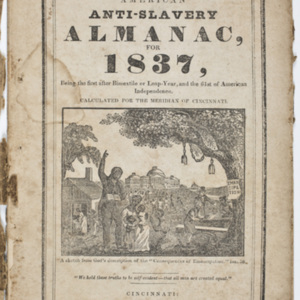
As with many other reform movements of the day, abolitionists used all available forms of mass communication to disseminate their message, including almanacs. Antebellum reform organizations published almanacs that included—among their charts…
Important Intelligence of PEACE! Between America and Great-Britain

This broadside announcing the Treaty of Paris was published by Isaiah Thomas (1749-1831) in Worcester, Massachusetts. The subtitle—”Sure and Certain”—immediately tries to dispel any worries about the treaty being a rumor. But…
A sermon...Occasioned by the capture of the British Army, under the command of Earl Cornwallis
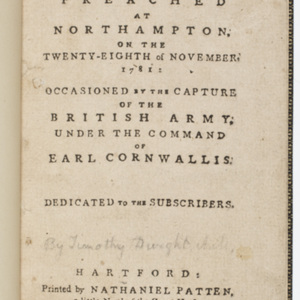
Just as before the war, sermons were still an important means of reflecting on and spreading news. This sermon, preached by Timothy Dwight (1752-1817) at Northampton, Massachusetts, on November 28, 1781, puts news of the British surrender at Yorktown…
Letter from Timothy Bigelow to Stephen Salisbury, October 7 and 14, 1777
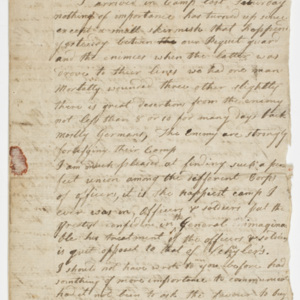
Throughout the Revolution, war news was conveyed through personal letters, as is evident by these two letters written by Timothy Bigelow (1739-90) to Stephen Salisbury (1746-1829). At this time Bigelow was a colonel in command of the Fifteenth…
"To the Inhabitants of the Colony of Massachusetts-Bay."
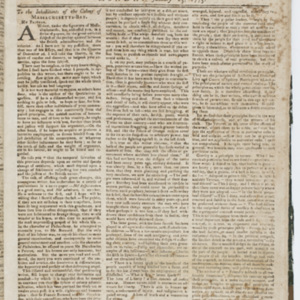
In 1774 and 1775, lawyer and devoted loyalist Daniel Leonard (1740-1829) wrote a series of seventeen articles, published in the Boston Tory newspaper Massachusetts Gazette; and the Boston Post-Boy and Advertiser, under the pseudonym…
The last Speech and dying Advice of poor Julian, Who was Executed the 22d of March, 1733. for the Murder of Mr. John Rogers of Pembroke.

One genre of news broadside in colonial America, quite different in quality from the elegantly printed government proclamation, was the confession or “last speech” of a condemned criminal. These were typically small sheets, printed quickly on cheap…
Concio Hyemalis. A Winter Sermon.
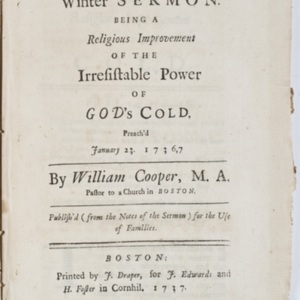
From 1716 until his death in 1743, William Cooper (1694-1743) was Benjamin Colman’s colleague in ministry at Boston’s Brattle Street Church. Like Colman and like Thomas Prince at Old South Church, Cooper frequently preached on current…