Browse Items (116 total)
Sort by:
The American Anti-Slavery Almanac, for 1837
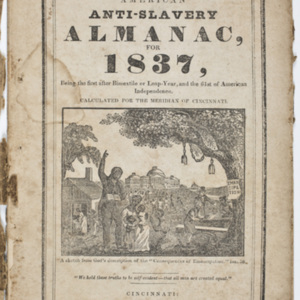
As with many other reform movements of the day, abolitionists used all available forms of mass communication to disseminate their message, including almanacs. Antebellum reform organizations published almanacs that included—among their charts…
Important Intelligence of PEACE! Between America and Great-Britain

This broadside announcing the Treaty of Paris was published by Isaiah Thomas (1749-1831) in Worcester, Massachusetts. The subtitle—”Sure and Certain”—immediately tries to dispel any worries about the treaty being a rumor. But…
"To the Inhabitants of the Colony of Massachusetts-Bay."
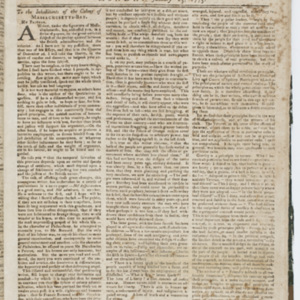
In 1774 and 1775, lawyer and devoted loyalist Daniel Leonard (1740-1829) wrote a series of seventeen articles, published in the Boston Tory newspaper Massachusetts Gazette; and the Boston Post-Boy and Advertiser, under the pseudonym…
"To the Inhabitants of the Province of Massachusetts Bay."
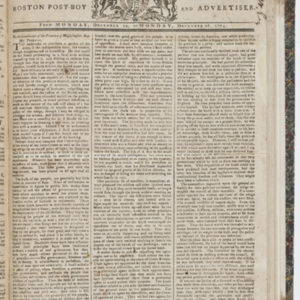
Daniel Leonard (1740-1829) was a lawyer and devoted loyalist. He lived in Taunton, Massachusetts, and was a member of one of the leading and wealthiest families in the commonwealth. In 1774, he was forced to flee his home by his Whig neighbors. He…
"Messieurs Printers…At a meeting of the inhabitants of the town of Worcester…"
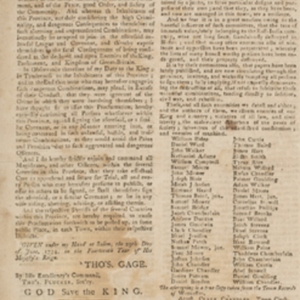
So-called “rebels” or “patriots” were not the only ones to use print media to their advantage during the pre-Revolution crisis. In the spring of 1774, loyalists in the shire town of Worcester, Massachusetts, felt that they…
"Extract of a letter from Leicester, August, 1774. 'Yesterday Mr. Paine, of Worcester, was visited by near 3000 people"
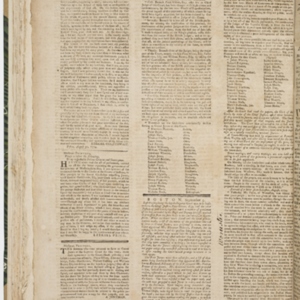
Timothy Paine (1730 – 93) was a wealthy and influential loyalist from Worcester, Massachusetts, connected by marriage to the Chandlers, another wealthy loyalist family. Paine graduated from Harvard and studied law after he was appointed clerk…
Battle of Antietam
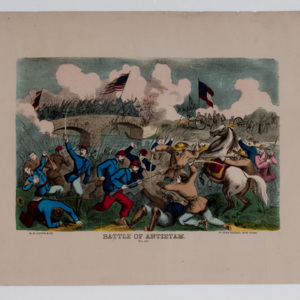
Though lithography gained in popularity in the years leading up to and during the Civil War, relief printing was still a commonly used process for illustration. This hand-colored wood engraving of the Battle of Antietam, which took place on September…
Charleston Mercury Extra: Passed unanimously at 1.15 o'clock, P.M., December 20th, 1860

On November 10, 1860, after a decade of political division and just four days after Lincoln’s election, South Carolina called a secession convention for the following month. Considered by virtue of timing to be the first Confederate imprint, this…
Effects of the Fugitive-Slave-Law
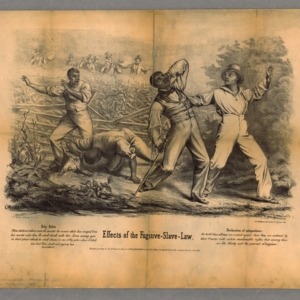
Just as the abolition movement harnessed the power of the printed word in newspapers, periodicals, tracts, and almanacs to spread its antislavery message, it also used printed visuals in the form of lithographs, engravings, and political cartoons. In…
Attack On the Post Office, Charleston, S.C.
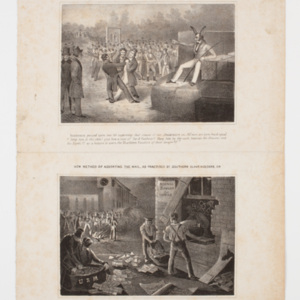
As veterans of the Bible and religious tract movements, the founders of the American Anti-Slavery Society (AASS) believed in the power of the printed word to convert sinners, including those whose sin was slaveholding. Immediately after its founding…