Browse Items (116 total)
Sort by:
The Lexington of 1861
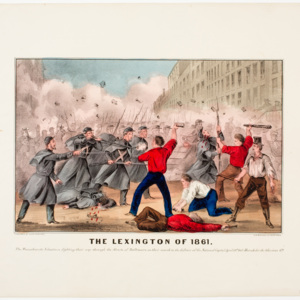
In many cases, visual resources not only provided a means by which to depict a news event, but also a way to interpret that event. This lithograph, produced by Currier & Ives, shows the Sixth Massachusetts Volunteer Regiment fighting its way…
Battle of Antietam
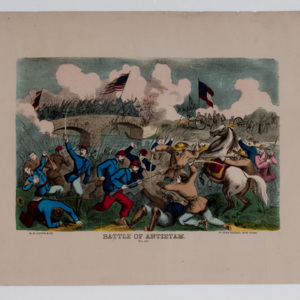
Though lithography gained in popularity in the years leading up to and during the Civil War, relief printing was still a commonly used process for illustration. This hand-colored wood engraving of the Battle of Antietam, which took place on September…
"Extract of a letter from Leicester, August, 1774. 'Yesterday Mr. Paine, of Worcester, was visited by near 3000 people"
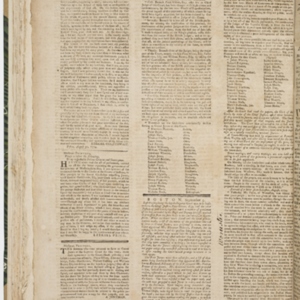
Timothy Paine (1730 – 93) was a wealthy and influential loyalist from Worcester, Massachusetts, connected by marriage to the Chandlers, another wealthy loyalist family. Paine graduated from Harvard and studied law after he was appointed clerk…
"Messieurs Printers…At a meeting of the inhabitants of the town of Worcester…"
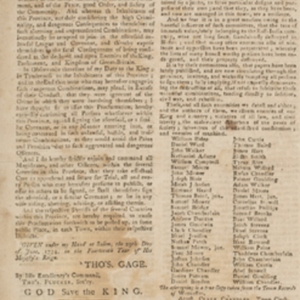
So-called “rebels” or “patriots” were not the only ones to use print media to their advantage during the pre-Revolution crisis. In the spring of 1774, loyalists in the shire town of Worcester, Massachusetts, felt that they…
Massachusetts in Mourning
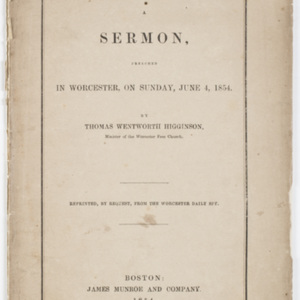
Thomas Wentworth Higginson (1823-1911) was an influential author, abolitionist, Unitarian minister, and soldier. Born in Cambridge, Massachusetts, in 1823, Higginson attended Harvard University and Harvard Divinity School, finishing his divinity…
"To the Inhabitants of the Province of Massachusetts Bay."
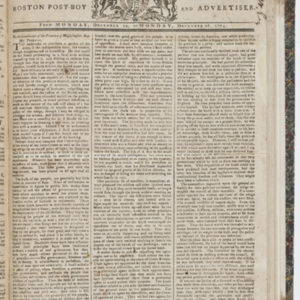
Daniel Leonard (1740-1829) was a lawyer and devoted loyalist. He lived in Taunton, Massachusetts, and was a member of one of the leading and wealthiest families in the commonwealth. In 1774, he was forced to flee his home by his Whig neighbors. He…
Concio Hyemalis. A Winter Sermon.
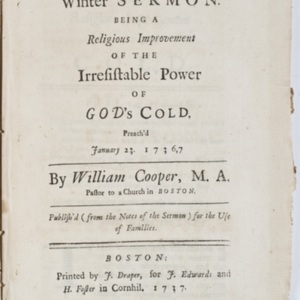
From 1716 until his death in 1743, William Cooper (1694-1743) was Benjamin Colman’s colleague in ministry at Boston’s Brattle Street Church. Like Colman and like Thomas Prince at Old South Church, Cooper frequently preached on current…
The last Speech and dying Advice of poor Julian, Who was Executed the 22d of March, 1733. for the Murder of Mr. John Rogers of Pembroke.

One genre of news broadside in colonial America, quite different in quality from the elegantly printed government proclamation, was the confession or “last speech” of a condemned criminal. These were typically small sheets, printed quickly on cheap…
"To the Inhabitants of the Colony of Massachusetts-Bay."
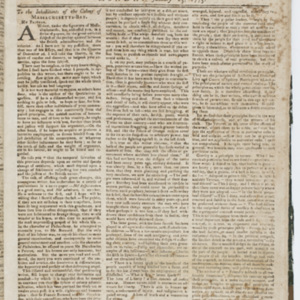
In 1774 and 1775, lawyer and devoted loyalist Daniel Leonard (1740-1829) wrote a series of seventeen articles, published in the Boston Tory newspaper Massachusetts Gazette; and the Boston Post-Boy and Advertiser, under the pseudonym…
Letter from Timothy Bigelow to Stephen Salisbury, October 7 and 14, 1777
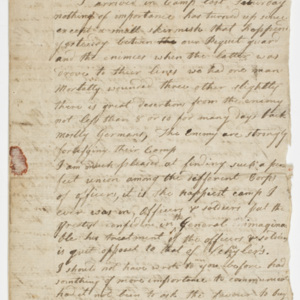
Throughout the Revolution, war news was conveyed through personal letters, as is evident by these two letters written by Timothy Bigelow (1739-90) to Stephen Salisbury (1746-1829). At this time Bigelow was a colonel in command of the Fifteenth…