Browse Items (116 total)
Sort by:
"Williamsburg, July 7. At a respectable meeting of the Freeholders and Freemen of the county of Richmond…"
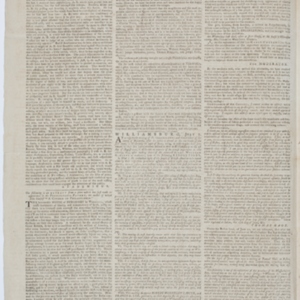
This issue of the Virginia Gazette includes a summary of a meeting held to discuss resolutions with the representatives from Richmond County who would be attending the First Virginia Convention on August 1, 1774. (There would eventually be five…
"PHILADELPHIA, April 27, 1775. Extracts of Letters from BOSTON, per post."
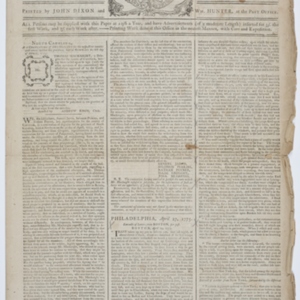
This May 6, 1775, issue of John Dixon (d. 1791) and William Hunter’s Virginia Gazette illustrates how news of Lexington and Concord spread throughout the colonies.On the first page in the middle column are extracts of letters from Boston about…
Fair copy of the Circumstantial Account sent to Gov. Trumbull of Connecticut
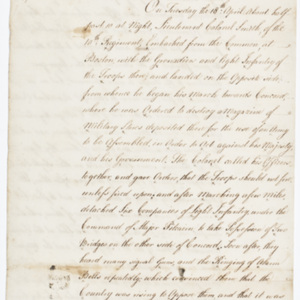
The royal governor of Massachusetts, General Thomas Gage (1719-87), responded to the flurry of news reports of the Battles of Lexington and Concord by sending official accounts of the confrontation to high officials in the adjoining colonies. He…
The Oriental, or, Tung-Ngai San-Luk
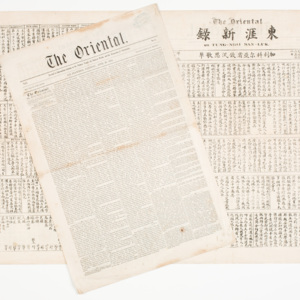
Newspapers in foreign languages catering to the growing immigrant populations popped up throughout the antebellum era. They appeared in German, French, Spanish, Italian, Polish, Welsh, Swedish, Norwegian, Danish, Dutch, and Hawaiian.
Chinese…
Horseneck Truth-Teller and Gossip Journal
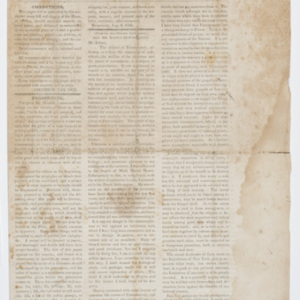
This is the first volume of the Horseneck Truth-Teller, and Gossip’s Journal, an example of a popular genre of newspaper new in the antebellum era: the gossip and moral-exposure paper. The publisher was given as Diedrich van Tod, but it was…
The Truth Teller

As the country grew in the antebellum years, so did the diversity of its population. This diversity, which included linguistic, religious, and ethnic differences, was reflected in the types of newspapers that appeared. This paper, The Truth Teller,…
The Sun
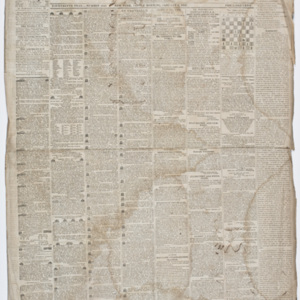
As the number of newspapers grew throughout the United States, so did the frequency of publication. The first daily newspaper in America appeared in Philadelphia in 1783, and by 1800 Philadelphia had six dailies, New York had five, Baltimore three,…
Tippecanoe Banner and Spirit of Democracy

This paper is an example of a presidential campaign newspaper, a form that became very popular during the 1840s and 1850s. This one supports the election of William Henry Harrison (1773-1841). The hotly contested presidential election of 1840…
Cherokee Phoenix

The Cherokee Phoenix was the first newspaper published by Native Americans. In 1825 the Cherokee Council pledged $1,500 for the purchase of a printing press and type; the American Board of Commissioners for Foreign Missions also pledged assistance.…
The Temperance Family Almanac for the Year of Our Lord 1835
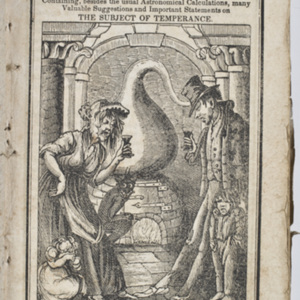
As with many other reform movements of the day, temperance activists made use of a variety of print media to further their cause, including the long-popular genre of almanacs. It became common for antebellum reform organizations to publish almanacs…