Browse Items (116 total)
Sort by:
Bloody Butchery, by the British Troops: or, The Runaway Fight of the Regulars.
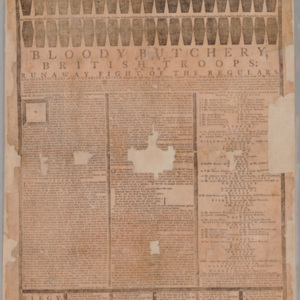
The American account of the events at Lexington and Concord is recounted in this dramatic broadside. Note the heavy black borders and the coffins that adorn the top of the broadside. Both the graphics and the inflammatory prose are designed to incite…
A Narrative, of the Excursion and Ravages of the King's Troops
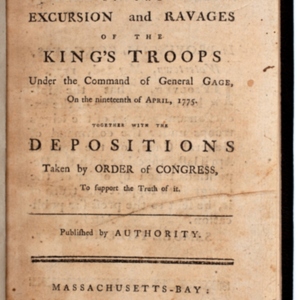
This book, commissioned by the new Provincial Congress, was one of the first items printed in Worcester, Massachusetts, after printer Isaiah Thomas’s arrival in April 1775. As the title explains, it is A Narrative, of the Excursion and Ravages of the…
The New-Hampshire Gazette, and Historical Chronicle
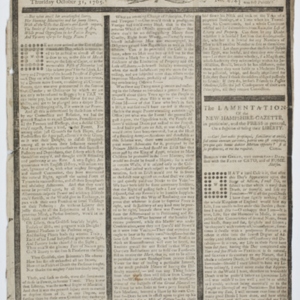
The New-Hampshire Gazette, published by Daniel Fowle (ca. 1715-87), was typical of many newspapers throughout the colonies that protested the steep taxes instituted by the Stamp Act on virtually every aspect of a printer’s business. Printers…
Glorious News. Boston, Friday 11 o'Clock, 16th May 1766.

This broadside proclaims the “Glorious News” that on March 18, 1766, the king had given his assent to Parliament’s act to repeal the Stamp Act. In order to authenticate the news, the broadside explains exactly where it came from: a ship of John…
The American Weekly Mercury

The first newspaper to appear in America outside Boston was the American Weekly Mercury, launched by Andrew Bradford (1686-1742) in Philadelphia in 1719. His father, William Bradford (1663-1752), had opened the first print shop in the new city of…
In Congress, July 4, 1776. A Declaration by the Representatives of the United States of America, in general Congress assembled.
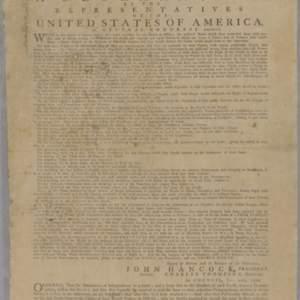
Although it is now the calligraphic version of the Declaration—commissioned by Congress and signed by all the members after it had been accepted by the colonies—that is most familiar today, it was actually through the printed version that the…
Plan of the Siege of York Town in Virginia
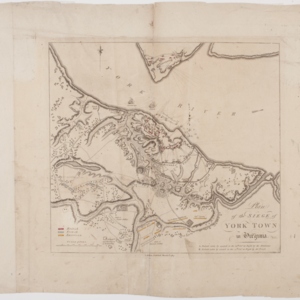
This engraved map was published in London in March 1787. It details the siege of Yorktown in 1781, the last great battle of the American Revolution. It clearly shows the American and French forces as they surround the British forces under the command…
A Poem, Spoken Extempore, by a Young Lady, on hearing the Guns firing and Bells chiming on account of...the Surrender of York Town

As they had been in the pre-war years, broadsides continued to be a way to spread and provide commentary on the news. This broadside features two poems about the surrender of Yorktown. The first is “A Poem Spoken Extempore, by a Young Lady, on…
Rivington's New-York Gazetteer; or The Connecticut, New-Jersey, Hudson's-River, and Quebec Weekly Advertiser
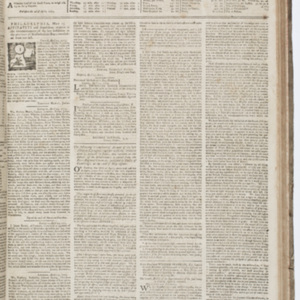
James Rivington (1724-1802), publisher of Rivington’s New-York Gazetteer, was born in London and was a bookseller in his native land before immigrating to the colonies in 1760. He eventually established a bookstore in New York and then ventured into…