Browse Items (116 total)
Sort by:
Soldier's Letter
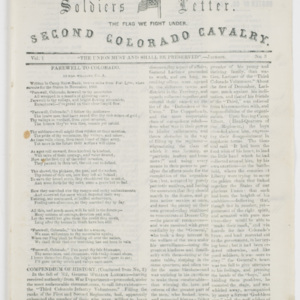
The Soldier’s Letter was a military camp newspaper published in Kansas City, Missouri, and Fort Riley, Kansas.It was issued by the Second Colorado Cavalry and edited by Private Oliver F. Wallace with contributions by other enlisted men and a few…
The News Letter Book for 1737. Weakly News Letters & Journals.
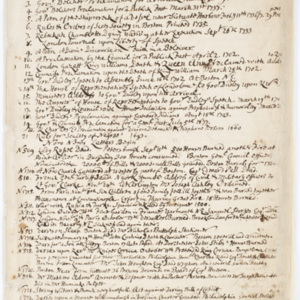
Almanacs, diaries, and newspapers shared a basic structure. Each organized events by the calendar: by day, by week, by month, by year. Each was a kind of annals or chronology, and in New England there was an underlying belief that chronology, whether…
Letter from Samuel Salisbury to Stephen Salisbury, April 20, 1775
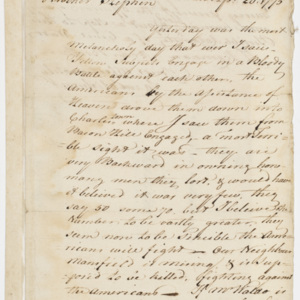
Samuel Salisbury (1739-1818) and his brother Stephen Salisbury (1746-1829) were in business together importing and selling merchandise from England and the West Indies. Samuel was located in Boston while Stephen came to the central Massachusetts…
Attack On the Post Office, Charleston, S.C.
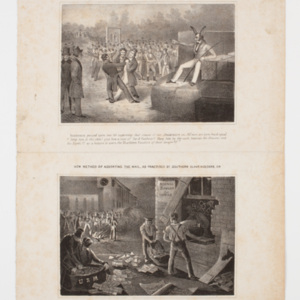
As veterans of the Bible and religious tract movements, the founders of the American Anti-Slavery Society (AASS) believed in the power of the printed word to convert sinners, including those whose sin was slaveholding. Immediately after its founding…
The Anti-Slavery Alphabet
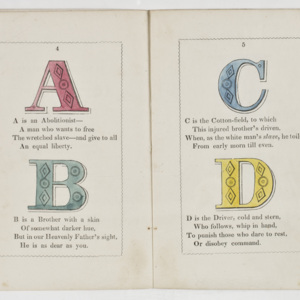
The Anti-Slavery Alphabet is a reader that was published in 1846 for the purpose of being sold at the Anti-Slavery Fair in Philadelphia. The fair was organized by the Philadelphia Female Anti-Slavery Society (PFASS) and raised money for abolitionism…
Effects of the Fugitive-Slave-Law
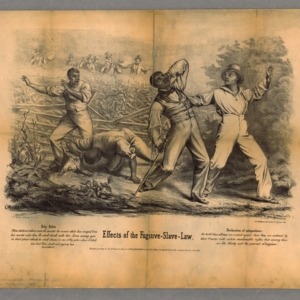
Just as the abolition movement harnessed the power of the printed word in newspapers, periodicals, tracts, and almanacs to spread its antislavery message, it also used printed visuals in the form of lithographs, engravings, and political cartoons. In…
Charleston Mercury Extra: Passed unanimously at 1.15 o'clock, P.M., December 20th, 1860

On November 10, 1860, after a decade of political division and just four days after Lincoln’s election, South Carolina called a secession convention for the following month. Considered by virtue of timing to be the first Confederate imprint, this…
Death of Col. Edward D. Baker, at the Battle of Balls Bluff
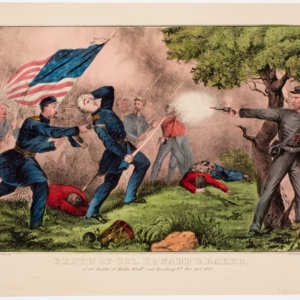
This hand-colored lithograph depicts the dramatic death of Colonel Edward D. Baker (1811-61), the only U.S. senator ever killed in battle. Like Abraham Lincoln, Baker began his political career in Illinois, and the two men developed a strong…
The Empty Sleeve
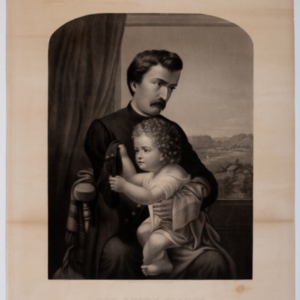
Not all news stories during the Civil War concerned battle outcomes, troop movements, and casualty lists. One ongoing news story—and one that became even more pressing as the war drew to a close—was the emotional and physical wreckage of returning…
An Amalgamation Polka
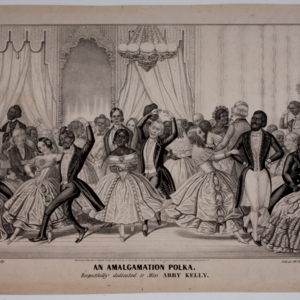
Mid-nineteenth-century visuals of African Americans were largely characterized by satire, an overexaggeration of features, and stereotypes. This lithograph is one of several in an entire Amalgamation Series created by Edward Williams Clay…