Browse Items (116 total)
Sort by:
Attack On the Post Office, Charleston, S.C.
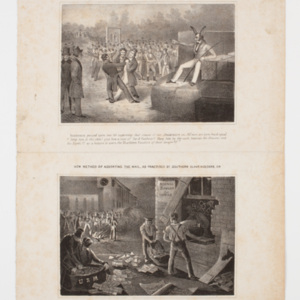
As veterans of the Bible and religious tract movements, the founders of the American Anti-Slavery Society (AASS) believed in the power of the printed word to convert sinners, including those whose sin was slaveholding. Immediately after its founding…
Battle of Antietam
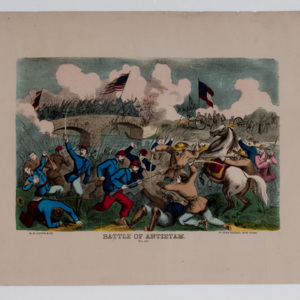
Though lithography gained in popularity in the years leading up to and during the Civil War, relief printing was still a commonly used process for illustration. This hand-colored wood engraving of the Battle of Antietam, which took place on September…
Bird's Eye View of the Seat of War
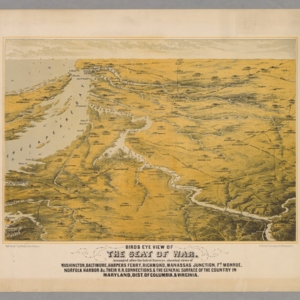
Among the visual ways in which people tried to make sense of the Civil War were maps. Maps helped people visualize the places where their loved ones were fighting, places most of them had never seen. Though few newspapers outside of the illustrated…
Bloody Butchery, by the British Troops: or, The Runaway Fight of the Regulars.
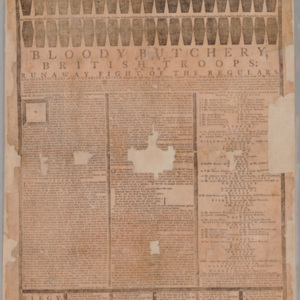
The American account of the events at Lexington and Concord is recounted in this dramatic broadside. Note the heavy black borders and the coffins that adorn the top of the broadside. Both the graphics and the inflammatory prose are designed to incite…
Boston Daily Journal
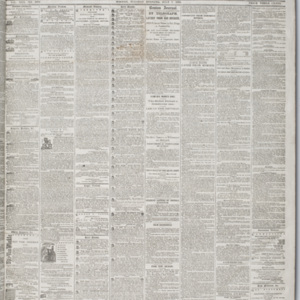
One of the few battlefield reporters to cover the Civil War from beginning to end—from Bull Run to the fall of Richmond—was C.C. Coffin (1823-96) of the Boston Journal. After the Battle of Gettysburg, when the outcome was assured by late…
Boston, April 9, 1773. : Sir, The Committee of Correspondence of this Town have received the following Intelligence...

This broadside, printed in Boston in April 1773, contains the text of a letter from the Virginia House of Burgesses informing Boston of the creation of a standing Committee of Correspondence and assuring the New Englanders of Virginia’s…
By His Excellency Jonathan Belcher, Esq;...A Proclamation.

The most formal medium of news dissemination in colonial New England was the government proclamation, issued by the governor or other high official and printed elegantly in broadside form. Proclamations often announced special days of thanksgiving…
By His Excellency William Shirley, Esq;...A Proclamation.

In colonial America the surest way for a printer to achieve financial stability was to secure government contracts for printing the laws and other official documents. Usually, the government printer also ran his newspaper as a kind of sycophantic…
By the Governour & Council. Whereas some have lately presumed to Print and Disperse a Pamphlet, Entituled, Publick Occurrences

In 1690, a recent immigrant to Boston, Benjamin Harris (d. 1716), decided the time was right to launch a newspaper. In the wake of the Glorious Revolution of 1688 and the royal regime change in England, colonists longed for news from home. Harris,…