Browse Items (116 total)
Sort by:
The New-Hampshire Gazette, and Historical Chronicle
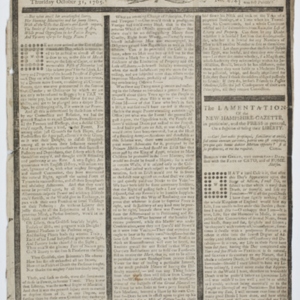
The New-Hampshire Gazette, published by Daniel Fowle (ca. 1715-87), was typical of many newspapers throughout the colonies that protested the steep taxes instituted by the Stamp Act on virtually every aspect of a printer’s business. Printers…
Glorious News. Boston, Friday 11 o'Clock, 16th May 1766.

This broadside proclaims the “Glorious News” that on March 18, 1766, the king had given his assent to Parliament’s act to repeal the Stamp Act. In order to authenticate the news, the broadside explains exactly where it came from: a ship of John…
A View of Part of the Town of Boston in New-England and Brittish Ships of War: Landing Their Troops! 1768
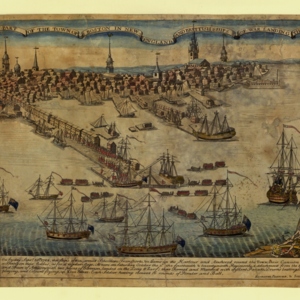
While newspapers decried in print the occupation of Boston by British troops beginning in 1768, Paul Revere (1734-1818), a silversmith and engraver in Boston, also did so visually. This engraving shows Boston Harbor facing the north part of town,…
The Bloody Massacre perpetrated in King - Street Boston on March 5th 1770 by a party of the 29th Regt.
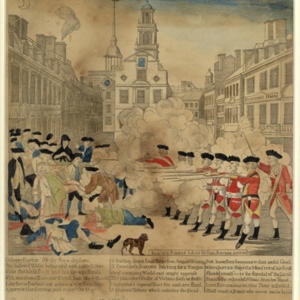
Paul Revere (1734-1818) was a silversmith and engraver born and raised in Boston. Though The Bloody Massacre, often referred to as “The Boston Massacre,” was not Paul Revere’s first foray into using engraving as commentary on news events and…
The American Weekly Mercury

The first newspaper to appear in America outside Boston was the American Weekly Mercury, launched by Andrew Bradford (1686-1742) in Philadelphia in 1719. His father, William Bradford (1663-1752), had opened the first print shop in the new city of…
In Congress, July 4, 1776. A Declaration by the Representatives of the United States of America, in general Congress assembled.
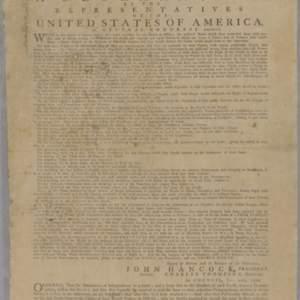
Although it is now the calligraphic version of the Declaration—commissioned by Congress and signed by all the members after it had been accepted by the colonies—that is most familiar today, it was actually through the printed version that the…
By the Governour & Council. Whereas some have lately presumed to Print and Disperse a Pamphlet, Entituled, Publick Occurrences

In 1690, a recent immigrant to Boston, Benjamin Harris (d. 1716), decided the time was right to launch a newspaper. In the wake of the Glorious Revolution of 1688 and the royal regime change in England, colonists longed for news from home. Harris,…
Boston, April 9, 1773. : Sir, The Committee of Correspondence of this Town have received the following Intelligence...

This broadside, printed in Boston in April 1773, contains the text of a letter from the Virginia House of Burgesses informing Boston of the creation of a standing Committee of Correspondence and assuring the New Englanders of Virginia’s…
A Plan of the Town and Harbour of Boston. and the Country adjacent with the Road from Boston to Concord Shewing the Place of the late Engagement
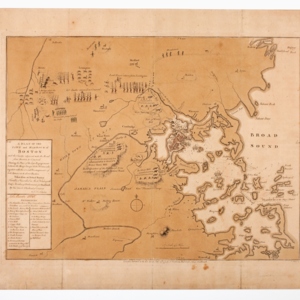
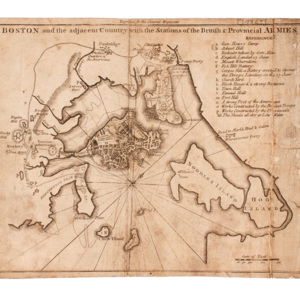
Maps were an important form of news gathering and reporting during the American Revolution. Most were created by engineers in the British army and often they depicted military campaigns or battles, providing not only important intelligence about the…