Browse Items (116 total)
Sort by:
Death of Col. Edward D. Baker, at the Battle of Balls Bluff
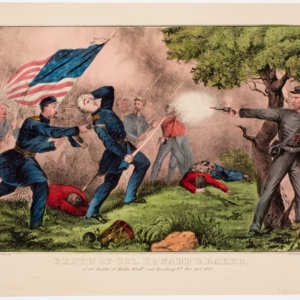
This hand-colored lithograph depicts the dramatic death of Colonel Edward D. Baker (1811-61), the only U.S. senator ever killed in battle. Like Abraham Lincoln, Baker began his political career in Illinois, and the two men developed a strong…
The Lexington of 1861
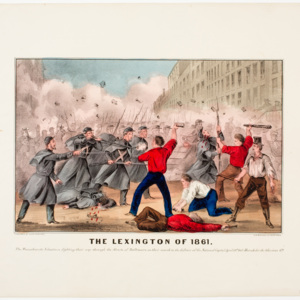
In many cases, visual resources not only provided a means by which to depict a news event, but also a way to interpret that event. This lithograph, produced by Currier & Ives, shows the Sixth Massachusetts Volunteer Regiment fighting its way…
A Plan of the Town and Harbour of Boston. and the Country adjacent with the Road from Boston to Concord Shewing the Place of the late Engagement
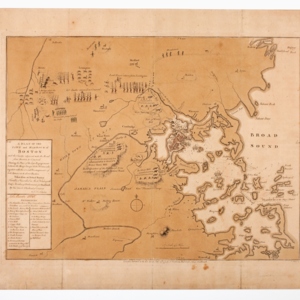
Maps were an important form of news gathering and reporting during the American Revolution. Most were created by engineers in the British army and often they depicted military campaigns or battles, providing not only important intelligence about the…
A sermon...Occasioned by the capture of the British Army, under the command of Earl Cornwallis
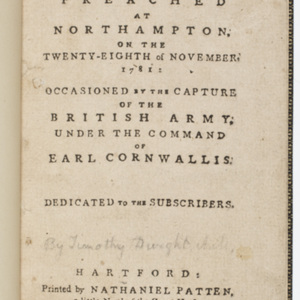
Just as before the war, sermons were still an important means of reflecting on and spreading news. This sermon, preached by Timothy Dwight (1752-1817) at Northampton, Massachusetts, on November 28, 1781, puts news of the British surrender at Yorktown…
Politics In an Oyster-House. Les Politiques au Cabaret.
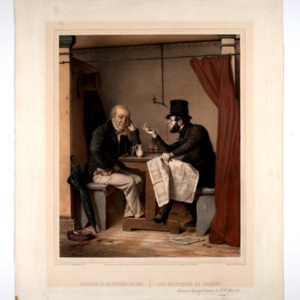
This 1851 lithograph, after an 1848 painting by Richard Caton Woodville (1825-55), encapsulates the central role the newspaper played in American politics. In the image, two men sit across the table from each other in an oyster house, an…
Massachusetts in Mourning
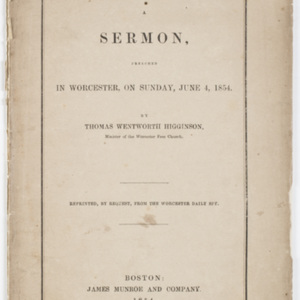
Thomas Wentworth Higginson (1823-1911) was an influential author, abolitionist, Unitarian minister, and soldier. Born in Cambridge, Massachusetts, in 1823, Higginson attended Harvard University and Harvard Divinity School, finishing his divinity…
"An extensively read News paper"

In the 1840s and 1850s, thanks to steam-powered and rotary presses, newspaper dimensions were often enormous. The size of the printing presses, their ability to print evenly over a large surface area, and the speed with which they could print…
Mexican News

This 1853 engraving by Alfred Jones (1819-1900), called Mexican News, is based on a popular 1848 painting by Richard Caton Woodville (1825-55) titled War News from Mexico. The image places the newspaper at center stage and illustrates how ingrained…
The last Speech and dying Advice of poor Julian, Who was Executed the 22d of March, 1733. for the Murder of Mr. John Rogers of Pembroke.

One genre of news broadside in colonial America, quite different in quality from the elegantly printed government proclamation, was the confession or “last speech” of a condemned criminal. These were typically small sheets, printed quickly on cheap…
By the Governour & Council. Whereas some have lately presumed to Print and Disperse a Pamphlet, Entituled, Publick Occurrences

In 1690, a recent immigrant to Boston, Benjamin Harris (d. 1716), decided the time was right to launch a newspaper. In the wake of the Glorious Revolution of 1688 and the royal regime change in England, colonists longed for news from home. Harris,…