Browse Items (116 total)
Sort by:
The Pennsylvania Gazette

Biographers and historians agree that Benjamin Franklin (1706-90) was the best journalist in colonial America and his Pennsylvania Gazette the best newspaper. Founded in 1728, the Gazette was the second newspaper to be produced in Philadelphia. In…
The Oriental, or, Tung-Ngai San-Luk
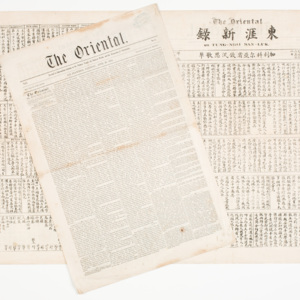
Newspapers in foreign languages catering to the growing immigrant populations popped up throughout the antebellum era. They appeared in German, French, Spanish, Italian, Polish, Welsh, Swedish, Norwegian, Danish, Dutch, and Hawaiian.
Chinese…
The North Star

The most famous African American in antebellum America was Frederick Douglass (ca. 1818-95), an escaped slave from Maryland who achieved renown in the North as an antislavery lecturer and writer. Douglass began his abolitionist career in league with…
The News Letter Book for 1737. Weakly News Letters & Journals.
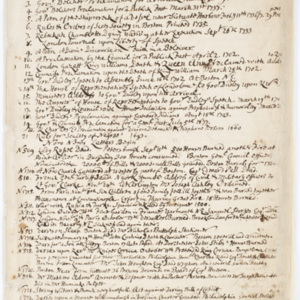
Almanacs, diaries, and newspapers shared a basic structure. Each organized events by the calendar: by day, by week, by month, by year. Each was a kind of annals or chronology, and in New England there was an underlying belief that chronology, whether…
The New-York Weekly Journal

The first newspaper in New York was the New-York Gazette, founded in 1725 by William Bradford (1663-1752). The New-York Weekly Journal appeared eight years later, and from its beginning it was more than a business competitor to the Gazette; it was a…
The New-Hampshire Gazette, and Historical Chronicle
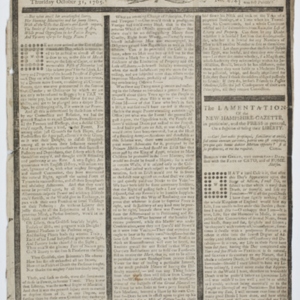
The New-Hampshire Gazette, published by Daniel Fowle (ca. 1715-87), was typical of many newspapers throughout the colonies that protested the steep taxes instituted by the Stamp Act on virtually every aspect of a printer’s business. Printers…
The New England Weekly Journal
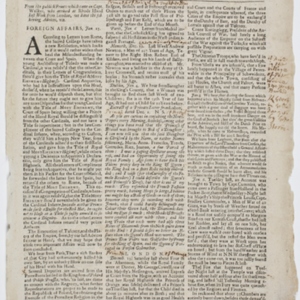
The New England Weekly Journal was founded in 1727 as a literary paper, along the lines of the Spectator in London and New England Courant in Boston, the newspaper that launched the career of Benjamin Franklin. But the Weekly Journal was more aligned…
The Liberator
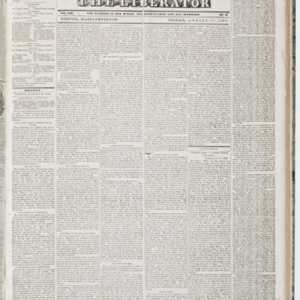
An important category of newspapers in antebellum America was the organizational paper. Every religious or reform movement seemed to have its national and state associations and every association its newspaper. That certainly was true of the…
The Lexington of 1861
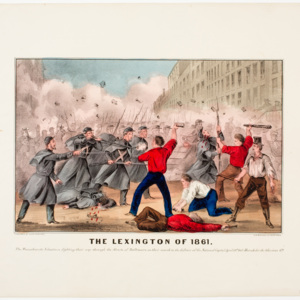
In many cases, visual resources not only provided a means by which to depict a news event, but also a way to interpret that event. This lithograph, produced by Currier & Ives, shows the Sixth Massachusetts Volunteer Regiment fighting its way…
The last Speech and dying Advice of poor Julian, Who was Executed the 22d of March, 1733. for the Murder of Mr. John Rogers of Pembroke.

One genre of news broadside in colonial America, quite different in quality from the elegantly printed government proclamation, was the confession or “last speech” of a condemned criminal. These were typically small sheets, printed quickly on cheap…