Browse Items (116 total)
Sort by:
The Virginia Gazette

The first newspaper in America south of the Potomac River was the Virginia Gazette, founded by William Parks (1699-1750) in 1736. Parks, who had previously operated a print shop and published a newspaper in Maryland, brought printing to Williamsburg…
The Boston News-Letter

The Boston News-Letter was the first newspaper in America to survive beyond its first issue. Indeed, it survived for seventy-two years as a fixture of the Boston publishing scene. The founding editor and publisher was John Campbell (1653-1728), who…
The Daily Dispatch
Getting news by telegraph and railroad was much more difficult for Southern newspapers than Northern papers. This was true in general, but even more so when General Lee’s Army of Northern Virginia crossed the Potomac into Northern territory.…
Boston Daily Journal
One of the few battlefield reporters to cover the Civil War from beginning to end—from Bull Run to the fall of Richmond—was C.C. Coffin (1823-96) of the Boston Journal. After the Battle of Gettysburg, when the outcome was assured by late…
The Truant Boy
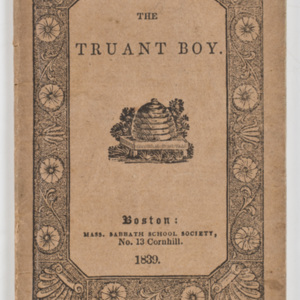
The national Sunday school movement, like other religious and reform movements in the early nineteenth century, was fundamentally a publishing enterprise. The goal was to organize and support Sunday schools, but the chief means to that end was the…
"The Colporter."
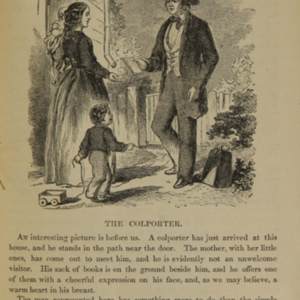
This illustration depicts an American Tract Society (ATS) colporteur at work. The term “colporteur” was coined in eighteenth-century France as a name for itinerant peddlers of books, especially religious books. In America, the term came…
Poor Richard, 1739. An Almanack for the Year of Christ 1739.

Throughout the colonial period, almanacs were the best-selling product of the American press. The almanac was one of the first imprints of the Cambridge Press—the first press in British North America—in the 1640s; by the 1760s tens of…
The Pennsylvania Gazette

Biographers and historians agree that Benjamin Franklin (1706-90) was the best journalist in colonial America and his Pennsylvania Gazette the best newspaper. Founded in 1728, the Gazette was the second newspaper to be produced in Philadelphia. In…
The New-York Weekly Journal

The first newspaper in New York was the New-York Gazette, founded in 1725 by William Bradford (1663-1752). The New-York Weekly Journal appeared eight years later, and from its beginning it was more than a business competitor to the Gazette; it was a…
A Poem Occasioned by the untimely Death of Hugh Henderson, alias John Hamilton, who was Hangd at Worcester for House-Breaking. Nov. 24. 1737.

Public executions had long been popular news events in Europe, and they fit well into the news environment of Puritan New England. They were sensational, which appealed to the voyeurism of audiences, but they were also morally instructive, which…