Browse Items (116 total)
Sort by:
"A Typical Negro"

As the war progressed, Harper’s Weekly changed from toeing the middle political (or even apolitical) ground to a more outright Union stance. This was also the case for its attitude toward African Americans. By 1863, especially after the…
The Southern Illustrated News
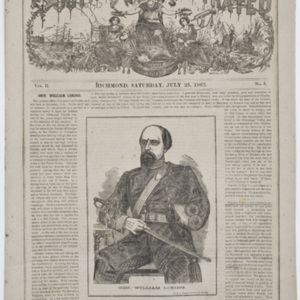
Before the Civil War, Southerners were also consuming the popular Harper’s Weekly and Frank Leslie’s Illustrated Newspaper. After the commencement of the war, however, readers in the Confederate states were cut off from these papers. In…
The North Star

The most famous African American in antebellum America was Frederick Douglass (ca. 1818-95), an escaped slave from Maryland who achieved renown in the North as an antislavery lecturer and writer. Douglass began his abolitionist career in league with…
Extraordinary Events the Doings of God, and Marvellous in Pious Eyes

Thomas Prince (1687-1758), the senior minister of Old South Church in Boston from 1718 until his death in 1758, was a leading American proponent of the new natural sciences and the British Enlightenment. Yet he was a theological conservative who…
"Journal of Occurrences"

Although the repeal of the Stamp Act led many to briefly believe the Crown would leave the colonies alone, the institution of the Townshend Acts in 1767 erased that hope. The colonists’ resistance to these acts led to the establishment of…
Disturnell's New Map of the United States and Canada; Showing All the Canals, Rail Roads, Telegraph Lines and Principal Stage Routes

The rapid expansion of new modes of transportation and communication technology that increasingly connected the American states is evident in this 1856 Disturnell’s New Map of the United States and Canada. Drawn by Henry A. Burr, the topographer to…