Browse Items (116 total)
Sort by:
In Congress, July 4, 1776. A Declaration by the Representatives of the United States of America, in general Congress assembled.
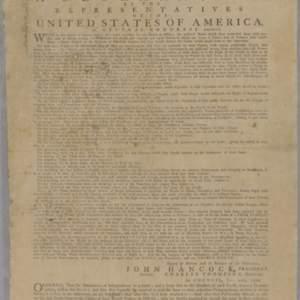
Although it is now the calligraphic version of the Declaration—commissioned by Congress and signed by all the members after it had been accepted by the colonies—that is most familiar today, it was actually through the printed version that the…
The American Weekly Mercury

The first newspaper to appear in America outside Boston was the American Weekly Mercury, launched by Andrew Bradford (1686-1742) in Philadelphia in 1719. His father, William Bradford (1663-1752), had opened the first print shop in the new city of…
The Bloody Massacre perpetrated in King - Street Boston on March 5th 1770 by a party of the 29th Regt.
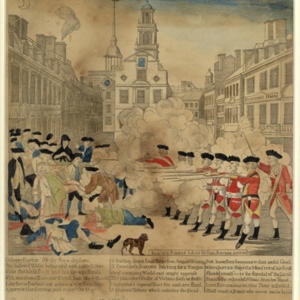
Paul Revere (1734-1818) was a silversmith and engraver born and raised in Boston. Though The Bloody Massacre, often referred to as “The Boston Massacre,” was not Paul Revere’s first foray into using engraving as commentary on news events and…
A View of Part of the Town of Boston in New-England and Brittish Ships of War: Landing Their Troops! 1768
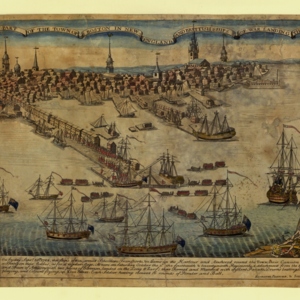
While newspapers decried in print the occupation of Boston by British troops beginning in 1768, Paul Revere (1734-1818), a silversmith and engraver in Boston, also did so visually. This engraving shows Boston Harbor facing the north part of town,…
Glorious News. Boston, Friday 11 o'Clock, 16th May 1766.

This broadside proclaims the “Glorious News” that on March 18, 1766, the king had given his assent to Parliament’s act to repeal the Stamp Act. In order to authenticate the news, the broadside explains exactly where it came from: a ship of John…
The New-Hampshire Gazette, and Historical Chronicle
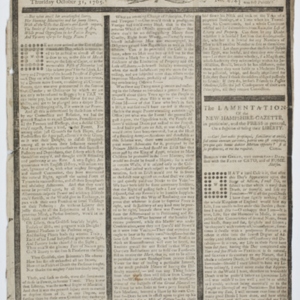
The New-Hampshire Gazette, published by Daniel Fowle (ca. 1715-87), was typical of many newspapers throughout the colonies that protested the steep taxes instituted by the Stamp Act on virtually every aspect of a printer’s business. Printers…
A Narrative, of the Excursion and Ravages of the King's Troops
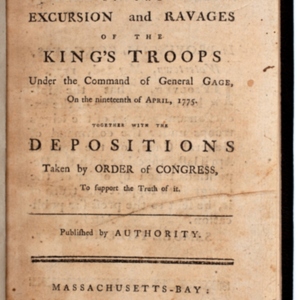
This book, commissioned by the new Provincial Congress, was one of the first items printed in Worcester, Massachusetts, after printer Isaiah Thomas’s arrival in April 1775. As the title explains, it is A Narrative, of the Excursion and Ravages of the…
Thomas Prince Diary
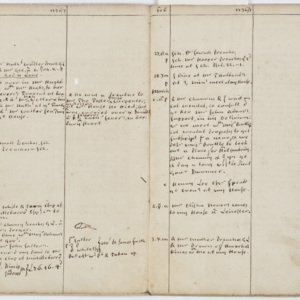
Thomas Prince (1687-1758), born in Sandwich, Massachusetts, was a leading public figure in Boston as senior minister of Old South Church from 1718 until his death. During that forty-year career, Prince was an avid news consumer as well as an…
Mexican News

This 1853 engraving by Alfred Jones (1819-1900), called Mexican News, is based on a popular 1848 painting by Richard Caton Woodville (1825-55) titled War News from Mexico. The image places the newspaper at center stage and illustrates how ingrained…
Bloody Butchery, by the British Troops: or, The Runaway Fight of the Regulars.
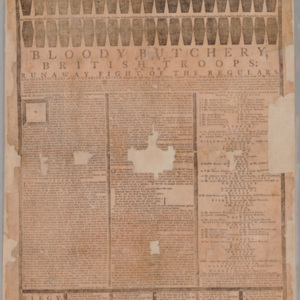
The American account of the events at Lexington and Concord is recounted in this dramatic broadside. Note the heavy black borders and the coffins that adorn the top of the broadside. Both the graphics and the inflammatory prose are designed to incite…