Browse Items (116 total)
Sort by:
"Worcester, July 24…On Monday last a number of patriotic gentlemen of this town…assembled on the green near the liberty pole…"
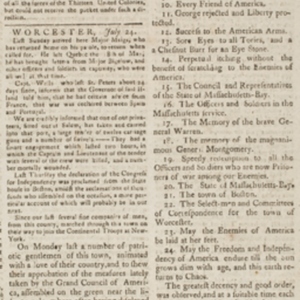
Public readings of the newly minted Declaration of Independence took place in taverns, churches, town greens, or anywhere else people could gather. In New England, the first public reading of the Declaration of Independence is believed to have taken…
First printing of the Declaration of Independence in a newspaper
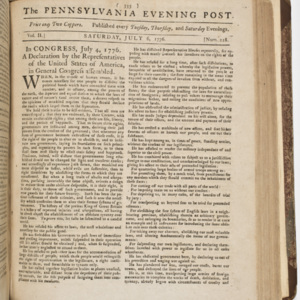
The Continental Congress charged five men with the responsibility to commit to paper the American colonies’ Declaration of Independence from Britain: Thomas Jefferson (1743-1826), Benjamin Franklin (1706-90), John Adams (1735-1826), Robert…
"Bloody News. Portsmouth, April 20, 1775."
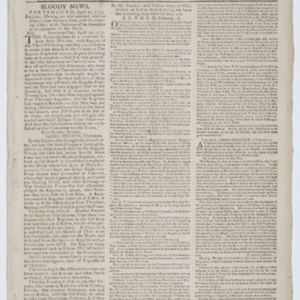
Although breaking news usually appeared on the interior of colonial newspapers as that side of the paper was generally printed last, this copy of the New-Hampshire Gazette—published by Daniel Fowle (ca. 1715-87)—leads with a front-page…
Rivington's New-York Gazetteer; or The Connecticut, New-Jersey, Hudson's-River, and Quebec Weekly Advertiser
James Rivington (1724-1802), publisher of Rivington’s New-York Gazetteer, was born in London and was a bookseller in his native land before immigrating to the colonies in 1760. He eventually established a bookstore in New York and then ventured into…
A Poem, Spoken Extempore, by a Young Lady, on hearing the Guns firing and Bells chiming on account of...the Surrender of York Town

As they had been in the pre-war years, broadsides continued to be a way to spread and provide commentary on the news. This broadside features two poems about the surrender of Yorktown. The first is “A Poem Spoken Extempore, by a Young Lady, on…
Plan of the Siege of York Town in Virginia
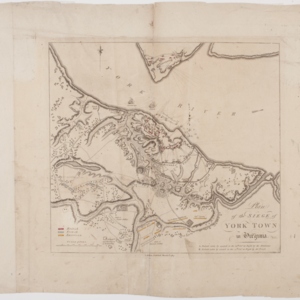
This engraved map was published in London in March 1787. It details the siege of Yorktown in 1781, the last great battle of the American Revolution. It clearly shows the American and French forces as they surround the British forces under the command…
A Plan of the Town and Harbour of Boston. and the Country adjacent with the Road from Boston to Concord Shewing the Place of the late Engagement
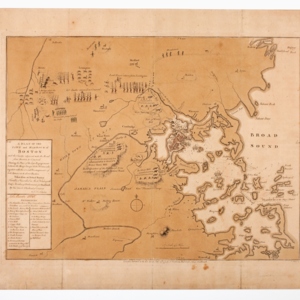
Maps were an important form of news gathering and reporting during the American Revolution. Most were created by engineers in the British army and often they depicted military campaigns or battles, providing not only important intelligence about the…
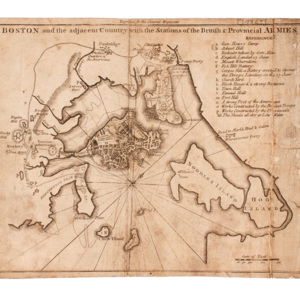
Boston, April 9, 1773. : Sir, The Committee of Correspondence of this Town have received the following Intelligence...

This broadside, printed in Boston in April 1773, contains the text of a letter from the Virginia House of Burgesses informing Boston of the creation of a standing Committee of Correspondence and assuring the New Englanders of Virginia’s…
By the Governour & Council. Whereas some have lately presumed to Print and Disperse a Pamphlet, Entituled, Publick Occurrences

In 1690, a recent immigrant to Boston, Benjamin Harris (d. 1716), decided the time was right to launch a newspaper. In the wake of the Glorious Revolution of 1688 and the royal regime change in England, colonists longed for news from home. Harris,…