Click below to hear selected verses of "The Death of General Wolf"
performed by David & Ginger Hildebrand
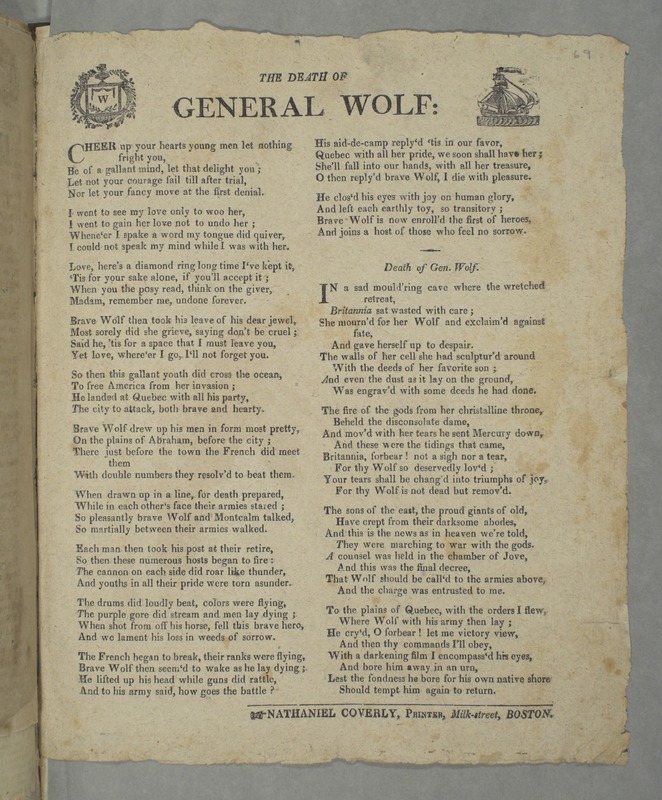
James Wolfe (1727-59) was a hero replaced in Americans’ hearts and minds by another larger-than-life hero, George Washington, who arrived in Boston in 1775. The two texts on this broadside celebrate Wolfe, who successfully led the 1759 siege of Quebec but died during the culminating attack. Probably inspired by Benjamin West’s highly sentimentalized 1771 depiction of Wolfe’s death, these texts were reprinted many times, often together, although the pairing is thematic only (Mackenzie 198-200; Laws 119; Schrader, “Broadside Ballads” 101-7; Ford, Broadsides #1156-60, #3048-52; Roud). The two texts come from vastly different sources: the first is an American folk ballad.
The earliest records of the first text, popularly called “Brave Wolfe,” are three American manuscript copies dating from the late 1790s (Kingsley; Brooks; Bragdon). The ballad could have been written and sung as early as 1759, but there is no reliable documentation and it is not likely. In his note to the Pennsylvania Magazine when he submitted his text to be published, Paine says that he did not know of any other text celebrating Wolfe. The song is still cherished in American folk memory today. In 1814 there were already distinct variant forms for this relatively recently created ballad. This broadside and The Death of General Wolfe: Together with John Bull’s Description of a Church contain two versions, each of which contains parts collected in twentieth-century oral tradition. This has twelve verses. It is generally a fine example of American folk ballad style, but the last verse does not appear in either oral versions collected in the twentieth century or in most earlier broadside versions. When compared to The Death of General Wolfe: Together with John Bull’s Description of a Church, which has nine similar verses and one entirely different verse, the first text seems to have been improved, perhaps by Coverly to pair better with the second song on the sheet.
The associated tune for this text has also had remarkable longevity and was used only with these lyrics. Two American fiddlers wrote out the tune in the 1790s in virtually the same version, and theirs is that same tune that survived in oral tradition (Perkins, “Collection”; Kingsley). Not only is it unusual for a folk ballad and tune to be so closely associated in eighteenth-century sources, but it is even rarer for such a basic tune and text to remain together from the eighteenth to the twentieth-century folk ballad.
Citation
“The Death of General Wolf:,” Isaiah Thomas Broadside Ballads Project, accessed October 22, 2026, https://collections.americanantiquarian.org/thomasballads/items/show/77.