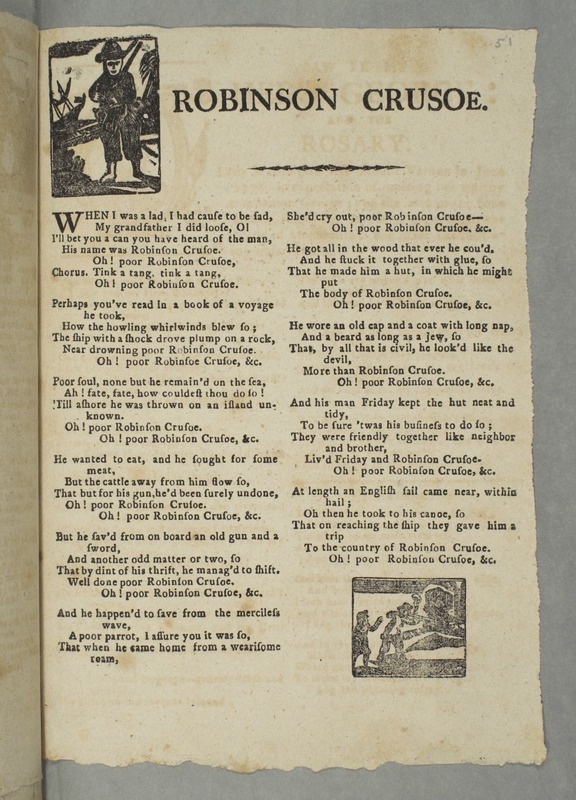
The Life and Strange Surprising Adventures of Robinson Crusoe by Daniel Defoe was published in 1719 with immediate success. It inspired many imitations. This lyric drew on Defoe’s story and was set to a version of an old military duty tune called “The Rogues March.”
The premier of a pantomime/harlequinade titled “Robinson Crusoe” occurred on January 29, 1781. The book was by Richard Brinsley Sheridan (1751-1816); the music arranged by Thomas Linley Sr. (1733-95) (Hogan 1:405; Fiske 446-47). According to Iona and Peter Opie, “Jack Cussans, vagabond and singer of the late eighteenth century” wrote the song to a tune from the 1781 show. They cite a sheet music edition entitled Oh, Poor Robinson Crusoe, “A favourite Comic Chaunt written and sung by Mr. Cussans at the Royal Circus and Sadler’s Wells with universal applause” (1797). John P. Cussans appeared on the London stage once in 1798. A patriotic lyric set to the same tune by Thomas John Dibdin (1771-1841) appeared about the same time, entitled “The Tight (or Snug) Little Island” and performed in The British Taft (1797). It began “Daddy Neptune one day to freedom did say.” It is unclear which came first (373-74).
Much of Linley’s music was borrowed from known sources, the quotations providing much humor to the audience. “The Rogues March” was widely known and usually played for dishonorable discharges and public punishments from the 1750s well into the nineteenth century. These sentiments are not part of the Robinson Crusoe story, thus the choice may have been intentional for its comic effect. The song was later included in the revival of Samuel Foote’s farce, The Mayor of Garret (ca. 1809), printed in thirteen songsters between 1801 and 1818, and lived on in oral tradition (R. Keller, Early American Songsters; Roud #5805). According to a broadside advertisement from April 30, 1810, a pantomime called Robinson Crusoe and His Man Friday played in Boston that year, perhaps creating a market for this piece.