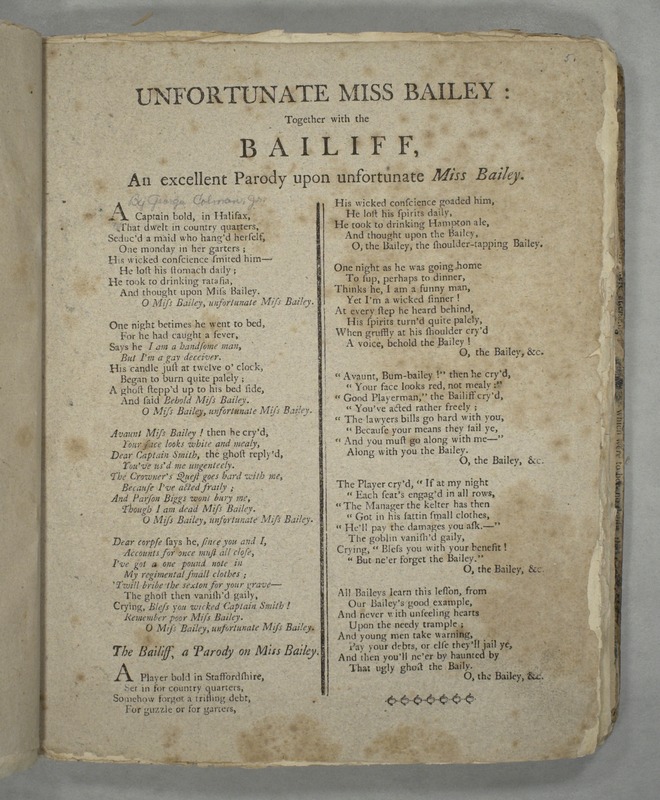
“Unfortunate Miss Bailey” treats seduction as ruthless low comedy. The victim appears at midnight as a ghost, complaining that because she committed suicide, she cannot be buried. The murderer is frightened into doing something to atone for his crime, but all he will do is bribe the sexton to dig a grave; he has no remorse—the ghost “vanish’d gaily,” evidently accepting his offer.
The song was first used in Love Laughs at Locksmiths (1803) by George Colman the Younger (1762-1836), which was performed in Boston a number of times between 1805 and 1814 (Porter, With an Air 523). Sung by Risk in the second act, it is usually credited to Colman although it was interpolated into the score after the show had opened. It was set to the tune of Samuel Foote’s comic song “Ally Croaker” (see Teague’s Ramble to the Camp), which he wrote for his comedy The Englishman in Paris (1753).
Colman’s text was printed in several newspapers in 1803. In the Newark (NJ) Centinel of Freedom on November 22, 1803, the editor revealed the reason he chose to print the new song.
The following is from the pen of Mr. Colman, an English author, of the highest celebrity, as a writer of dramatic pieces. It is a very happy way of ridiculing the absurd notion of spectres and hob-goblins, frequently rendered terrific to children by the foolish and culpable stories of nurses and old women.
One has to wonder whether the moral message the song conveyed was entirely appropriate to the same audience. The text appeared in twenty songsters between 1807 and 1820 and on a few broadsides and was printed in the Oxford Book of Light Verse (R. Keller, Early American Songsters; Auden #222). In the twentieth century, the song entered the revival folk song repertory, propelled to fame by the Kingston Trio who discovered the old song, performed it widely, and recorded it in 1959 on the album Here We Go Again.
In the early 1820s the tune of “Miss Bailey” was used in turn by Samuel Woodworth for a new song called “Hunters of Kentucky,” which became popular with traveling theatrical companies and lasted among folk performers. Paul F. Wells and Anne Dhu McLucas have discussed the role of musical theater as a link between folk and popular traditions, using “Rose Tree” (see Guardian Angels) and “Miss Bailey” as examples (99-115).
“The Bailiff,” an amusing parody on the first song on this broadside, plays on the victim’s name as it means an English arresting officer, the bailey or bailiff. In this case, an actor tries to drink away his conscience about a small debt he owes. When the bailey comes to arrest him for the debt, he promises to pay the debt back from the proceeds at his benefit performance, presumably scheduled in the near future. This promise causes the bailey to vanish with the warning not to forget. The lyric ends with a moral verse encouraging gentle treatment with the needy, and advice to pay your debts, suggesting that it was written with an eye to an early nineteenth-century consumer. The song appeared in nine songsters between 1807 and 1820 (R. Keller, Early American Songsters).