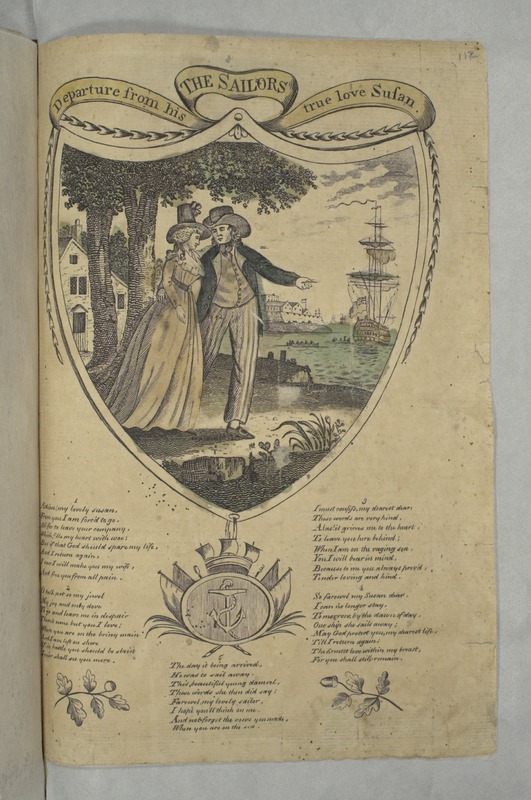
The Sailors departure from his true love Susan
“The Sailor’s Departure from His True Love Susan” is an English lyric of the “William and Susan” genre—the mariner’s farewell to his love on sailing—this time in dialogue form. William’s invoking God’s protection for Susan marks this as a more modern lyric, closer to nineteenth-century sentiments than earlier texts of this genre. See also Black Ey’d Susan.
Before Isaiah Thomas gave the collection of broadsides he had bought in Boston to his binder, he added eight sheets to the second volume, one of them a program for a celebration he had attended (see Order of Performances) and seven of them English prints, bound together near the back of the volume. Three of the English prints are identified as coming from John Evans’s press at Long Lane, West Smithfield, between 1791 and 1792—see A Sequel to the Disconsolate Sailor, Bonney Bet of Aberdeen, and Wives and Sweethearts—and the others resemble them closely—see The Lovely Apparition, The Plough Boy, and The Rose Tree. They are printed from engraved plates and the fine details of the illustrations are enhanced with watercolors. Broadsides like these were rare in America although not unknown—it is likely that Thomas obtained the sheets directly from his favorite bookseller in London, Thomas Evans (McCorison, “Memoirs” 29). We have found no other broadsides like these in American collections except for the two uncolored sheets by Horace Doolittle, engraved between 1799 and 1804. These contained “Dog and Gun” and “I Am Not Twenty,” popular songs of limited circulation in American songsters and not otherwise found in broadsides (Harlow 107-8).
Citation
“The Sailors departure from his true love Susan,” Isaiah Thomas Broadside Ballads Project, accessed October 22, 2026, https://collections.americanantiquarian.org/thomasballads/items/show/38.