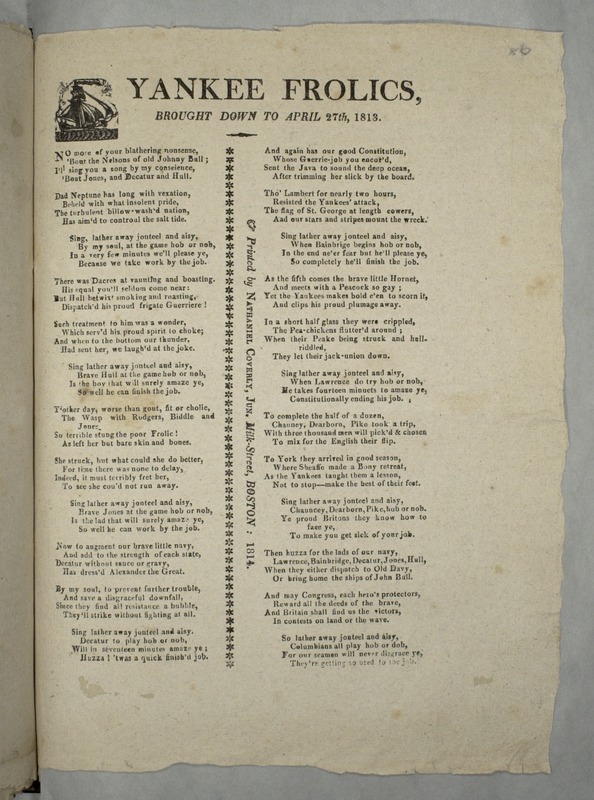
The first column of this amusing song, “Yankee Frolics,” was printed in the Philadelphia Aurora on December 15, 1812 (Lawrence 197). It was updated—“brought down to Feb. 23, 1813”—in a seven-verse version published in the Boston Independent Chronicle on April 1, 1813. As the title suggests, for this edition Coverly inserted an additional verse before the last to include the new victories, bringing the text “down to April 27th, 1813.” Commander Martin reviews this broadside type and the events listed in it:
After six months or so of war, the United States Navy had compiled a rather respectable record. Never mind that Great Britain was heavily engaged in a war with Napoleon Bonaparte. Never mind that it took time to outfit and redeploy men and ships from Britain to address this new theater of war. Unlike the abortive efforts of the United States Army, the little navy was doing itself proud and in the process making the citizenry proud. It was a marketer’s dream for the purveyors of broadsides.
The catalog broadside, of which Yankee Frolics is an excellent example, combines patriotic sentiments with a listing of the naval successes to date. (And notice that an ‘as of’ date is provided!) Following a roughly chronological pattern, listed are the names of the heroes: Jones, Decatur, and Hull; Rodgers, Biddle, Bainbridge, and Lawrence. Each of them had previously received call to public notice in broadsides recalling individual victories. Here, they are listed the way sportswriters today might announce an all-star team. Two enemy captains also merit mention: James Dacres of Guerriere, who had gained a bad reputation for his alleged pre-war activities off our coast, and Henry Lambert, who died nobly fighting Bainbridge.
In the fourth stanza, the writer gives evidence of having seen Decatur’s prize, or at least having read a detailed description of it. The reference to Alexander the Great is not to the historic figure, but to the figurehead on the bow of ex-HMS Macedonian.
A new element is introduced in the saga here: notice is taken of action by the ‘fresh water’ navy on Lake Ontario, for it was on April 27, 1813, that a joint Army-Navy force descended on York, Ontario (now Toronto), capturing one small man-of-war and destroying another a-building. Its leaders were Commodore Isaac Chauncey, Major General Henry Dearborn, and Brigadier General Zebulon Pike (he for whom Pike’s Peak was named). The latter was killed during the operation. An unfortunate incident occurred when the troops got out of hand and set the government buildings ablaze. The burning of Washington sixteen months later was the pay-back. (Forester; Sweetman)
Benson J. Lossing describes the celebrations in New York that followed Decatur’s arrival with his prize, Macedonian. A banquet was followed by a theatrical production at which an early version of the song was sung. Since the song had already appeared in print, it is clear that Lossing’s suggestion that it was written “for this occasion” is in error, but the description does give a good picture of the way songs like this were used.
This banquet was given on Thursday, the 7th of January, 1813, at two o’clock in the afternoon, under the direction of Aldermen Van Der Bilt, Buckmaster, and King. The room had the same decoration as at the time of the banquet given to Hull, Jones, and Decatur, a few days before. The sailors, numbering about four hundred, marched to the hotel in pairs, and were greeted by crowds of men and women in the streets, loud cheers from the multitude, and the waving of handkerchiefs from the windows. The band of the 11th Regiment, among whom was an old trumpeter who had served under Washington, received them with music at the door. At the table they were addressed by Alderman Van Der Bilt, who was responded to by the boatswain of the United States. In the evening they went to the theatre by invitation of the manager, which was communicated to them in person by Decatur. The whole pit was reserved for them. The orchestra opened with Yankee Doodle. The drop curtain, in the form of a transparency, had on it a representation of the fight between the United States and Macedonian. Children danced on the stage. They bore large letters of the alphabet in their hands, which, being joined in the course of the dance, produced in transparency the names of HULL, JONES, and DECATUR. Then Mr. M’Farland, as an Irish clown, came forward and sang a comic song of seven stanzas, written for this occasion, beginning
No more of your blathering nonsense
’Bout Nelsons of old Johnny Bull:
I’ll sing you a song, by my conscience,
’Bout JONES, and DECATUR, and HULL.
Dad Neptune has long, with vexation,
Beheld with what insolent pride
The turbulent, billow-washed nation
Has aimed to control the salt tide.
CHORUS—Sing lather away, jonteel and aisy, By my soul, at the game hob-or-nob,
In a very few minutes we’ll plase ye,
Because we take work by the job.” (457-58)
The song was printed in twenty-one songsters between 1813 and 1820, most of these only the first four verses (R. Keller). According to the print in the Columbian Naval Songster, the tune to which the text was set was an old 9/8 Irish jig called “Moll Roe” used for songs in several eighteenth-century ballad operas and songsters (Simpson 596-98; Wells 2:500-501).