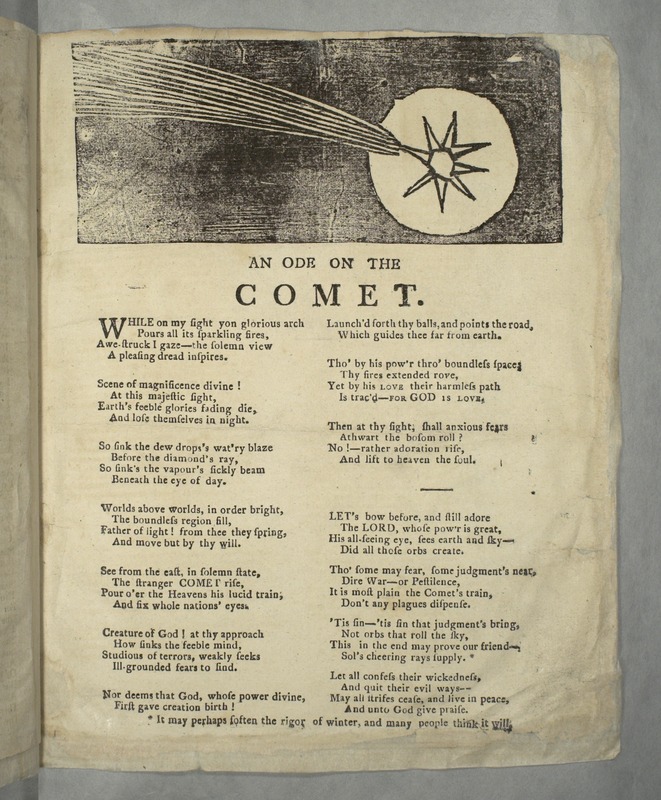
This interesting broadside capitalizes on a dramatic natural phenomenon in the sky that was considered a harbinger of evil by many. With its heavily inked woodcut and stark layout, the sheet probably appealed to buyers for its sensational value as well as for information about something remarkable that they had seen recently.
The “Great Comet” was discovered in the evening sky on March 25, 1811, by Frenchman Honoré Flaugergues. It was one of the largest comets in history and had an unprecedented seventeen-month visibility. At one point during September and October 1811, the coma of the comet reached a diameter nearly that of the sun and became visible to the naked eye by people around the world (Weekly Register 10-11). Isaiah Thomas wrote on September 16 that
the Comet which has made its appearance morning & evening for several weeks past appears more luminous in the evening than it has done hitherto. Its place in evening is in the n. w. near the clever and sets about 9 oclock. (Diary 117-18)
“The clever” was probably the constellation Ursa Major. Thomas further reported on September 27 that the comet “appeared very brilliant at 4 o’clock this morning” (118).
The two texts on this sheet take quite different points of view. With a refreshing new angle on wondrous events, the first author reports on the appearance of the comet as a beautiful creation of God. He assuages fears by crediting God’s love that causes them to trace their “harmless path” through the sky. Rather than be afraid, he calls on the people to praise God and “lift to Heaven the soul.” The poem has nine verses and is in ballad meter. It was printed in the Goshen (NY) Orange County Patriot on November 26, 1811.
The second text on this broadside is also in ballad meter. The opening uses the same phrases and concepts found in On the Dark Day. However, here the author takes full advantage of the people’s fears but with a modern understanding. He tells them that “It is most plain the Comet’s train, / Don’t any plagues dispense.” He then thunders his real reason for writing the verses: “’Tis sin—’tis sin that judgment’s bring / Not orbs that roll the sky.” In the last verse, as in On the Dark Day, people are urged to “confess their wickedness and quit their evil ways.” It is unclear whether the footnote to verse 3 is by the author or the printer. It seems to ignore the direful warning with the prosaic comment that the comet may provide some warmth: “It may perhaps soften the rigor of winter, and many people think it will.”
The comet was noticed in other media as well and used for didactic purposes. The Comet Explained and Improved, a lengthy conversation between a minister and one of his parishioners, was derived largely from the Weekly Register account (Boston Series 211). The message is that the earthly dangers from a comet are nothing compared to the dangers of immortal damnation. Another Boston printer located John Winthrop’s Two Lectures on Comets from 1759 when Haley’s comet had caused such a stir. He reprinted the Harvard professor’s lectures and added a sanguine “supplement, relative to the present comet of 1811.”
Those mysterious strangers now receive a candid welcome. Their gentle radiance has an air of clemency and is viewed with calm complacence. No fears are entertained of their impinging on any of the orbs of our system or exercising a hurtful influence by their approximation. (Winthrop, Davis, and Oliver 189)