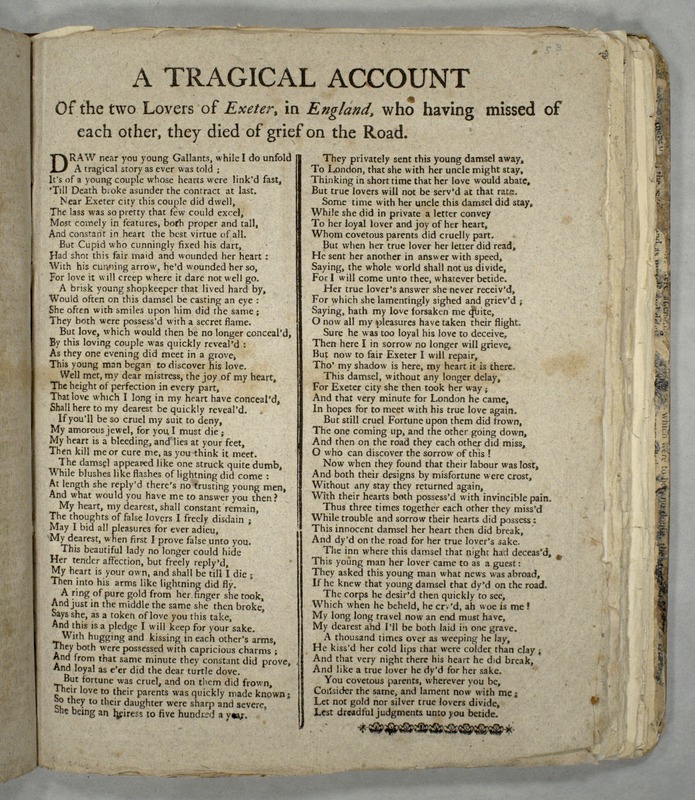
A Tragical account of the two lovers of Exeter, in England, who having missed of each other, they died of grief on the road
This narrative of parental opposition leads to the death of both lovers; she by frustration as she traveled back and forth between London and Exeter to find him, and he on a similar quest through spontaneous sentimental decline on finding her body. A moral admonishing parents for such cruel actions closes the song.
The relatively few extant copies of this broadside may suggest that it was not widely reprinted in America and perhaps only moderately known in England. But the copies at Harvard University are from important broadside and chapbook collections, and there is still much to be learned about the quantitative relationships between print and oral tradition (Schrader, “Broadside Ballads” 95-97; Dugaw, “Tradition” 249-68). Four of the Harvard copies are in chapbooks and on a broadside owned by Bishop Thomas Percy, which he acquired in the 1760s for his work as one of the first serious scholars of balladry (#84, The Two Loyal Lovers of Exeter; Welsh and Tillinghast #805-8; Roud). In addition to another broadside copy printed by Chatham in Coventry, England, the Harvard collection holds the only other reported American broadside edition of this ballad, a sheet printed around 1800 by Coverly’s colleague Joseph White and “Sold near Charles-river Bridge” (Ford, “Broadsides” #3372).
The most important American copy of this ballad is in Eliphalet Mason’s Complete Pocket Song Book (1802). This copy is significant because it is there set to music that the compiler claims to have written. Perhaps most of all, it is important because Mason may have been the first American to consciously collect and publish folk songs. In his preface, Mason explains that, having “for some years past, devoted his leisure time to the study of music, and having been in divers parts of the New-England States, he has selected from singers of song, those words and airs, which are most calculated to instruct the mind and please the ear . . . . The chief design . . . is the promotion of music among young people.” Thus, if Mason did write this tune, it may have been colored by the other tunes he was collecting.
Citation
“A Tragical account of the two lovers of Exeter, in England, who having missed of each other, they died of grief on the road,” Isaiah Thomas Broadside Ballads Project, accessed October 22, 2026, https://collections.americanantiquarian.org/thomasballads/items/show/244.