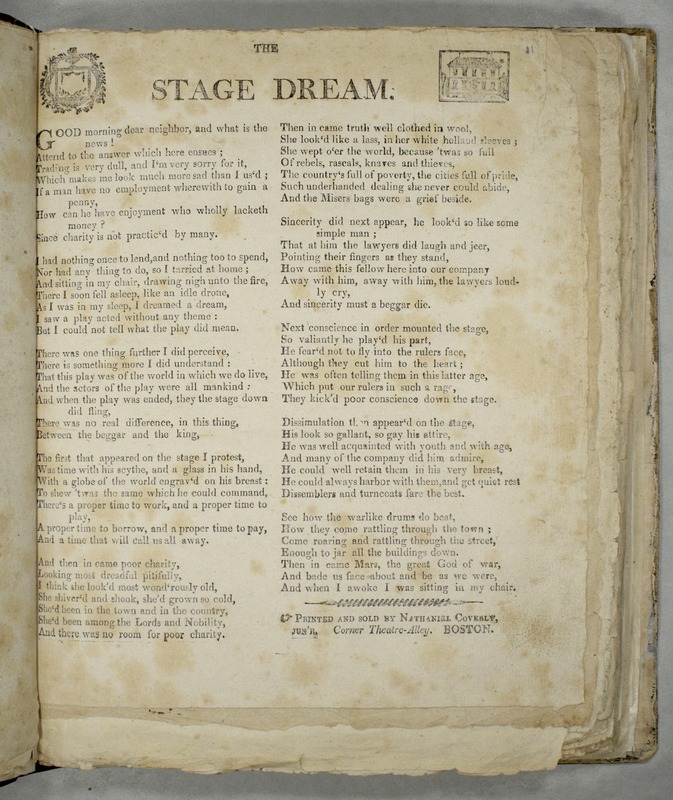
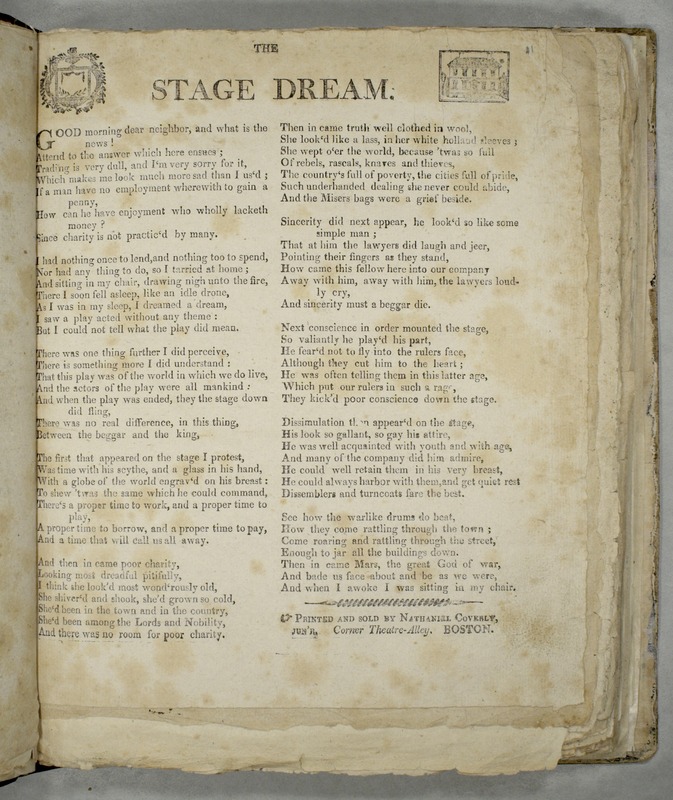
This song with a curious seven-line verse structure is directly derived from an old ballad licensed in 1668, “Poor Robin’s Dream: Commonly Called Poor Charity,” which had an indicated tune of “The New Pack of Cards.” The song criticizes worldly indifference to the needy in the metaphor of a stage play seen in a dream, giving the printer liberty of expression without the danger of official condemnation. The first verse from the older ballad runs
How now! good fellow, what all amort?
I prithee tell me what is the news?
Trading is dead, and I’m sorry for’t,
Which makes me look worse than I use,
If a man has no employment, whereby to get a penny,
He has no employment, if that he wanteth money,
And charity is not used by many. (Madden Collection 3:38 #629)
A version of this text was published with music in Stephen Jenks’s Jovial Songster in 1806 but the fit is not comfortable. While the Coverly version of the text is close to Jenks’s, there are enough changes to the lyrics that the Jenks tune is even less satisfactory. For example, instead of Jenks’s choppy opening line
How now! fellow! And what is all the news?
I pray you tell me, what is all the mode?
Coverly’s opening is in a smooth rhythm.
Good morning dear neighbor, and what is the news!
Attend to the answer which here ensues.
The succeeding verses have a variety of rhythmic schemes, suggesting that the lyric may have been better known as a recitation than a song. The text persisted in tradition in several versions (Simpson 508-11; Roud; Echo; or, Columbian 10-12; R. Keller).
The conceit that there was no difference between a beggar and a king goes back to Chaucer’s time. For centuries, beggars begged because they had no choice. Charity was dispensed by individuals to individuals, but the poor never got enough to survive. Charity as an institution developed in the form of guilds and clubs for specific trades to look after widows and orphans of their brethren, and help those members who fell on hard times, but even this system was spotty. Lacking support, needy people fell to the responsibility of the parish or the town in which they lived. In the early 1800s, Democratic-Republicans in Boston wanted to return to the older system of individual charity rather than the government dole, making this old text a saleable item for Coverly’s shop.