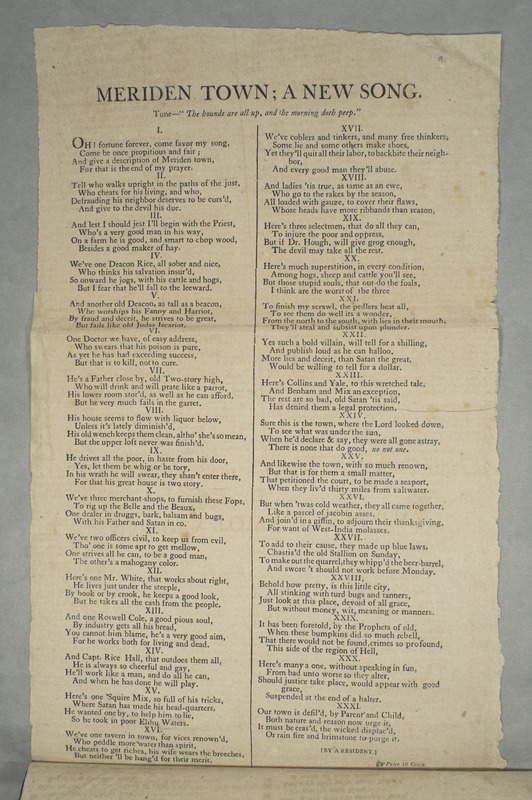
Like “Hard Times” (see The Soldier and His Fair Maid) but with specific people as targets, “Meriden Town” is a harsh criticism of the residents of the new town of Meriden, Connecticut. The song was probably written sometime between the incorporation of the town in 1806 and the death of Meriden resident Dr. Insign Hough in 1813.
In May 1786, the inhabitants of the Meriden parish of Wallingford requested that the General Assembly designate them as a distinct town in Middlesex County. Their plea was similar to those of other population centers that sought autonomy: they were “subjected to great trouble, inconvenience & expense” because of their distance from Wallingford’s center. Wallingford firmly opposed the division. The Meriden residents tried again in 1794, in 1803, and in 1804, and were summarily turned down each time. Finally, in 1805, a joint committee was appointed and its report showed that the population and property of the Meriden parish was more than one-third part of the town of Wallingford, and that “they did not in their present situation enjoy their just rights” as citizens. A petition was forwarded to the state and in May 1806, the General Assembly created the town of Meriden (C. Davis 141-43).
The author of this broadside, who signed himself “a resident,” may have been a disaffected ex-Wallingford citizen. The song is remarkably unflattering to most of the residents of Meriden. We have been able to positively identify some of those mentioned in the text: Dr. Isaac Hough (1781-1852) (verse 6, 19); his father, Dr. Insign Hough (1746-1813) (verses 7-9); Amos White (shopkeeper, verse 12); and Roswell Cowles (“Cole,” stonemason, verse 13). Others may be Lyman Collins, Samuel Yale or his sons William and Samuel, Jared Benham, and Jarius Mix (Gillespie and Curtis).
The song was known to Dr. Isaac Hough, one of those mentioned in the lyrics. Charles Davis, author of the history of Wallingford, remembers Hough being pleased by the lines
Dr. Hough, he keeps good stuff,
And lives just under the steeple;
By hook or by crook, he keeps his good looks
And takes the cash from the people. (507)
This is actually a reworking of verse 12, which in the Thomas text refers to Amos White, who had a store across from the church, on the southeast corner of Broad and East Main Streets (Gillespie and Curtis, map opp. 342).
Here’s one Mr. White, that works about right,
He lives just under the steeple,
By hook or by crook, he keeps a good look,
But he takes all the cash from the people.
Hough’s office and tavern were at the same intersection, but on the northwest corner. This kind of text change suggests that at least some of the text traveled aurally, changing according to what the singer remembered or wanted to say.
The indicated tune, “The Hounds Are All Out,” is a “rouse up for the hunt” song that was used by Henry Carey in his Country Bumkins. It may have been chosen by the author of the Meriden song for the insults in the original text. The song appeared in Carey’s Musical Century and in several sheet music editions in a florid version. It was copied into several American manuscripts in a somewhat less bravura variant (Schnapper 163; R. Keller, Early American Secular Music and Its European Sources).