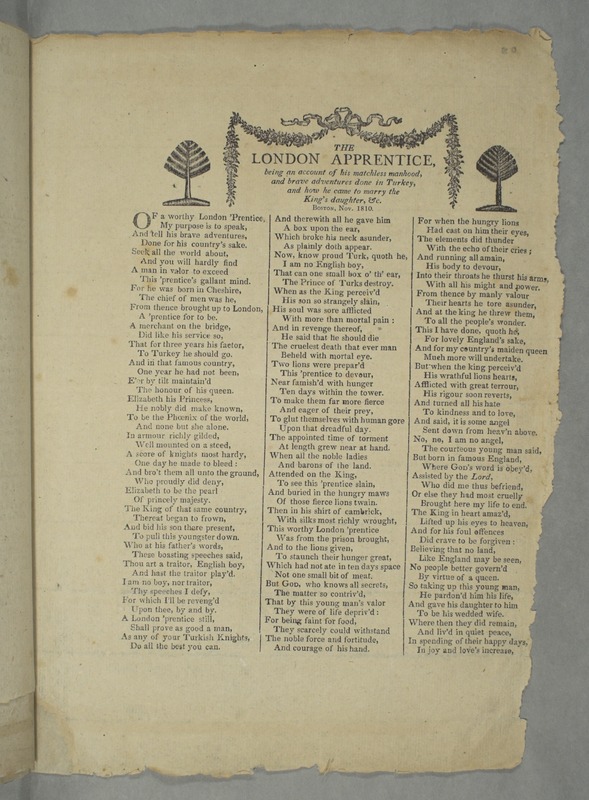
The London apprentice, being an account of his matchless manhood, and brave adventures done in Turkey, and how he came to marry the king's daughter, &c.
The fifteenth line in the third column, “and for my country’s maiden queen,” tells the age of this ballad. It was written in about 1595 in Queen Elizabeth I’s reign, and the line was still present in nineteenth-century American broadside copies. With a short traditional introduction, “The London Apprentice” is another of the most long-lasting and stable ballads in the entire literature. It can be found in nearly every collection and on many broadsides from its inception well into the nineteenth century (Simpson 13-16). William Hogarth depicts a broadside copy pinned to the loom of his lazy apprentice in the engraving called “Industry and Idleness.”
The tale is odd, considering its long survival. The general theme is that any Englishman, even an apprentice, is a superman. As summarized by G. Malcolm Laws Jr., the story is as follows.
The London prentice is sent by a merchant to be a factor in Turkey. There he keeps asserting the superiority of Queen Elizabeth over all other rulers. Annoyed, the Turkish king asks his son to stop the youth’s boasting, whereupon the prentice breaks the prince’s neck. Condemned to be torn apart by two lions, the prentice thrusts his arms down their throats and tears out their hearts. Finally convinced of English superiority, the Turkish ruler acknowledges the virtues of England’s queen and gives the prentice his daughter in marriage. (Q38:292-93)
The tune associated with this text was called “All You That Love Good Fellows” or “The London Prentice.” In the 1760s the dramatic opening phrase of this old tune was used as the basis for a new tune to which a stirring patriotic text by George Alexander Stevens, called “The British Grenadiers,” was set (see American Taxation).
Citation
“The London apprentice, being an account of his matchless manhood, and brave adventures done in Turkey, and how he came to marry the king's daughter, &c.,” Isaiah Thomas Broadside Ballads Project, accessed October 22, 2026, https://collections.americanantiquarian.org/thomasballads/items/show/150.